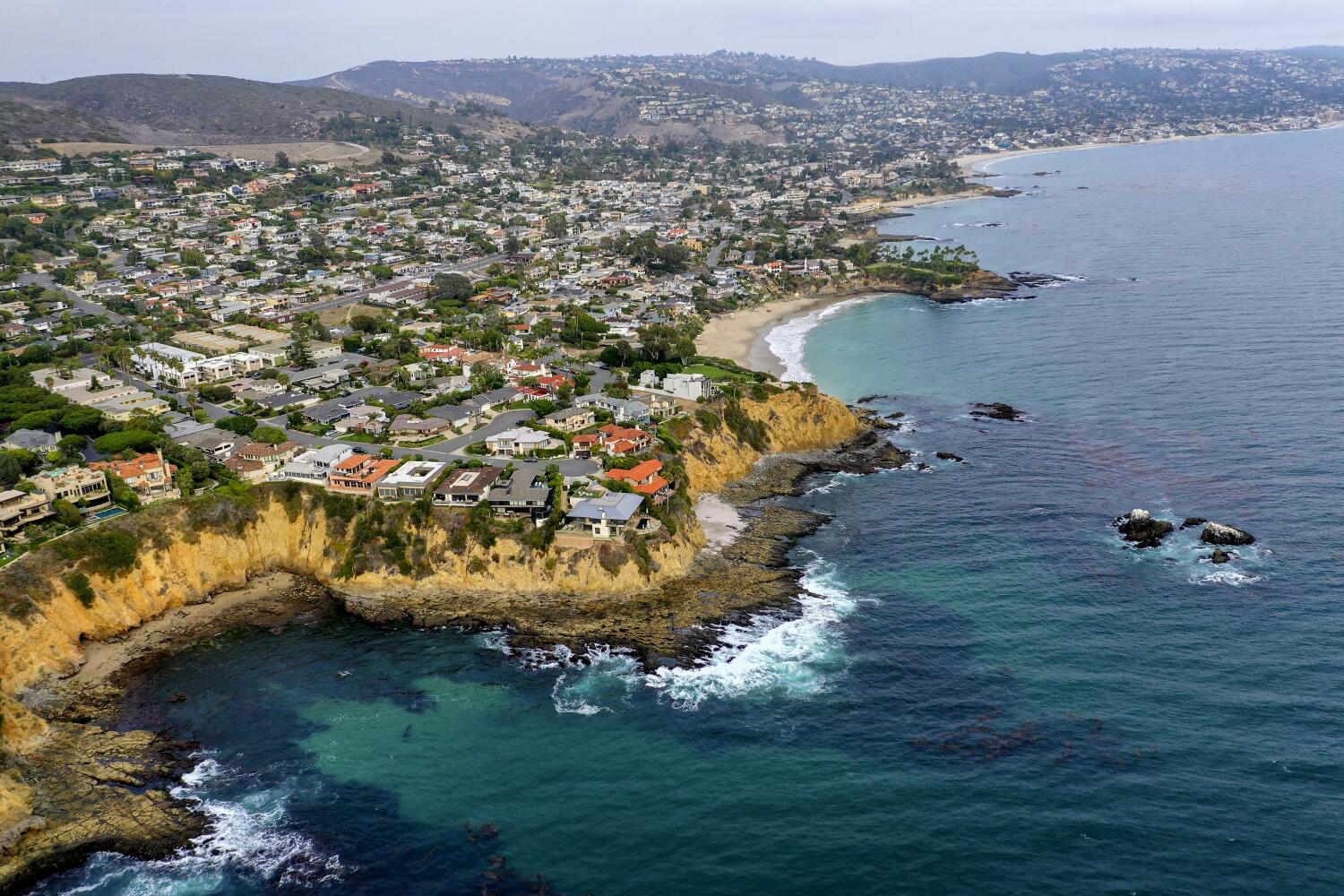
The salt air off Abalone Point does not care about commas. It does not pause for zeros. It eats away at structural steel, pits the surfaces of custom-cast bronze railings, and leaves a fine, chalky film on triple-paned glass just as easily whether a house cost one million dollars or more than one hundred million.
Yet, when the sun dips below the Pacific horizon along the Orange County coastline, it lights up a specific crescent of cliffs that recently became the most expensive real estate canvas in local history.
A single residential property in Laguna Beach changed hands for $110 million.
The transaction did not just break the local record; it shattered it, stepping clean over the previous high-water mark of $70 million set in nearby Newport Beach a few years prior. To the standard observer reading the real estate wires, it was a data point. A line item in a ledger of staggering wealth. A blurb about square footage, private beach access, and gated security within the ultra-exclusive Irvine Cove enclave.
But look past the deed transfers and the non-disclosure agreements. There is a human architecture to a number that massive. A house of that scale is rarely just a home. It is an island of isolation, a monument to a specific kind of modern ambition, and a mirror reflecting how the very concept of shelter has been detached from reality.
The Weight of the Seven-Figure Threshold
To understand what it means to live inside a nine-figure real estate transaction, you have to understand the physical reality of the coast.
Imagine walking along the public sand just below the bluffs of Irvine Cove. The tide is coming in. The wet sand sinks beneath your feet. Above you, the cliffs rise, capped by structures that look less like houses and more like modern fortresses cut from limestone and glass.
From the beach, you can hear the surf. It is loud. Thunderous, even. But up on the terraces of a $110 million compound, that sound is filtered through layers of engineering. The world becomes muffled.
A friend of mine, an architect who spent three years designing a similarly scaled coastal property further up the coast, once told me that the primary goal of ultra-high-net-worth residential design is not beauty. It is elimination.
"They want to eliminate the variables," he said, holding a glass of condensation-heavy water as we looked out over a much humbler view. "They want the ocean view, but not the dampness. They want the breeze, but never the wind. They want the light, but absolutely none of the heat. A hundred million dollars buys you the ability to edit nature until it behaves like a screensaver."
Consider the sheer mechanics required to keep a structure like that alive. It requires a staff. Not a weekly maid service, but a rotating crew of property managers, HVAC specialists, security personnel, and landscape detailers. The irony of paying a historic premium for absolute privacy is that your home must constantly be populated by strangers just to keep the automation from failing. The smart-home servers require cooling closets. The infinity pool requires constant chemical balancing against the invading salt spray.
The owner becomes less of a resident and more of a museum curator, presiding over a highly specialized ecosystem that requires thousands of dollars a day just to maintain a state of stasis.
The Architectural Anatomy of a Record
The property in question spans multiple structures, a master class in architectural discretion designed to blend into the coastal topography while asserting total dominance over it. It sits on a rare double-lot, a luxury of space that is almost impossible to find in a region where homes are traditionally packed together like elegant dominoes along the Pacific Coast Highway.
Every square inch of the estate speaks to a refusal to compromise.
- The Southern Exposure: The main residence is oriented to capture the winter sun while shielding the primary outdoor living spaces from the harsh afternoon glare of summer.
- The Subterranean Footprint: Much of the square footage exists below the natural grade, housing private theaters, wine cellars that mimic European caves, and parking galleries that feel more like boutique museums than garages.
- The Material Monarchy: The stone was not sourced from a local yard; it was quarried from specific veins in Italy, shipped in blocks, and cut on-site so the grain of the marble flows seamlessly from the indoor flooring out onto the pool deck.
But the real luxury here isn't the stone or the automated glass walls that slide into pockets at the touch of a button. It is the land itself.
Laguna Beach is bounded by protected wilderness on one side and the ocean on the other. It is a geographic funnel. There is no more dirt being made. When you buy a double-lot in Irvine Cove, you are not just purchasing a home; you are taking a piece of finite planetary surface off the board permanently. You are buying the absence of neighbors. You are buying a guarantee that your view of the horizon will remain entirely unmonitored by anyone else's window.
The Invisible Stakes of the Nine-Figure Neighborhood
When a house sells for $110 million, the shockwaves travel far beyond the gated entry of Irvine Cove. They ripple through the local economy in ways that are felt by people who will never even see the driveway of the estate.
Property taxes alone on a transaction of this magnitude become an engine for local municipalities. But there is a darker side to the ledger.
When the floor of the luxury market rises this drastically, it exerts an upward gravitational pull on every tier of housing below it. The bungalow three miles away feels a little more justified in its three-million-dollar price tag. The mid-century condo looks at its neighborhood comps and ticks upward. The service workers, the teachers, the artists who gave Laguna Beach its bohemian soul in the mid-twentieth century are pushed further inland, across the canyon, until the town risks becoming an empty stage set—beautiful, perfectly manicured, and entirely devoid of the messy, vibrant life that made it desirable in the first place.
I walked through the art colony district of Laguna on a Tuesday afternoon shortly after the news of the sale broke. The galleries were quiet. The light was that perfect, golden California slant that drew painters here a century ago.
I spoke to a woman who had been framing art in the area since the late 1980s. She didn't want to give her name, her fingers stained with wood stain as she wiped down a length of walnut molding.
"People look at those numbers and they think it's a different world," she said, nodding toward the north end of town where the gated enclaves hide. "But it changes the air we breathe down here. It makes everything feel temporary. Like we're all just occupying space until someone with enough money decides they want the dirt under our feet."
The Quiet at the End of the Coast
There is a specific time of day, just after twilight, when the lights of the great coastal estates turn on.
From a distance, they look like luxury liners anchored on the cliffs. The glass walls reveal vast, high-ceilinged rooms. You can see the silhouettes of immense modern sculptures, the glow of hidden LED strips tracing the edges of floating staircases, the pale blue flicker of television screens in rooms larger than most people's apartments.
But look closer, and you notice what is missing.
Movement.
Many of these ultra-high-value properties sit empty for large portions of the year. They are asset classes shaped like buildings. They are places to park capital where it can appreciate while enjoying the tax advantages of real estate ownership. The lights are on because a computerized system determined that the sun had set, not because someone walked into the room and flipped a switch. The pool is heated because the automation protocol dictates it must remain at seventy-eight degrees year-round, waiting for a swim that might only happen three weekends out of twelve months.
The $110 million record is a testament to human ingenuity and the incredible concentration of modern wealth. It is a marvel of engineering, a triumph of design, and a spectacular manifestation of the desire for permanence in a shifting world.
But as the dark water of the Pacific crashes against the rocks at the base of Abalone Point, repeating its ancient, rhythmic assault on the stone, the great house sits silent in its gates. It is perfectly insulated. Perfectly secure. Perfectly alone.
The waves continue their work, oblivious to the record they are breaking against.