The air inside the auction room smelled of expensive paper, watered-down gin, and nerves.
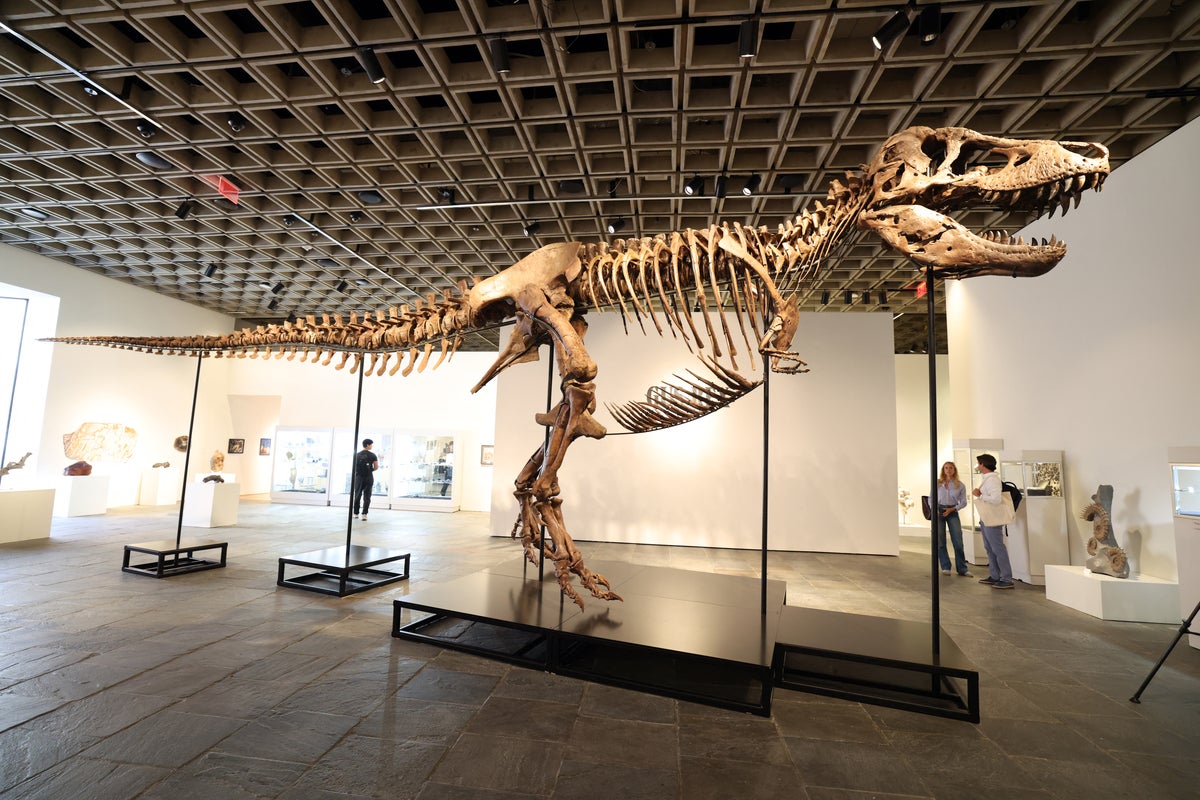
Under the sharp glare of the track lighting, a skull the size of a grand piano loomed over the crowd. The bone was the color of dark molasses, scarred by sixty-six million years of pressure and chemistry. This was Gus. When he was alive, he weighed eight tons, breathed through nasal cavities larger than a human chest, and crushed the bones of his prey with a bite force that could snap a steel beam.
Now, he was Lot 24.
The auctioneer’s voice was a rhythmic, hypnotic chant, climbing by millions in seconds. In the back row, a young academic in a frayed tweed jacket stared at his shoes, hands buried deep in his pockets. In the front row, a man in a bespoke suit didn't even look at the stage. He just stared at his phone, occasionally raising a small, numbered plastic paddle.
When the gavel finally fell, the room erupted into polite, wealthy applause.
Fifty million dollars.
With one sharp rap of wooden mallet against sounding block, Gus became the most expensive dinosaur fossil ever sold. He was no longer a monument of natural history. He was an asset class.
But the real story of Gus doesn't begin in a Manhattan gallery, nor does it end with a wire transfer. It began in the blistering, dry heat of the Badlands, where the line between obsession and survival is as thin as a layer of shale.
The Dirt Under the Fingernails
To understand how a pile of fossilized bones becomes worth a fortune, you have to meet the people who actually pull them from the earth.
Consider Marcus. He is a composite of the dozen or so independent commercial fossil hunters who scratch out a living in the Hell Creek Formation, a vast, sun-baked stretch of land spanning the Dakotas, Montana, and Wyoming. Marcus does not have a PhD. He does not have tenure, a research grant, or a university pension.
What he has is a pickup truck with a broken air conditioner, a trailer full of plaster bandages, and a mountain of debt.
Three years before the auction, Marcus was walking a dry creek bed on a private ranch in South Dakota. The temperature was 104 degrees. The air was so dry his throat felt coated in sandpaper. He was looking for "float"—tiny fragments of dark, heavy fossilized bone that had washed down the hillside during the spring rains.
He found a piece no larger than a walnut.
He climbed the slope, tracking the debris line, until he saw it: a thick, black curve of bone protruding from the crumbling gray clay. He knelt. He used a small paintbrush to sweep away the dust.
"You don't think about the money when you find them," Marcus once told me, his hands heavily calloused and permanently stained with iron-rich dirt. "You think about the breath. You think about the last time this thing felt the sun. And then, about three seconds later, you think about how you're going to pay your mortgage."
Excavating a skeleton like Gus is not a romantic weekend activity. It is a brutal, back-breaking marathon. For eighteen months, Marcus and a tiny crew lived in tents, fighting off rattlesnakes and sudden, violent prairie thunderstorms. They used dental picks, screwdrivers, and pocket knives. They worked slowly, inch by painful inch, to ensure they did not scratch the fragile bone.
Every bone had to be mapped, stabilized with specialized liquid plastics, and wrapped in heavy plaster jackets. The femur alone weighed over five hundred pounds. Getting it up the ravine required a custom-built wooden sled, a winch, and four days of agonizing labor that nearly cost Marcus two of his fingers.
It was a miracle of preservation. Over ninety percent of the skeleton was intact, including the delicate, paper-thin bones of the inner ear. It was a scientific goldmine.
But science does not pay the bills.
The Great Schism of the Earth
There is a quiet, bitter war raging over the deep past.
On one side stand the academic paleontologists. To them, every dinosaur fossil is a page in a rare, irreplaceable book. When a fossil is sold privately, that page is ripped out and burned. They argue that without proper context—the exact layer of soil, the fossilized pollen nearby, the positioning of the bones—a skeleton loses ninety percent of its scientific value.
On the other side are the commercial hunters and private landowners. Under United States law, fossils found on private land belong entirely to the landowner. They can be dug up, sold, or smashed with a sledgehammer if the owner wishes. Without the commercial diggers, many of these fossils would simply erode into dust, lost to the wind forever.
"Museums don't have the budget to find these things," says a prominent commercial dealer who asked to remain anonymous. "We do the work. We take the financial risk. Why shouldn't we get paid for it?"
But the scale has tipped.
In 1997, a T. rex named Sue sold at auction for $8.36 million. It was a shocking, historic sum, funded largely by corporations like McDonald's and Disney, who promptly donated the dinosaur to the Field Museum in Chicago. At the time, scientists feared it would spark a gold rush.
They were right.
Two decades later, another T. rex named Stan sold for $31.8 million.
And now, Gus. Fifty million.
Consider the mathematics of a museum's acquisitions budget. A major metropolitan natural history museum might have a few hundred thousand dollars a year to spend on new specimens. In a bidding war against a hedge fund manager, a tech billionaire, or an oil-rich royal family, the museum is bringing a knife to a nuclear launch.
The tragedy is silent. The public sees the stunning skeletons under the museum glass, but they do not see the dozens of specimens that slip quietly into private penthouses, corporate boardrooms, and secure storage facilities in Swiss freeports.
The Living Room Trophy
What does a person do with a $50 million dinosaur?
They do not study it. They do not publish papers on its bone density or what its teeth tell us about the climate of the Late Cretaceous.
Instead, it becomes the ultimate piece of interior design.
In certain circles of extreme wealth, contemporary art has lost some of its luster. Anyone can buy a Warhol or a Basquiat if they have the cash. But a Tyrannosaurus rex? There are only a handful of near-complete specimens on the entire planet. It is the ultimate statement of rarity, power, and dominance.
Imagine hosting a dinner party. The guests sip champagne beneath the ribs of a predator that once hunted the very ground they stand on. The lighting is dim, casting long, monstrous shadows across the minimalist Italian furniture. It is a display of wealth so profound it borders on the mythological.
But bones are not stone. They are fragile, organic structures. Without precise humidity controls and professional preservation, they begin to decay. Pyrite disease—a chemical reaction caused by moisture reacting with iron compounds in the fossil—can turn a multi-million-dollar skull into a pile of sulfurous dust in a matter of decades.
We are locking our history in vault doors, and we are letting it rot in the dark.
The Price of Curiosity
There is a deeper cost to the $50 million dinosaur, one that cannot be measured in currency.
It is the cost to the next generation.
Think back to your first visit to a museum. The sheer, breathless awe of standing beneath something so impossibly vast, realizing that our human story is just a tiny, recent blip on a ancient, crowded canvas. That spark of curiosity is what drives children to become geologists, biologists, and astronomers.
When we price museums out of the market, we rob those children of their wonder. We turn the ancient heritage of our planet into a luxury good, reserved only for those who can afford the ticket price of admission to a private collection.
Marcus got his payout. He cleared his debts, bought a new truck, and even managed to put some money away for his kids' college fund. But when I asked him if he was happy about the sale of Gus, his face darkened.
"I wanted him to go to Chicago," he said softly. "Or Denver. I wanted to be able to take my grandkids to see him. I wanted to point at the tail and tell them, 'Your grandpappy spent three weeks in a ditch just to get that wiggle out of the clay.'"
Instead, Gus is headed to an undisclosed location in Asia. The buyer was a shell corporation registered in the Cayman Islands.
The crates have been loaded. The shipping containers are sealed. The ghost has left the prairie, and the door to the past has swung shut just a little bit further.
In the end, we did not buy a dinosaur. We bought a mirror. And what it reflects back at us is a society that knows the price of everything, but the value of nothing.