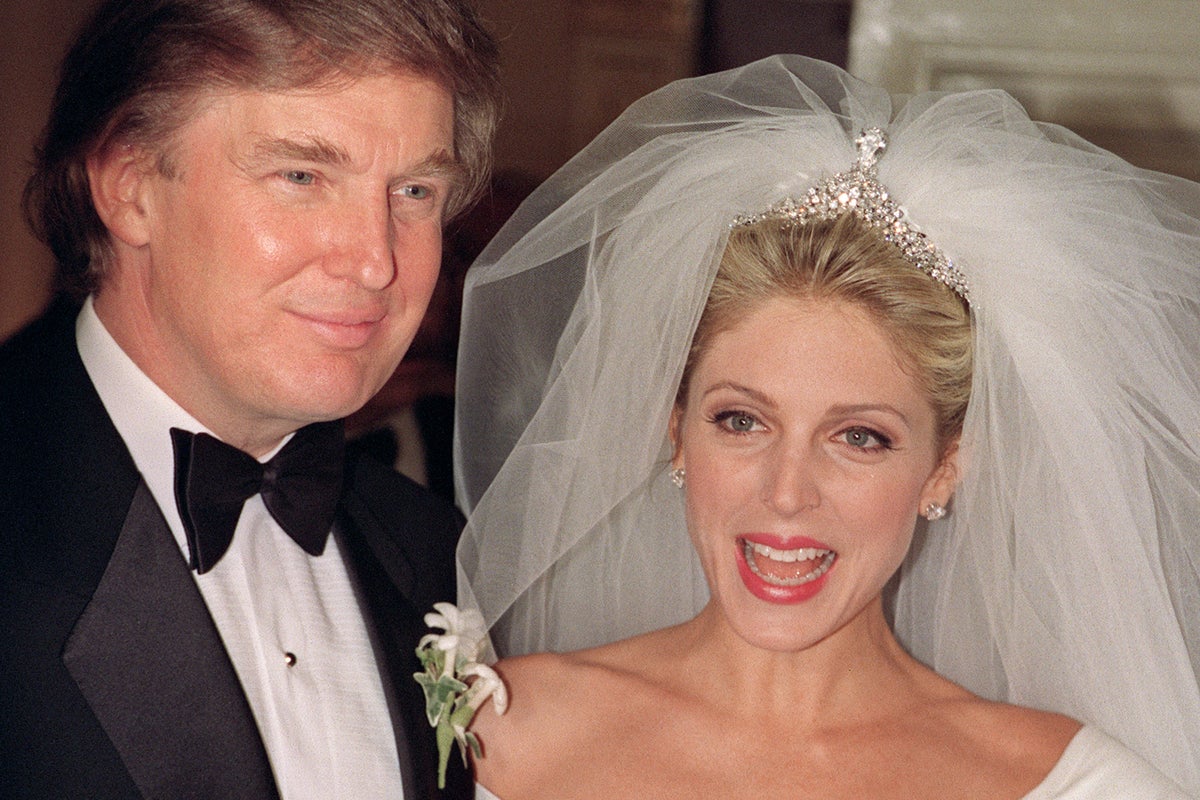
The media is currently hyperventilating because Donald Trump reacted to an AI-generated "Age Journey" video. They are fixated on the gossip. They are obsessing over the fact that the video included Marla Maples but skipped Ivana and Melania. This is the "lazy consensus" of modern journalism: focusing on the soap opera while the theater is burning down.
You are being conditioned to care about the wrong thing. Meanwhile, you can explore related stories here: The Mechanics of Leakage: Why Trade Restrictions Fail to Contain Chinese AI Integration.
The story isn't about which ex-wife made the cut in a viral clip. The story is that we have officially entered the era of the "Synthetic Narrative," where the past is no longer a fixed record of events, but a liquid asset that can be reshaped to fit any aesthetic or political whim. When a former president—and current candidate—marvels at a revisionist digital history, he isn't just watching a video. He is endorsing the idea that data-driven nostalgia is more "real" than the messiness of actual history.
The Myth of the Omission
Critics are pointing to the exclusion of Melania and Ivana as if it’s a strategic political erasure. It isn't. It's an algorithmic byproduct. To understand the full picture, check out the recent report by TechCrunch.
Most "Age Journey" AI tools operate on training sets that prioritize high-contrast, high-resolution imagery. If an algorithm finds a seamless transition between a 1990s red carpet photo of Marla Maples and a specific era of Trump’s face, it takes the path of least resistance. The AI doesn’t have a political agenda; it has a mathematical one. It optimizes for visual "flow," not historical accuracy.
By treating this like a calculated snub, the media gives the technology too much credit for intent and not enough credit for its power to distort. The danger isn't that the AI "forgot" Melania. The danger is that the audience doesn't care that it did. We are trading the friction of truth for the smoothness of a well-rendered transition.
[Image of a generative adversarial network architecture diagram]
Your Memory is the Next Product
I’ve watched tech firms burn through billions trying to solve the "uncanny valley." We are past that now. The goal has shifted from making AI look human to making humans prefer the AI version of reality.
These "Age Journey" videos are a gateway drug. They use the dopamine hit of nostalgia to mask the fact that we are eroding the concept of a "primary source." In five years, your own family photo albums will be "optimized" by AI. It will remove the cousin you don't like. It will add the smile you didn't have at that miserable Christmas dinner.
Trump marveling at his own simulated life is just the beta test. When a world leader accepts a curated, synthetic version of his own biography, it signals to the rest of the world that the "truth" is whatever looks best on a 9:16 vertical screen.
The Problem with "People Also Ask" Logic
When people search for "Why did the Trump AI video leave out Melania?", they are asking a flawed question. They are looking for a human motive in a machine-generated output.
The honest, brutal answer? Because the machine didn't find her "compatible" with the specific latent space it was traversing at that millisecond.
We need to stop anthropomorphizing these tools. They are not "editing" history. They are hallucinating a new one based on statistical probability. If you start making political decisions—or forming opinions on a candidate’s personal life—based on what an AI "chose" to show, you have already lost the war for your own cognitive origniality.
The Death of the Photographic Record
Since 1839, the photograph has been a pillar of evidence. "The camera never lies" was always a bit of a stretch, but it held enough weight to anchor our shared reality.
That anchor is gone.
In a world of generative AI, a video of a man aging is no longer a document of time passing. It is a mathematical interpolation. We are moving from the "Age of Information" to the "Age of Simulation."
In the simulation, the fact that Marla Maples appears and others don't is a triviality. The real issue is the "hallucination of continuity." These videos create a sense of inevitable progression, a smooth arc from youth to power. They scrub away the scandals, the depositions, the bankruptcies, and the nuance. They provide a "clean" history.
The Industry Insider’s Warning
I have been in the rooms where these models are fine-tuned. The developers aren't worried about "erasing" wives. They are worried about "engagement metrics."
A video that creates a stir—even one caused by an omission—is a successful video. The controversy is the feature, not the bug. Every time a major news outlet writes a "Trump omits Melania" headline, they are participating in the training of the algorithm. They are teaching the AI that "Omission = Virality."
If you want to actually "fact-check" the future, you have to stop looking at the content and start looking at the architecture.
Why the "Counter-Intuitive" Take is the Only One That Matters
The standard take is: "AI is getting scarily good at making videos!"
The contrarian truth: "AI is getting scarily good at making us accept fake evidence as long as it’s entertaining."
If we continue to treat these moments as celebrity gossip, we are ignoring the structural shift in how humans process evidence. We are becoming "low-fidelity" thinkers. We accept the gist of a video because the pixels are pretty.
Stop Fixing the Output, Start Questioning the Input
The tech world keeps trying to "fix" AI bias or "fix" AI hallucinations. This is a fool’s errand. You cannot fix a system whose entire purpose is to generate plausible-sounding or plausible-looking lies.
Instead of demanding that AI creators include every historical figure in a 30-second clip, we should be demanding a return to archival literacy. We should be teaching people how to identify the "shimmer" of a synthetic frame. We should be celebrating the "ugly" truth over the "smooth" simulation.
Trump’s reaction—the "marveling"—is the exact reaction the architects of these systems want. They want us to be enchanted. They want us to treat the screen like a magic mirror.
But remember: magic mirrors only show you what you want to see. And what you want to see rarely includes the parts of history that make you uncomfortable.
The Actionable Pivot
Stop sharing "Age Journey" videos.
Stop engaging with the "who was left out" discourse.
Every time you click on a story about an AI-generated snub, you are voting for a world where reality is decided by a GPU cluster in Northern Virginia. You are telling the market that you prefer a curated lie over a messy truth.
The real "journey" isn't from 1946 to 2026. It’s the journey from being a citizen of a factual world to being a spectator in a synthetic one.
The video didn't omit Melania because of a feud. It omitted her because, in the cold logic of the algorithm, she wasn't necessary to keep you watching.
If that doesn't terrify you, you're already part of the machine.