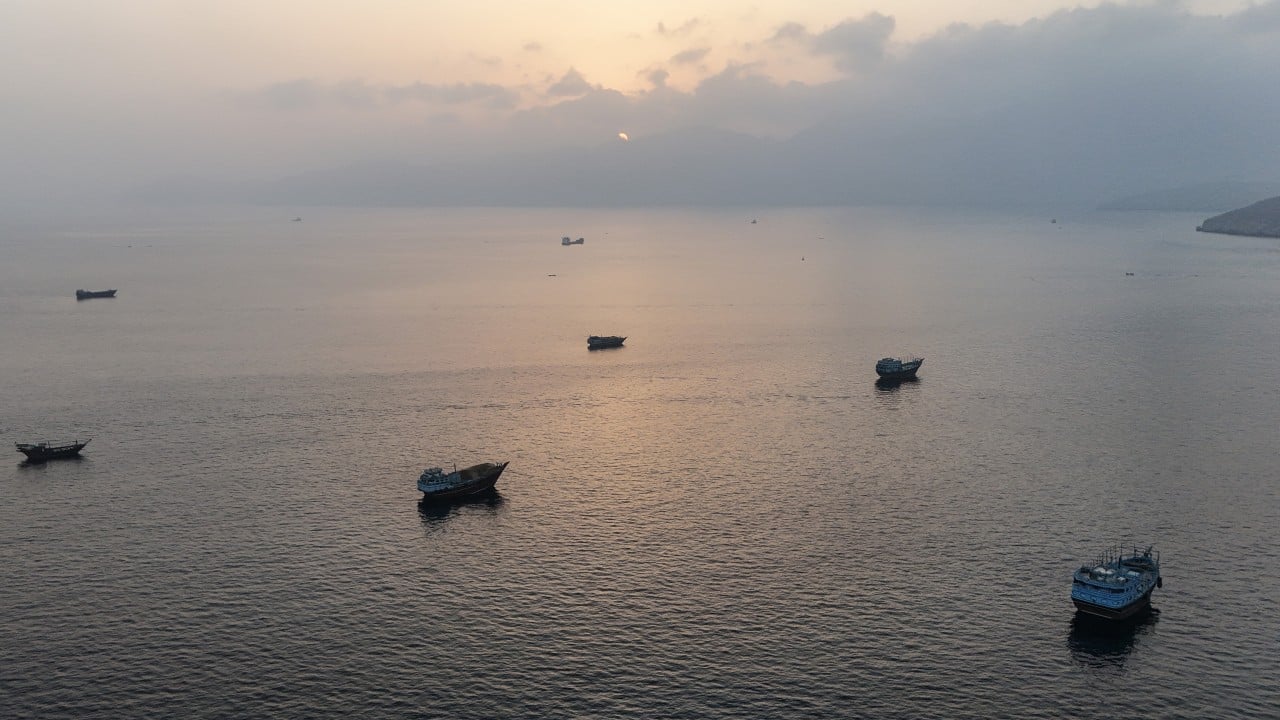
The overnight kinetic exchanges across the Persian Gulf demonstrate a structural failure in the deterrence architecture established by the recent US-Iran Memorandum of Understanding (MOU). By launching synchronized missile and drone salvos against Naval Support Activity Bahrain (headquarters of the US Navy’s 5th Fleet) and the Ali al-Salem Air Base in Kuwait, Iran’s Islamic Revolutionary Guard Corps (IRGC) did not merely violate a ceasefire; it executed a calculated doctrine of asymmetric escalation dominance. This escalation occurred in direct response to a United States Central Command (CENTCOM) offensive hours prior, which struck 10 targets near the Strait of Hormuz. The breakdown of this diplomatic framework reveals that both states operate under fundamentally incompatible cost functions, rendering a stable truce structurally impossible under current parameters.
The core vulnerability of the MOU lies in its lack of a synchronized verification mechanism for lateral theaters. While Washington views the ceasefire strictly through the lens of freedom of navigation and commercial shipping safety within the Strait of Hormuz, Tehran treats the agreement as an interconnected regional ledger. The current friction stems from a multi-variable calculus: the US expects complete cessation of Iranian interdiction against commercial vessels—such as the recent strike on a Singapore-flagged cargo ship—while Iran links its compliance to conditions outside the immediate bilateral scope, specifically requiring the cessation of Israeli military operations in southern Lebanon. When these external variables fluctuate, the ceasefire mechanism collapses.
The Tri-Lateral Escalation Loop
The breakdown of the current truce follows a predictable, highly visible chain of causality that can be broken down into three distinct phases:
[Phase 1: Maritime Interdiction]
Iran enforces strict routing mandates in the Strait of Hormuz.
A commercial vessel maneuvers outside these lines and is struck.
       │
       ▼
[Phase 2: Symmetric Infrastructure Degradation]
US CENTCOM executes targeted kinetic strikes against Iranian
coastal radar, drone storage, and surveillance installations.
       │
       ▼
[Phase 3: Asymmetric Hosting-State Retaliation]
IRGC bypasses direct US assets in the immediate theater to strike
logistical nodes and command centers in host nations (Kuwait/Bahrain).
This structural loop exposes the asymmetrical calculation of the Iranian command structure. When CENTCOM targets primary military installations inside sovereign Iranian territory, the IRGC does not respond symmetrically by attempting to strike the continental United States or major carrier strike groups at sea. Instead, it shifts the operational cost onto regional third parties that host US military infrastructure.
By targeting Port Salman in Bahrain and Ali al-Salem in Kuwait, Tehran alters the geopolitical balance. It signals to Gulf Cooperation Council (GCC) states that hosting American infrastructure carries an immediate, high-velocity kinetic penalty.
Quantifying the Regional Defenses
The military reality of these strikes reveals a massive disparity between projectile expenditure and actual structural degradation. According to data from the Bahrain Defence Force, regional air defense systems have maintained a high interception rate since hostilities originally broke out in late February 2026.
- Total Ballistic Missile Interceptions: 112
- Total Unmanned Aerial Vehicle (UAV) Interceptions: 186
- Primary Kinetic Countermeasures: US-operated MIM-104 Patriot systems and integrated regional radar networks.
While the IRGC claimed the total destruction of eight distinct US military facilities across Kuwait and Bahrain during the overnight raid, preliminary assessments from CENTCOM and local interior ministries confirm zero US casualties and minor structural damage to secondary infrastructure. However, the true metric of success for the IRGC is not immediate structural destruction; it is economic and logistical friction.
When defensive interceptors engage low-cost loitering munitions or ballistic missiles over densely populated areas like Manama, the resulting debris field creates secondary civilian damage. For example, previous engagements have ignited local fires near critical energy assets, such as the Bahrain Petroleum Company (BAPCO) refinery complexes, forcing operators to declare force majeure on group operations. The economic cost function of utilizing a million-dollar Patriot missile interceptor to down a twenty-thousand-dollar drone creates a long-term sustainability crisis for host-nation defense budgets.
The Diplomatic Bottleneck
The immediate casualty of this kinetic escalation is the active diplomatic channel currently operating in Switzerland. The IRGC statement explicitly warned that ongoing violations of its territorial sovereignty would result in a complete halt of all diplomatic processes. This creates a strategic bottleneck for the US executive branch, where conflicting internal doctrines prevent a unified policy response.
The current administration's strategy relies on a framework of immediate, overwhelming reciprocity. The executive assertion that Iran "will no longer exist" if forced into full-scale war is designed to establish a psychological ceiling for Iranian escalation. Conversely, the diplomatic wing utilizes the ongoing negotiations to offer sanctions relief and structural stabilization in exchange for maritime compliance.
This internal tension undermines the credibility of the US deterrence model. Iran exploits this division by testing the boundaries of the MOU, betting that the US is structurally disincentivized from transitioning from localized retaliatory strikes to an absolute, regime-altering campaign.
The Strategic Path Forward
To break the escalation loop and stabilize the theater, US planners must transition away from reactive, tit-for-tat kinetic responses and implement a structural realignment of regional assets.
First, the US must decouple the security of commercial shipping lanes from host-nation vulnerabilities. This requires shifting high-value naval command functions away from fixed, easily targeted littoral sites like Naval Support Activity Bahrain and moving toward mobile, distributed command-and-control architectures at sea or outside the immediate range of Iranian tactical ballistic missiles.
Second, future iterations of any maritime memorandum must feature strict, non-negotiable insulation from external geopolitical variables, explicitly omitting third-party conflicts in Lebanon or Syria from the bilateral compliance matrix.
Finally, the US must help regional partners transition from expensive point-defense missile systems to high-capacity, low-cost directed energy and electronic warfare systems capable of neutralizing drone swarms without incurring unsustainable economic depletion. Without these structural adjustments, any future ceasefire will remain a temporary pause before the next inevitable kinetic breakout.