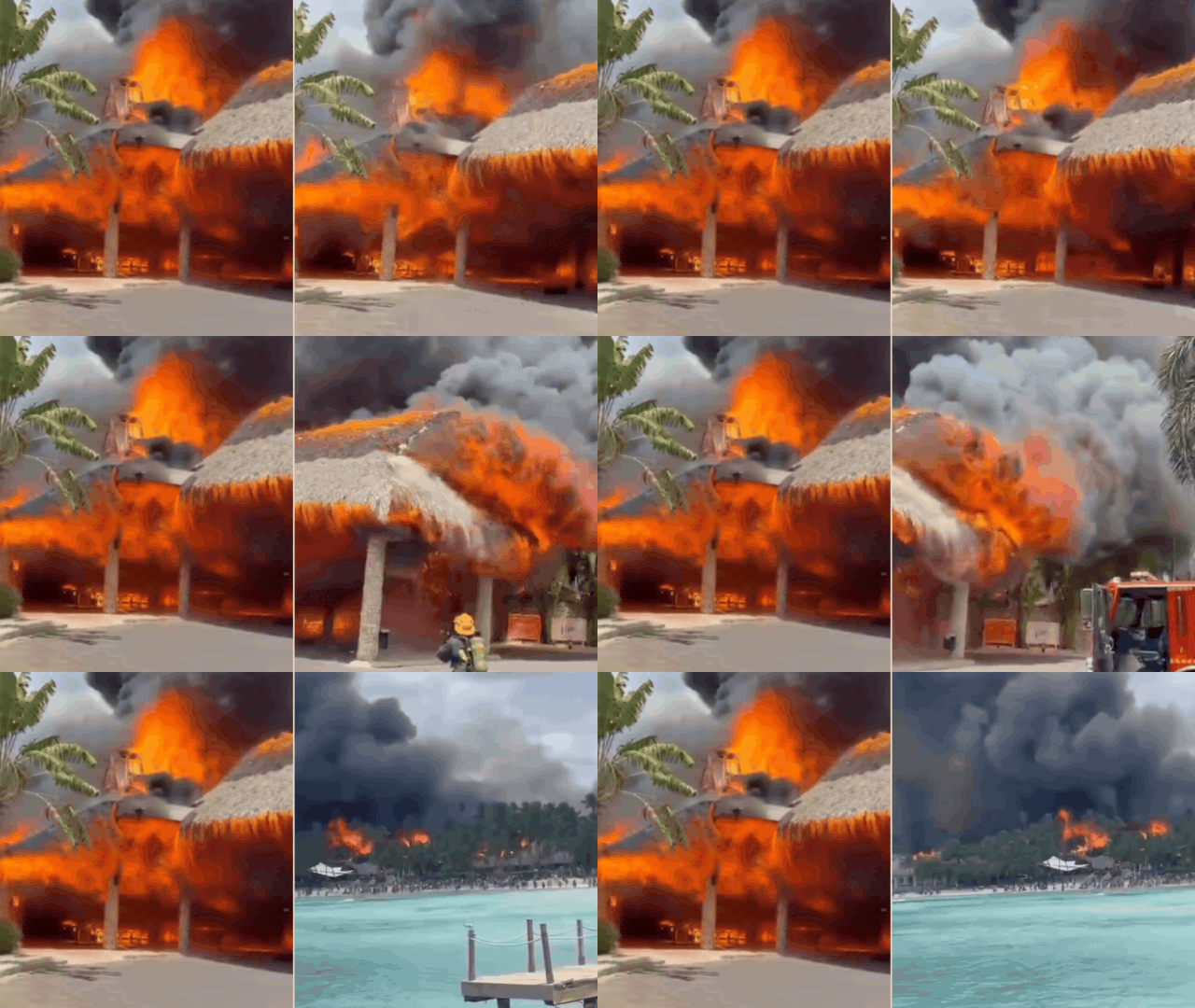
Large-scale structural fires in high-density resort environments strip away operational illusions, revealing the exact point where architectural aesthetics collide with catastrophic risk management failures. The June 19, 2026 fire at the Viva Wyndham Dominicus Beach Hotel in Bayahibe, Dominican Republic, which resulted in the death of a 46-year-old Italian tourist and forced the emergency evacuation of approximately 1,690 guests, provides a stark case study in rapid-velocity thermal propagation. By examining this event through a rigorous risk framework, hospitality executives and structural engineers can isolate the specific vulnerabilities inherent to tropical resort designs.
The Triad of Thermal Acceleration
The exceptional speed with which the fire consumed the resort infrastructure is explained by three distinct compounding variables. When these elements align, standard suppression methods fail to contain the initial ignition zone.
- Combustible Thatch Interfacing: The resort utilized natural palm-thatched roofs as a primary architectural feature. While aesthetically aligned with Caribbean branding, untreated palm material acts as an optimal fuel source due to its high surface-area-to-mass ratio and low moisture retention.
- Convective Wind Amplification: The coastal location of Bayahibe subjects properties to sustained maritime winds. These air currents introduce high volumes of oxygen directly into the ignition core, transforming a localized fire into a forced-draft furnace that drives thermal energy horizontally across contiguous structures.
- Structural Contiguity: Thatch-roof bungalows are frequently built in close spatial proximity to optimize beach frontage. This dense layout eliminates natural firebreaks, facilitating rapid radiant heat transfer and airborne ember spot-firing.
[Initial Ignition] ---> [Thatch Roof Fuel Base]
                              |
                     (Sustained Ocean Winds)
                              |
                              v
                  [Forced-Draft Acceleration] ---> [Horizontal Proximity Leap] ---> [Systemic Compromise]
The Operational Cost Function of Mass Evacuation
Displacing 1,690 individuals simultaneously introduces a complex logistics problem that tests the absolute limits of local emergency infrastructure and corporate resilience. The incident required the immediate mobilization of fire crews from neighboring La Romana and the deployment of the Dirección de Servicios de Atención a Emergencias Extrahospitalarias (DAEH).
The total impact of an emergency mass evacuation can be categorized into three operational distinct layers.
Phase 1: Immediate Casualty and Triage Containment
The primary metric of success in any evacuation is the preservation of human life. At the Bayahibe resort, the breakdown in containment led to one fatality and nine recorded injuries. Three individuals required immediate hospitalization for acute trauma or smoke inhalation, while six others—including responders—were stabilized on-site. The cost at this stage is measured in human life and immediate medical liabilities.
Phase 2: Asset Redistribution and Capacity Shock
Evacuating nearly 1,700 guests requires a pre-negotiated mutual aid network among regional hospitality operators. In this instance, the adjacent sister property, Viva Wyndham Dominicus Palace, remained structurally unaffected and operational. The immediate absorption of displaced guests into surrounding infrastructure prevents a secondary humanitarian crisis but creates an immediate logistical bottleneck regarding room inventory, data migration, and immediate provisioning.
Phase 3: Macro-Destination Reputational Resilience
According to statements from the Dominican Republic’s Emergency Operations Center (COE), wider tourism activities across the island continued without interruption. The country recorded 5.6 million visitors in the first five months of 2026, making macro-destination stability vital for national GDP. When an isolated structural failure occurs, official communications must instantly decouple the specific asset failure from the broader regional safety narrative to mitigate immediate capital flight or cancellation spikes.
Structural Mitigation and Hardening Protocols
The systemic vulnerability highlighted by the Bayahibe incident demands a shift from passive compliance to active engineering interventions for properties utilizing organic building materials. Relying purely on local municipal response times when dealing with high-velocity fuels is a mathematical guarantee of structural loss.
Fire-Retardant Chemical Impregnation
Natural thatch must undergo pressure-impregnation with specialized fire-retardant polymers during construction. These chemical agents alter the thermal degradation pathway of cellulose, forcing the material to form a carbonaceous char layer when exposed to heat rather than igniting into open flame. This treatment changes the material classification from highly flammable to self-extinguishing.
Automated External Deluge Systems
Standard internal commercial sprinklers are insufficient when the exterior roof structure constitutes the primary fuel load. High-risk tropical properties require exterior roof-mounted deluge systems. These systems utilize automated ultraviolet or infrared flame detectors to deploy high-volume water curtains across the external thatch surface within seconds of ignition, neutralizing the wind-driven horizontal spread.
The table below outlines the core differences in performance between standard compliance and an engineered safety state.
| Risk Dimension | Standard Regulatory Compliance | Engineered High-Risk Mitigation State |
|---|---|---|
| Primary Roof Composition | Untreated organic palm thatch | Polymer-impregnated, flame-retardant thatch |
| Suppression Strategy | Internal ceiling sprinklers, manual extinguishers | Exterior roof deluge systems, automated UV detection |
| Spatial Separation | Minimal distance for maximum guest density | Built-in structural firebreaks and fire-rated barriers |
| Wind Vulnerability | Unmitigated; accelerated convective spread | Mitigated via localized high-volume zone isolation |
Advanced Emergency Manifest Protocols
The logistics of accounting for 1,690 individuals during an active thermal event reveals a fundamental flaw in traditional paper-based or localized digital property management systems. When power grids fail during an emergency, access to central guest lists is often lost.
Resorts operating with high-density, multi-building footprints must transition to cloud-synchronized, offline-capable digital muster systems. These systems utilize low-power mesh networks to update real-time guest locations and tracking data. Emergency response teams must have instantaneous access to a decoupled, off-site manifest that updates automatically as guests clear specific perimeter zones. Without this digital tracking capability, search and rescue operations are forced to rely on visual sweeps of burning structures, which drastically increases responder casualty rates and prolongs exposure windows for trapped occupants.
Operational leadership must actively transition away from traditional aesthetic designs that prioritize localized visual themes over established thermodynamic safety principles. The implementation of strict chemical modifications, exterior deluge defenses, and cloud-synchronized muster protocols represents the absolute baseline requirement for safeguarding human life and maintaining corporate continuity in high-density international travel destinations.