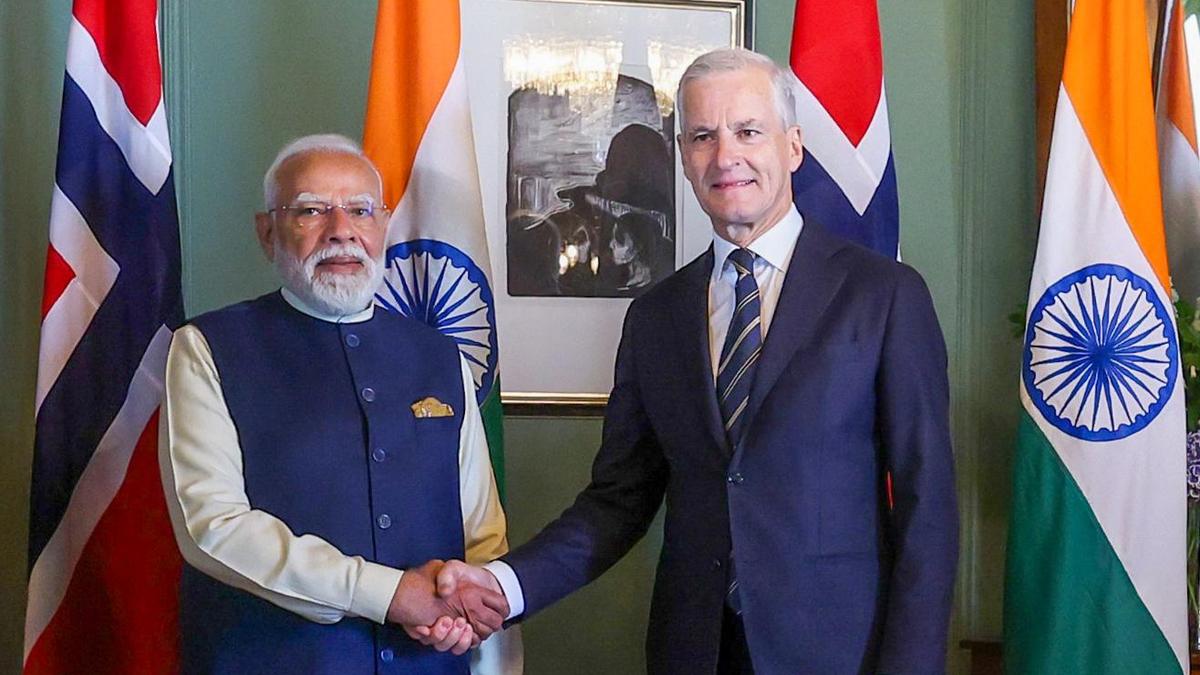
The transformation of the India-Norway bilateral relationship into a formal Green Strategic Partnership exposes a fundamental macroeconomic shift: the execution of an asymmetrical capital-scale arbitrage. This diplomatic framework, formalized alongside the implementation of the India-European Free Trade Association (EFTA) Trade and Economic Partnership Agreement (TEPA), matches a high-liquidity, technologically advanced sovereign with a high-velocity, labor-dense emerging market.
The strategic imperative driving this bilateral convergence is not a shared ideological alignment, but an urgent need for structural decoupling from volatile geopolitical trade routes and resource chains. By analyzing the operational and financial mechanics of this partnership, we can map how the convergence of European capital and Indian industrial scale aims to systematically de-risk supply chains across green maritime logistics, renewable energy infrastructure, and digital public goods.
The Macro-Economic Arbitrage Function
The architectural core of this partnership rests on a distinct complementary economic mismatch. This relationship can be modeled as a production function where output is maximized by matching Norway’s specialized capital surplus and proprietary technologies with India's industrial velocity and engineering capacity.
+------------------------------------+       +-----------------------------------+
|          NORWAY (Inputs)           |       |           INDIA (Inputs)          |
|  • High-Liquidity Capital Surplus  |       |  • High-Velocity Industrial Scale |
|  • Deep-Water & Maritime Tech      |       |  • High-Density Engineering Talent|
+------------------------------------+       +-----------------------------------+
                  \                                           /
                   \                                         /
                    v                                       v
         +-------------------------------------------------------------+
         |             GREEN STRATEGIC PARTNERSHIP ENGINE              |
         |  Arbitrage Goal: Scale-up proprietary tech at low unit cost|
         +-------------------------------------------------------------+
                                      |
                                      v
         +-------------------------------------------------------------+
         |                      ECONOMIC OUTPUTS                       |
         |  • Target: $100 Billion EFTA Foreign Direct Investment      |
         |  • Projected: 1 Million Domestic Manufacturing Jobs        |
         +-------------------------------------------------------------+
The financial mechanism driving this architecture is the TEPA framework, which mandates a targeted inflows of $100 billion in foreign direct environment over a 15-year horizon. The capital deployment schedule is strictly bifurcated: an initial $50 billion tranche during the first decade, followed by an additional $50 billion allocation in the subsequent five-year period. This capital injection is structurally tied to the projected creation of one million domestic jobs within the Indian economy.
From an investment banking perspective, Norway's sovereign capital requires deployment into high-growth infrastructure assets to hedge against domestic energy transition risks. Conversely, the Indian industrial ecosystem requires immense capital expenditure to meet its decarbonization targets without decelerating its manufacturing output. The integration of EFTA markets, which grants duty-free access to over 99% of Indian merchandise exports, serves as the regulatory catalyst to justify these capital deployments.
Decarbonizing the Global Maritime Cost Function
The green shipping initiative represents the most immediate technical application of this partnership. International maritime logistics face strict regulatory pressures from the International Maritime Organization (IMO) to achieve net-zero compliance. The barrier to this transition is not a lack of engineering designs, but the prohibitive capital cost of scaling prototype propulsion systems and alternative fuel supply chains.
The India-Norway framework addresses this bottleneck through a multi-stage maritime optimization model:
- Propulsion System Scaling: Norwegian maritime firms possess advanced intellectual property in hydrogen fuel cells, ammonia-ready internal combustion engines, and battery-hybrid coastal vessels. However, domestic European shipyards lack the capacity and labor cost structures required for mass production.
- Indian Shipbuilding Capacity: Indian state-owned and private shipyards provide the physical infrastructure and lower baseline labor costs necessary to convert these specialized blueprints into commercial-scale hulls.
- Fleet De-fleeting and Retrofitting: The physical proximity of India to major Indian Ocean trade lanes positions its maritime infrastructure as a natural geographical hub for retrofitting existing commercial fleets with Norwegian energy-saving devices and scrubbers.
The economic objective is to drive down the levelized cost of ownership (LCOE) for zero-emission vessels. By manufacturing these advanced systems within special economic zones in India, the partnership seeks to lower the capital expenditure premium of green ships by 30% to 40% compared to European construction baselines.
Blue Economy Infrastructure and Deep-Water Logistics
Beyond vessel propulsion, the blue economy framework targets the extraction of non-terrestrial economic value through structured resource management. This sector requires high-capital, high-risk investments in environments where engineering failure carries extreme financial penalties. The operational integration maps across three critical segments:
Marine Aquaculture Systems
Norway’s automated, sensor-driven open-ocean aquaculture technology is being adapted to India's tropical coastline. The technical challenge lies in recalibrating automated feeding algorithms, water quality monitoring arrays, and disease prevention models from cold-water salmonids to warm-water teleost species. The commercial objective is a structural optimization of Indian seafood export supply chains, shifting production from low-margin coastal shrimp farming to high-yield offshore aquaculture.
Offshore Wind Engineering
The deployment of offshore wind infrastructure along India’s southern and western coastlines faces significant engineering headwinds, notably monsoon-driven wave dynamics and soft seabed morphology. Norwegian state-backed energy conglomerates bring specialized competencies developed in the North Sea, specifically in tension-leg platforms, semi-submersible floating foundations, and high-voltage direct current (HVDC) subsea cabling. The strategic hurdle is adjusting these deep-water designs to function efficiently in shallower, lower-wind-speed environments typical of the Indian shelf.
Port Digitalization and Autonomy
The operational throughput of Indian ports is frequently constrained by logistical friction at the ship-to-shore interface. Utilizing Norwegian expertise in automated terminal operating systems (TOS) and vessel traffic management, the partnership aims to deploy predictive artificial intelligence models to optimize berth allocation, container stacking configurations, and bunkering schedules. This structural integration directly targets a reduction in vessel turnaround times, lowering the overall demurrage costs incurred by shipping lines.
Space-Based Earth Observation and Arctic Intersections
A critical but under-analyzed component of this upgraded relationship is the formal memorandum of understanding executed between the Indian Space Research Organisation (ISRO) and the Norwegian Space Agency. This is not a superficial scientific exchange; it is a highly functional data-sharing architecture designed to optimize climate modeling and resource tracking.
Norway’s geographical location allows its ground stations, particularly those in Svalbard, to track polar-orbiting satellites with unparalleled frequency. Conversely, India possesses a highly efficient, low-cost satellite launch architecture and a sophisticated constellation of Earth-observation satellites.
+--------------------------------------------------------------------------+
|                       DATA SYNTHESIS & FLOW ARCHITECTURE                 |
+--------------------------------------------------------------------------+
|                                                                          |
|  [ISRO Earth-Observation Constellation]  -->  (High-Frequency Data)       |
|                                                     |                    |
|                                                     v                    |
|  [Norwegian Ground Stations (Svalbard)]  -->  (Data Downlink Capture)     |
|                                                     |                    |
|                                                     v                    |
|  [Combined Analytical Framework]         -->  (Downstream Applications)   |
|                                                     |                    |
+--------------------------------------------------------------------------+
                                                      |
                    +---------------------------------+---------------------------------+
                    |                                 |                                 |
                    v                                 v                                 v
        [Arctic Thermal Monitoring]      [Marine Traffic Mapping]       [Disaster Risk Mitigation]
The analytical output of this satellite integration feeds directly into the Green Strategic Partnership by providing high-resolution telemetry for:
- Arctic Thermal Dynamics: Tracking ice-sheet degradation and thermohaline circulation changes from India’s Himadri research station in Svalbard, which provides early-warning variables for monsoon predictability models in the Indian subcontinent.
- Marine Traffic and Synthetic Aperture Radar (SAR) Mapping: Monitoring dark shipping activities, illegal fishing, and oil spills within the Exclusive Economic Zones (EEZs) of both nations, thereby enhancing maritime domain awareness.
- Disaster Risk Mitigation: Generating real-time predictive models for extreme weather events along coastal infrastructure, directly insulating commercial ports and offshore energy assets from catastrophic climate-induced write-downs.
Geopolitical Decoupling and Institutional Vulnerabilities
The strategic alignment between New Delhi and Oslo cannot be evaluated in a vacuum; it is shaped by escalating geopolitical fractures. The joint statements issued in Oslo explicitly acknowledge structural divergence regarding the weaponization of trade, technology, and diplomacy—a clear reference to the weaponization of the SWIFT banking system, unilateral sanctions, and the disruption of critical maritime chokepoints like the Strait of Hormuz and the Red Sea.
While Norway operates as a core NATO member tightly integrated into Western security frameworks, India maintains a doctrine of strategic autonomy, continuing its procurement of discounted Russian crude energy and sustaining its defense dependencies. This fundamental divergence introduces transactional friction into the partnership. Norway seeks to position itself as an alternative oil and gas exporter to accelerate India’s diversification away from Moscow, yet the sheer volume of India's energy demand makes complete near-term substitution economically unfeasible.
Furthermore, the partnership's reliance on the rules-based international order, specifically the United Nations Convention on the Law of the Sea (UNCLOS), highlights an underlying vulnerability. Both nations are heavily exposed to maritime trade disruptions. Norway's integration into the Indo-Pacific Oceans Initiative signals an attempt to internationalize the security of these shipping lanes, but the lack of a joint military enforcement mechanism means this security architecture remains purely consultative rather than defensive.
The Triangular Development Model for the Global South
To expand the addressable market of their combined capabilities, India and Norway have established a Triangular Development Cooperation framework. This model is designed to export scaled solutions to third-party developing nations, primarily across Sub-Saharan Africa and South Asia, utilizing India's proven Digital Public Infrastructure (DPI) as the operational vehicle.
The deployment methodology follows a strict capital-to-infrastructure blueprint:
+-----------------------------------------------------------------------+
|              TRIANGULAR DEVELOPMENT DEPLOYMENT BLUEPRINT               |
+-----------------------------------------------------------------------+
|                                                                       |
|  [Norway: Capital Underwriting] ---> [India: Open-Source Software]     |
|                                                    |                  |
|                                                    v                  |
|  [Target Country: Local Infrastructure Integration (Aadhaar/UPI Model)]|
|                                                    |                  |
|                                                    v                  |
|  [Outcome: Scalable Governance, Financial Inclusion, Market Expansion]|
+-----------------------------------------------------------------------+
This model bypasses the traditional, capital-heavy infrastructure loans that often lead to sovereign debt traps. For instance, by deploying open-source digital identity systems and localized digital payment rollouts, the recipient nation achieves rapid formalization of its economy. Norway acts as the financial anchor, mitigating the sovereign risk of the deployment, while India serves as the technology provider, delivering systems optimized for low-bandwidth environments and fragmented populations.
The strategic risk of this triangular approach is the variable institutional capacity of host nations to maintain these digital frameworks. Without long-term local technical training and regulatory harmonization, these deployments risk structural abandonment, turning into digital liabilities rather than engines of regional growth.
Strategic Execution Roadmap
The viability of the India-Norway Green Strategic Partnership depends on moving past diplomatic rhetoric and executing on specific operational goals. To realize the targeted $100 billion EFTA investment and achieve structural maritime decarbonization, both states must prioritize three concrete actions.
First, the joint establishment of a specialized Green Innovation Hub must be fast-tracked to resolve immediate engineering bottlenecks. This hub should function as a technology transfer clearinghouse, specifically focused on adapting Norway's deep-water offshore wind mooring designs to the lower-velocity wind profiles of the Indian Ocean shelf.
Second, the maritime ministries of both nations must formalize a standard regulatory framework for zero-emission coastal vessels. By synchronizing safety protocols, bunkering standards, and battery-swapping interfaces across Indian major ports, the partnership can create a predictable domestic market that justifies immediate private capital expenditure in green shipyard retrofitting.
Finally, the newly created Joint Working Group on Digitalization must establish clear governance protocols for the space telemetry and Earth-observation data generated between ISRO and Svalbard ground stations. This data layer must be directly integrated into commercial maritime logistics platforms to optimize routing algorithms, minimize fuel burn across Indo-Pacific trade lanes, and tangibly prove the economic value of the partnership's technical integrations. Only through these specific, measurable actions can this bilateral architecture transition from a political framework into a self-sustaining engine of capital-scale arbitrage.