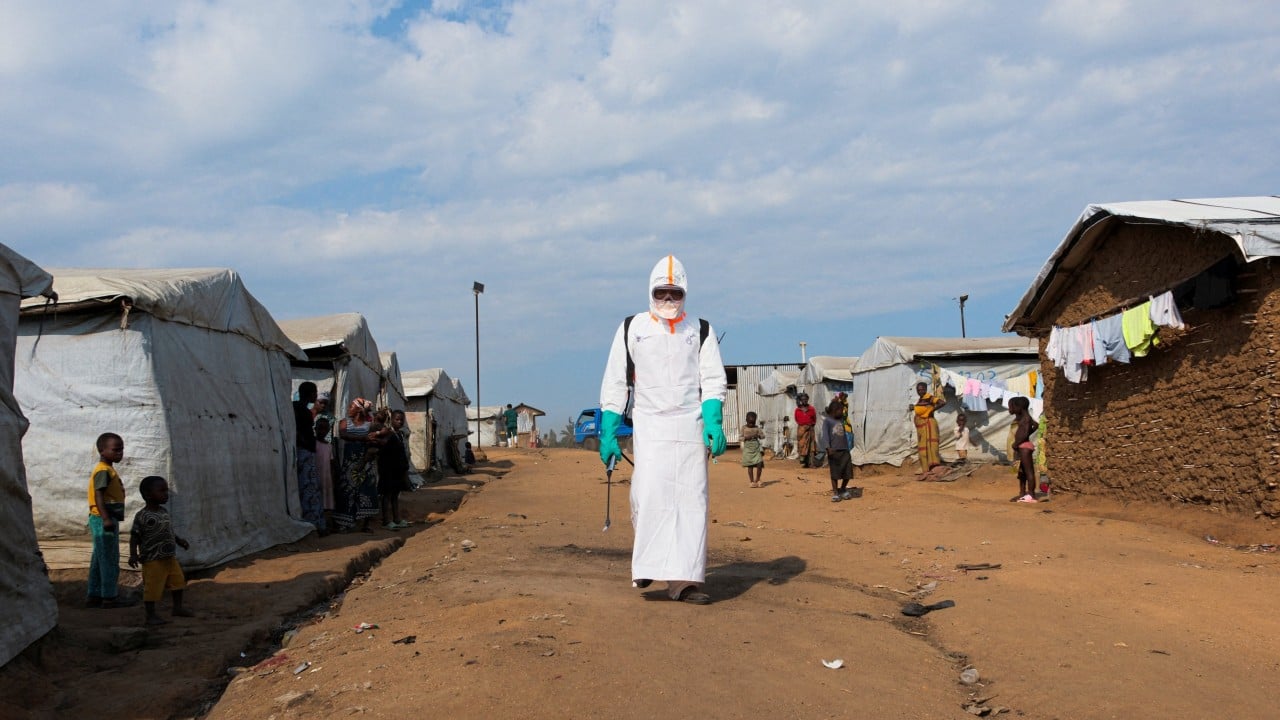
Biosecurity containment frameworks collapse when centralized health interventions collide with deep-seated institutional distrust. The kinetic destruction of Ebola treatment centers (ETCs) and the forceful extraction of patients by local populations in the eastern Democratic Republic of the Congo (DRC) are not random acts of lawlessness. Instead, these events represent a predictable, rational reaction to an optimization model that prioritizes viral isolation while externalizing the cultural and economic costs onto vulnerable families.
When clinical architecture ignores localized social structures, the containment strategy creates an adversarial dynamic. Managing an outbreak driven by the Bundibugyo ebolavirus strain—which lacks a licensed, highly effective vaccine or specific antiviral therapeutic—requires understanding the exact transmission vectors and social friction points. The collapse of physical containment in towns like Rwampara, Mongbwalu, and Butembo demonstrates that a strictly biomedical protocol fails when it ignores the local socio-political context.
The Friction Function of Standard Bio-Containment Protocols
Epidemiological containment models rely on a basic assumption: the population will voluntarily trade personal autonomy for collective safety. In high-distrust zones, this assumption fails. The friction within this system can be mapped across three distinct structural points.
       [Centralized Bio-Containment Protocol]
                         │
        ┌────────────────┼────────────────┐
        ▼                ▼                ▼
[Structural Friction] [Information Leak] [Economic Churn]
        │                │                │
        ▼                ▼                ▼
[Forced Isolation]   [Zero Internal   [Loss of Breadwinner]
& Sterile Burials     Data Access]     & Asset Forfeiture
1. Structural Friction: Alienation and Bio-Exclusion
The standard ETC model enforces an absolute separation between the patient and their community. By isolating individuals inside high-density polyethylene tents and using strict Personal Protective Equipment (PPE), the medical response strips away the human element of care.
When a patient enters this closed system, their family loses all visibility into their status. If the patient dies, traditional burial customs—which often involve washing and touching the deceased—are replaced by rapid, sterile burials managed by response teams. Because the corpse of an Ebola victim holds a high viral load, this bio-exclusion is medically necessary, but it creates profound social trauma. Forcing these protocols without community consent turns the ETC from a place of healing into a black box of death.
2. Information Leak: Asymmetric Communication Channels
Health authorities operate on top-down communication structures, broadcasting directives through radio or official decrees. This creates an information vacuum. In the absence of transparent, real-time data about what happens inside an isolation ward, rumor networks scale up to fill the void.
Without accessible data, the local population develops alternative explanations: the ETC is viewed as an organ-harvesting center, a political tool to suppress marginalized regions, or a corporate enterprise designed to secure international funding. The failure to share data and engage the community transparently transforms medical staff from lifesavers into hostile actors in the public eye.
3. Economic Churn: Asset Forfeiture and Household Vulnerability
Admittance to an ETC acts as an immediate economic shock to a household. The isolated individual is frequently the primary wage earner or agricultural producer. Furthermore, standard infection prevention and control protocols often demand the destruction of the patient's personal property, bedding, and clothing to eliminate fomite transmission.
Without a clear mechanism to compensate families for these losses, entry into the formal healthcare pipeline guarantees household poverty. The community responds by hiding cases, actively evading contact tracers, and rescuing relatives from clinics to preserve their remaining economic stability.
The Mathematical Realities of the Bundibugyo Strain
The current outbreak in Ituri and North Kivu provinces involves the Bundibugyo ebolavirus, a strain that complicates standard containment strategies. Unlike the Zaire ebolavirus strain, which can be mitigated using the Ervebo vaccine, the Bundibugyo strain has no licensed vaccine or proven monoclonal antibody therapy.
The epidemiology of this strain alters the risk calculations for both clinicians and the community:
- Variable Case Fatality Rate (CFR): Historical data places the CFR of the Bundibugyo strain between 30% and 50%. While lower than the 70% to 90% CFR seen with Zaire ebolavirus, this intermediate lethality creates a dangerous perception. Because a significant portion of infected individuals survive without intervention, communities question the necessity of forced isolation.
- High Subclinical and Misdiagnosed Transmission: Early symptoms of Bundibugyo infection—fever, myalgia, and gastrointestinal distress—closely mirror endemic malaria and typhoid. Families often keep patients at home during the initial, highly infectious stages, assuming a routine illness. By the time severe hemorrhagic manifestations appear, transmission networks have already spread through the household.
- Prolonged Virion Persistence: Surviving patients can shed the virus in immune-privileged sites, such as semen, for months after clinical recovery. This persistent viral reservoir means that simple discharge from an ETC does not eliminate the risk of starting new transmission chains if community monitoring breaks down.
The lack of effective pharmaceutical tools shifts the entire burden of containment onto behavioral modification and physical isolation. When these two tools are executed through coercive state power or militarized health responses, the system breaks down.
The Dynamics of Tactical Rejection
The destruction of the Doctors Without Borders facility in Mongbwalu and the armed removal of patients near Butembo follow a clear tactical pattern. These are not unorganized riots; they are targeted actions aimed at reclaiming bodies and patients from institutional control.
[Patient Ingress to ETC] ──► [Loss of Family Oversight] ──► [Rumor Acculturation]
                                                                    │
                                                                    ▼
[Destruction of Facility] ◄── [Forced Patient Rescue] ◄── [Kinship Mobilization]
This cycle begins with kinship mobilization. When a patient is admitted, the family experiences a loss of agency. As rumors grow and communications break down, the kinship network decides that the risk of leaving the patient in institutional custody outweights the risk of viral infection.
The rescue operations are fast and precise. Incendiary devices are used against temporary structures like isolation tents to force medical staff to flee. This allows the group to quickly find and extract their relatives. The immediate consequence is a complete failure of public health tracking. In Mongbwalu, 18 suspected cases escaped into surrounding communities, instantly creating dozens of untraceable contact chains.
This breakdown highlights a fundamental flaw in the response strategy: security cannot be maintained by merely adding more guards. Deploying state military forces or armed police to guard health infrastructure often confirms the population's worst fears, cementing the view that the medical response is a tool of state oppression.
Redesigning the Containment Architecture
To stop this cycle of institutional rejection, public health groups must abandon the fortress-style isolation model. The response infrastructure must be redesigned to align medical goals with local social priorities.
Transition to Semi-Permeable Isolation Corridors
The absolute physical barrier between the patient and the outside world must be replaced with a semi-permeable boundary. Modern ETC design should use transparent, high-tensile polymer partitioning that allows families to see and speak with their hospitalized relatives continuously.
By keeping communication open and visible, the "black box" perception of the treatment center disappears. Furthermore, clean family members should be integrated into non-clinical workflows, such as preparing familiar food or observing care routines from safe viewing zones.
Decentralize to Community-Led Care Units
Large, centralized ETCs managed by international teams should be reserved for the most severe cases. The frontline defense must be shifted to smaller, community-led care units staffed by local community health workers.
These localized units should be built using local materials and placed under the oversight of village elders. When the community owns the health infrastructure, the facility is protected as a local asset rather than targeted as an outside threat.
Implement Absolute Financial Indemnification
To mitigate the economic shock of isolation, public health budgets must treat cash transfers as a core medical intervention. Every household with an individual admitted to an isolation unit should receive an immediate cash transfer to replace lost income, along with guaranteed replacement packages for any property destroyed for infection control. Financial stability allows families to choose isolation without risking poverty.
Restructure Safe and Dignified Burial Protocols
Burial teams must stop operating like hazardous material disposal crews and start working as facilitators of grief. Protocols must be modified to allow family members to participate in funerals safely. This includes providing family members with modified PPE so they can view the body, read last rites, or perform non-contact traditional ceremonies. Respecting the dead removes the main catalyst for community violence.
The current strategy of treating outbreak containment as a purely medical and security challenge guarantees ongoing resistance and systemic failure. Outbreaks are stopped when communities choose to contain them. Until global health agencies realize that social trust is just as critical as viral isolation, the architecture of bio-containment will continue to burn.
For a deeper look into the operational realities on the ground, this field report on the DRC health crisis details how displacement and armed conflict complicate active disease surveillance and accelerate transmission risks across borders.