Municipal administrative actions often function as a trailing indicator of structural inefficiencies within federal operations. The decision by Newark Mayor Ras J. Baraka to implement an emergency curfew around the Delaney Hall detention facility represents more than a localized public safety intervention. It serves as an instructive case study in jurisdictional friction, illustrating what occurs when a municipal executive uses local police powers to stabilize an environment destabilized by federal immigration policy and private-sector facility management.
The strategic failure of the initial containment strategy lies in a fundamental misalignment of operational mandates. Federal agencies prioritize immigration enforcement and facility security; state authorities prioritize regional stability and constitutional crowd management; and municipal leadership is burdened with the immediate, localized externalities of civil unrest. When these three mandates collide under conditions of high information asymmetry and escalating physical tactics, systemic failure manifests as localized riots, necessitating blunt instruments of civil control like a targeted curfew.
The Escalation Mechanics: From Internal Protest to Civil Asymmetry
Civil unrest rarely accelerates in a vacuum. The breakdown of order at Delaney Hall followed a predictable operational progression that can be mapped across distinct phases of escalation.
[Internal Detainee Grievance (Hunger Strike)]
                     ↓
[External Advocacy & Counter-Protest Mobilization]
                     ↓
[Tactical Symmetry Breached (Projectiles / Incendiaries)]
                     ↓
[Jurisdictional Hand-off (Federal to State Personnel)]
                     ↓
[Municipal Intervention (Emergency Exclusionary Curfew)]
The catalyst was an internal labor and condition strike. Detainees within the 1,000-bed facility, managed by the private contractor GEO Group under U.S. Immigration and Customs Enforcement (ICE) oversight, initiated a hunger strike to protest substandard living conditions, medical neglect, and coercive administrative processing. This internal strike functioned as an information signal, crossing the facility walls and mobilizing external advocacy groups.
The introduction of external actors fundamentally altered the tactical equation. The arrival of ideological counter-protesters, including far-right formations like the Proud Boys alongside institutional Democratic lawmakers, generated political polarization. This altered the crowd dynamics from a single-focus advocacy demonstration into a multi-factional confrontation.
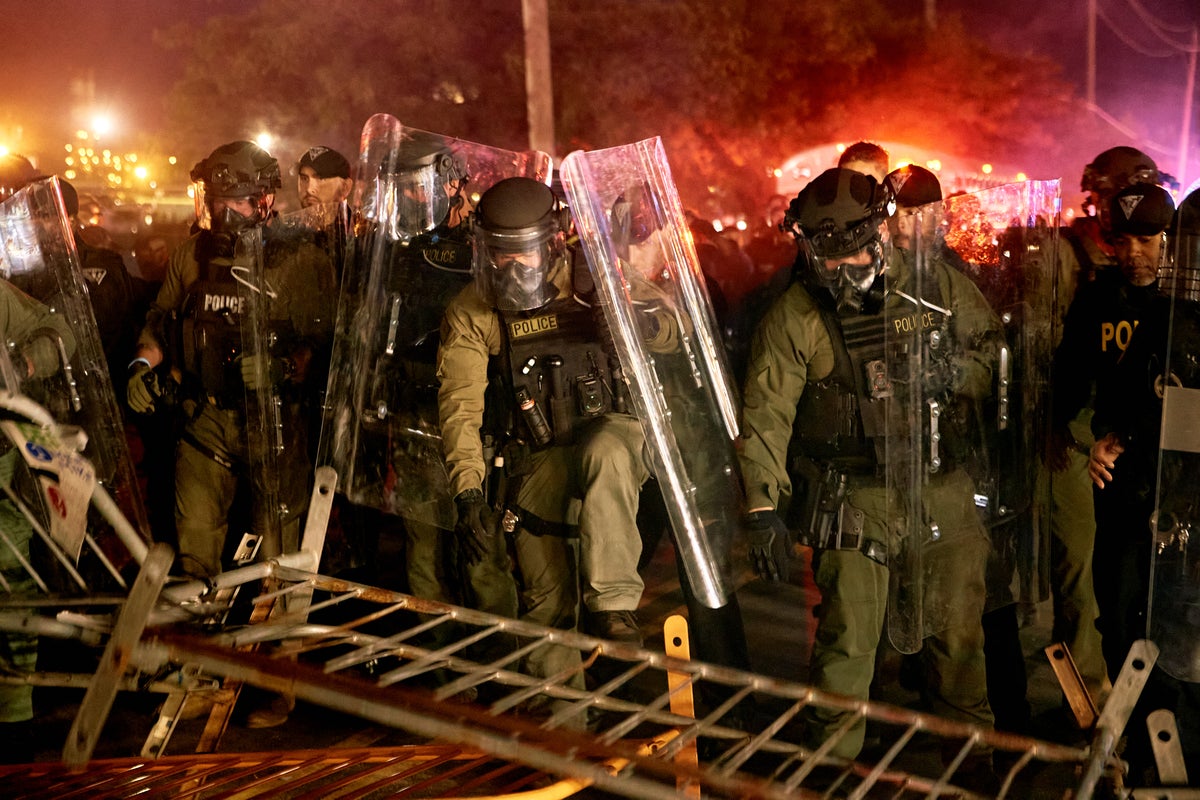
The physical threshold was crossed when protesters transitioned from passive resistance to active tactical engagement. Demonstrators overwhelmed physical perimeter controls, using modular police barricades as kinetic weapons, deploying projectiles, and utilizing improvised incendiary devices, specifically burning tires, to disrupt logistics along Doremus Avenue.
The Cost Function of Multijurisdictional Law Enforcement
A critical operational bottleneck occurred during the transition of law enforcement personnel. The management of civil disturbances requires a highly specialized tactical doctrine that federal immigration enforcement agents are neither structured nor staffed to sustain over prolonged durations.
On Friday, New Jersey State Police relieved federal agents at the perimeter. This hand-off introduced three distinct operational variables that ultimately accelerated the need for municipal intervention:
- Doctrine Disparity: Federal agents operate under immigration enforcement and asset-protection mandates, focusing heavily on static defense. State police operate under crowd-control frameworks, utilizing modular riot formations, mounted units, and chemical irritants like tear gas and pepper spray to disperse crowds.
- Logistical Exhaustion: Maintaining a continuous tactical footprint around a 1,000-bed urban facility incurs high variable costs in personnel hours, equipment degradation, and mutual aid coordination.
- The Symmetrical Escalation Paradox: The deployment of heightened tactical assets—such as officers on horseback and riot shields—frequently acts as an accelerant rather than a deterrent. It provides a visible target for militant factions within a crowd, driving a feedback loop of escalating force.
The operational failure of the state and federal perimeter strategy forced the municipal executive to intervene. The mayor’s implementation of a mandatory curfew within a half-mile radius of Delaney Hall, effective from 9 p.m. to 6 a.m., represents an admission that tactical containment at the facility perimeter had failed.
The Curfew as a Spatial Containment Mechanism
From a strategic perspective, an urban curfew is not an exercise in criminal justice; it is a spatial containment mechanism designed to alter the resource economics of protest. By declaring a blanket ban on pedestrian traffic and restricting vehicle access on Doremus Avenue to verified official business, the municipality achieves three precise tactical objectives.
First, it eliminates crowd anonymity. When a curfew is in effect, the mere presence of an individual within the designated zone constitutes an actionable violation. This lowers the evidentiary threshold required for law enforcement intervention, allowing police to make proactive dispersals and targeted arrests before a crowd can achieve critical mass.
Second, it disrupts the logistical supply lines of prolonged demonstrations. Crowds require ongoing influxes of personnel, hydration, communication equipment, and tactical materials. Restricting vehicle access to verified commercial or official business chokes off the supply lines necessary to sustain a protest footprint overnight.
Third, it separates peaceful advocates from tactical agitators. Legitimate civil rights advocates and civilian observers generally comply with municipal curfews to avoid legal exposure. The individuals who remain within the exclusion zone after hours are, by definition, willing to violate the law. This self-selection allows law enforcement to apply decisive tactical force, including arrests and physical clearing operations, with a significantly reduced risk of inflicting collateral harm on non-combatants.
The Structural Limits of Private Correctional Operations
The underlying vulnerability exposed by the Newark crisis resides in the operational model of private-sector detention facilities. The GEO Group re-opened Delaney Hall for federal immigration detention in February 2025. Private operational models run on fixed-revenue, cost-minimization structures that frequently create systemic vulnerabilities when subjected to stress.
| Operational Vector | Private Facility Constraint | Systemic Manifestation |
|---|---|---|
| Labor & Staffing | Fixed headcount optimized for baseline internal security. | Inability to surge personnel during external crises without depleting internal modules. |
| Resource Allocation | Profit margins depend on minimizing variable costs (food, medical, sanitation). | Substandard living conditions that spark internal labor or hunger strikes. |
| Risk Externalization | Contracts insulate operators from external municipal security costs. | Local taxpayers and municipal police absorb the financial burden of external security. |
This structural design guarantees that when conditions inside a private facility deteriorate sufficiently to trigger a strike, the resulting security externalities are immediately offloaded onto the surrounding municipality. The private operator retains its federal per-diem revenue per bed, while the city of Newark and the state of New Jersey absorb the operational, political, and financial costs of maintaining civil order on the streets outside.
Strategic Playbook for Municipal Executive Action
To resolve the immediate crisis and insulate the municipality from future federal policy failures, leadership must shift from reactive tactical containment to proactive structural insulation.
The municipal executive must treat the current curfew as a temporary stabilization window, using the pause in active hostilities to execute a three-part structural play.
Force the Re-Internalization of Costs
The city of Newark should immediately quantify the total variable costs incurred by municipal agencies—including police overtime, fire department deployments, sanitation clearing, and infrastructure damage along Doremus Avenue. The administration must file formal administrative resource claims against both the Department of Homeland Security and the GEO Group. By shifting the financial burden back to the private operator and the federal contracting agency, the city alters the cost-benefit analysis of maintaining substandard conditions at Delaney Hall.
Leverage the Visitation Protocol Transition
New Jersey Governor Mikie Sherrill announced the resumption of federal family visits at the facility. Municipal authorities must use this operational shift to establish a strict, audited transit and access corridor. Local law enforcement should control the check-points along Doremus Avenue to facilitate legitimate family and legal visitation while maintaining the exclusion zone for non-verified external actors. This preserves the constitutional rights of detainees and families while preventing the reformation of adversarial protest crowds.
Execute an Ordinance-Based Zoning Pivot
Long-term containment requires recognizing that a 1,000-bed immigration detention center operated by a third-party contractor is incompatible with urban public safety mandates in high-density areas. The municipal legal team should initiate a comprehensive review of local zoning ordinances, environmental impact requirements, and occupancy permits for the Delaney Hall site.
Rather than waiting for a slow federal policy shift or congressional action, the city can utilize municipal health, safety, and building code enforcement to impose strict operational compliance costs on the facility operator. This strategy systematically erodes the financial viability of private detention within city limits, creating a structured path toward the permanent closure of the facility without exposing the city to federal preemption lawsuits.