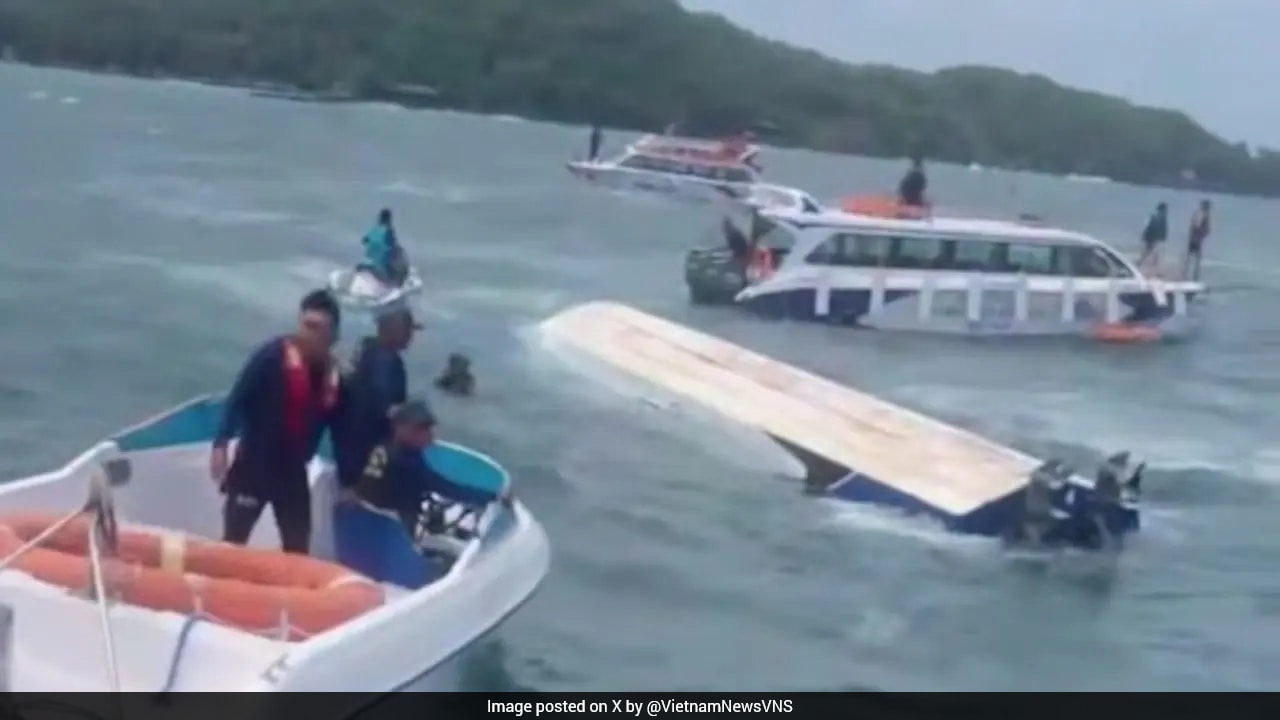
The capsizing of a commercial speedboat off Vietnam’s Phu Quoc Island, resulting in the deaths of 15 Indian tourists, highlights a recurring structural vulnerability in developing marine tourism markets. When consumer demand scales exponentially, it frequently outpaces local regulatory enforcement, safety infrastructure, and emergency response capabilities. The incident—occurring roughly 400 meters off Hon May Rut Ngoai Island—is not an isolated operational fluke, but a consequence of systemic risk factors that emerge when high-throughput island-hopping excursions intersect with volatile marine environments.
The vessel, operated by Ocean Pear Island Company, was transporting 32 passengers and four crew members from Hon May Rut to An Thoi Port when it overturned in rough sea conditions. While preliminary assessments by the local authorities point to high waves and strong winds as the immediate catalyst, a rigorous evaluation requires breaking the failure down into three distinct operational vectors: environmental thresholds, vessel dynamics, and emergency rescue constraints.
The Mechanics of Kinetic Failure in Shallow Marine Transits
Maritime accidents of this nature are rarely dictated by a single variable. Instead, they occur due to a compounding sequence of events that destabilizes the vessel's equilibrium. To understand why a professional transit failed so close to the shoreline, we must isolate the physical and operational pressures acting upon the craft.
Environmental Wave Vectors and Hull Displacement
The waters around the An Thoi archipelago are susceptible to localized swell amplifications. Speedboats used for tourist transits typically feature planing or semi-displacement hulls designed to maximize speed over calm or moderately chopped surfaces. When these hulls encounter sudden, large waves lengthwise or at a quartering angle, the vertical acceleration forces can easily exceed the vessel's self-righting moment. The presence of high waves without active precipitation suggests a wind-driven swell or tidal rip that caught the operator off guard, rapidly shifting the vessel from a stable state into a catastrophic roll.
The Center of Gravity and Passenger Load Dynamics
A critical vulnerability in tourist-configured speedboats is the distribution of live weight. With 32 passengers and four crew members on board, a significant percentage of the total displacement weight is positioned above the waterline. If a vessel takes a sharp turn to counteract a wave, or if a large wave forces a sudden tilt, the natural human reaction is for passengers to shift toward one side of the craft. This creates a severe asymmetric load, radically shifting the center of gravity and drastically reducing the hull's resistance to capsizing.
Entrapment Architecture and Hull Trajectories
Data from the rescue operation indicates that the primary driver of mortality was not impact, but entrapment. The speedboats frequently deployed for high-density excursions feature rigid or soft overhead canopies designed to protect passengers from UV exposure and spray. When the boat capsized completely, turning upside down within minutes, this structural framework acted as an underwater cage. Passengers wearing standard personal flotation devices (PFDs) were pushed upward by their life vests against the ceiling of the inverted hull, trapping them in pockets without air access and blocking immediate egress channels.
The Scale Gap: Institutional Overload in Tourist Hubs
The operational failure in Phu Quoc mirrors a broader macro-trend visible in major Southeast Asian marine tourism corridors. The island has transformed into a high-density international destination, logging over 1.8 million foreign arrivals annually. This growth trajectory exposes a critical bottleneck: the rate of infrastructure investment and regulatory oversight cannot keep up with the volume of daily transits.
The structural issues can be categorized across three major operational pillars:
- Real-Time Micro-Climate Forecasting: While macro-level meteorological data is widely accessible, shallow-water island channels require localized, real-time wave and wind monitoring. Operators frequently rely on visual assessments at the port of departure rather than data-driven, localized wave-height thresholds.
- Capacity Control and Hull Manifest Compliance: Commercial pressure incentivizes high asset utilization. In rapidly expanding tourism markets, boats are routinely operated at or near their absolute maximum structural passenger limits, reducing the safety margin required to handle unexpected environmental anomalies.
- First-Responder Proximity and Specialized Training: Though nearby tourist vessels arrived within five minutes of the capsize, they lacked the specialized dive and hull-breaching equipment required to extract individuals trapped under an inverted canopy. Professional maritime salvage, coast guard, and navy assets face inherent geographic delays when deploying to outer islets situated 10 to 12 kilometers away from main naval bases.
Comparative Institutional Analysis: Recurrent Regulatory Arbitrage
The structural nature of these risks is validated by a parallel incident from July 2025 in Ha Long Bay, where a tourist vessel capsized during a sudden storm, resulting in 35 fatalities. The common denominator between these events is a reliance on reactive enforcement rather than predictive risk mitigation.
| Metric / Variable | Phu Quoc Incident (July 2026) | Ha Long Bay Incident (July 2025) |
|---|---|---|
| Vessel Classification | High-speed planing/semi-displacement speedboat | Traditional multi-deck excursion boat |
| Primary Failure Trigger | Sudden swell/wave action and hull roll | High localized wind shear and structural instability |
| Primary Mortality Driver | Canopy entrapment and rapid hull inversion | Structural capsizing and slow evacuation protocols |
| Operational Distance | ~400 meters from nearest islet shore | Open bay transit corridors |
| Enforcement Deficit | Lack of real-time route suspension protocols for rough water | Failure to anticipate localized squall lines |
The comparison reveals a systemic regulatory blind spot regarding route-suspension thresholds. In both instances, vessels were permitted to depart or continue operations despite escalating environmental hazards, showcasing a lack of standardized, automated triggers to halt operations based on real-time wave heights or wind speeds.
Crisis Management and Consular Mobilization Protocols
When a mass-casualty event occurs involving foreign nationals, the logistical challenge immediately transitions from local rescue to international diplomatic and consular management. The Indian Embassy in Vietnam responded by establishing dedicated emergency control rooms in both Hanoi and Ho Chi Minh City to manage the multi-layered fallout.
The operational response protocol for international tourist crises involves handling several distinct pipelines:
- Identity Verification and Manifest Reconciliation: Consular officials must cross-reference local police recoveries with official tour operator logs and border control records to ensure all passengers are accounted for, resolving the discrepancy between the 21 survivors and 15 casualties.
- Medical Repatriation and Hospital Coordination: Survivors requiring acute medical care must be stabilized locally while insurance, medical transport, and linguistic barriers are managed by diplomatic attaches on the ground.
- Legal and Forensic Oversight: Consular teams monitor local police and maritime investigations to safeguard the legal rights of the victims’ families, ensuring that operational negligence by the carrier is thoroughly documented for subsequent civil or criminal proceedings.
Prescriptive Frameworks for Mitigating Small-Craft Transit Risks
To prevent catastrophic hull failures and mass entrapment in high-density marine tourism corridors, destination managers and regulators must shift from manual oversight to automated safety frameworks.
The first step requires the implementation of an Automated Marine Transit Authorization System (AMTAS). This system links local maritime port authorities with real-time oceanographic buoys placed along high-risk transit channels. When wave heights or wind speeds exceed a predetermined threshold calibrated for specific hull types, the system automatically revokes outward port clearances for small passenger vessels. This removes the decision-making vulnerability from commercial tour operators who are financially incentivized to run excursions in marginal weather.
The second critical intervention focuses on vessel architecture mandates. Regulators must phase out fixed overhead canopies on high-speed passenger vessels, replacing them with quick-release or open-air alternatives that eliminate the hazard of underwater entrapment during a capsizing event. Additionally, all commercial tourist craft operating in open or semi-sheltered waters must be retrofitted with external hull-grab lines and automated acoustic distress beacons. These measures ensure that even if a vessel inverts rapidly, passengers can maintain a hold on the exterior structure while signaling immediate, precise GPS coordinates to regional first responders.