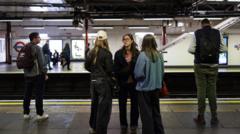
The withdrawal of labor by the National Union of Rail, Maritime and Transport Workers (RMT) across the London Underground network exposes a structural frailty in metropolitan transit systems. Mass transit operations are typically evaluated through high-level throughput metrics: total passenger journeys, headline delay minutes, and nominal revenue losses. These metrics obscure the true economic and operational mechanisms at play. When a 24-hour strike halts critical arterial lines—suspending the Circle and Waterloo & City lines while severing key segments of the Central, Piccadilly, and Metropolitan lines—the consequence is not merely a "difficult day" for commuters. It is a systematic reallocation of economic friction, a severe capacity bottleneck on secondary transport modes, and a stark stress test of workplace flexibility.
The dispute centers on a proposal by Transport for London (TfL) to transition driver rosters from a traditional five-day schedule to a compressed four-day workweek. While management frames the change as a voluntary mechanism to improve operational flexibility and roster reliability, the union targets the long-term physiological costs: extended shift durations, heightened operator fatigue, and the degradation of safety margins within a highly automated but safety-critical environment. This asymmetric evaluation of risk between labor and management guarantees a prolonged impasse, leaving the capital to absorb the structural shockwaves of network degradation.
The Microeconomics of Commuter Substitution Behavior
When primary underground rail capacity drops to near-zero on critical corridors, the immediate consequence is governed by substitution elasticity. Commuters do not simply vanish; they shift down the transit value chain based on their specific constraints of geographic location, financial capital, and contractual rigidity. This behavior operates within three distinct profiles.
The High-Flexibility Segment
Workers with high agency over their physical location—predominantly knowledge-sector employees within the City of London and Canary Wharf—decouple from the physical network entirely. They opt out of the transit system by shifting to remote operation. For this group, the friction of a strike does not manifest as travel delay, but as localized productivity loss or the postponement of collaborative, in-person tasks.
The Low-Flexibility, High-Capital Segment
Commuters who must be physically present at a workplace but possess discretionary income switch to high-cost alternative modes. This group shifts toward point-to-point private hire vehicles, ride-hailing networks, or personal vehicles. This sudden surge in demand triggers a dual bottleneck: artificial surge pricing mechanisms inflate the nominal cost of the trip, while the physical volume of vehicles exceeds the carrying capacity of London’s surface road network, leading to severe gridlock.
The Zero-Flexibility, Low-Capital Segment
The most vulnerable cohort consists of shift workers, retail staff, hospitality employees, and healthcare personnel who can neither work remotely nor afford private vehicular transport. This segment is forced onto the remaining public surface infrastructure, primarily London Buses, the Docklands Light Railway (DLR), and the London Overground. Because these systems are already calibrated for high baseline utilization during peak hours, the influx of displaced underground passengers pushes the infrastructure past its safe maximum capacity.
The Congestion Cascade and Secondary Network Bottlenecks
The systemic failure of an urban transit network is rarely contained within the disrupted mode itself. Instead, it triggers a predictable sequence of secondary network failures known as a congestion cascade.
When the Central line closes between White City and Liverpool Street, and the Piccadilly line suspends service to Heathrow Airport, the immediate result is a structural overload of the Elizabeth line and regional National Rail arteries. At major interchange hubs like Tottenham Court Road and London Liverpool Street, this manifests as acute station platform crowding.
This crowding triggers strict station management protocols. To prevent dangerous platform overruns, station operators must implement staggered entry closures, holding passengers outside the turnstiles. Consequently, the bottleneck migrates from the underground platform to the street-level concourse, paralyzing pedestrian traffic and delaying access to alternative surface transit.
Simultaneously, the surface bus network experiences severe capacity degradation. A standard double-decker bus carries approximately 90 passengers, whereas an 8-car deep-level Tube train carries roughly 800. Replacing the capacity of a single suspended underground line requires an unfeasible volume of surface vehicles. Because these buses must navigate the same surface streets now clogged by displaced private vehicles and ride-hailing cars, their operational velocity drops precipitously. The network enters a feedback loop where increased demand for alternative transport directly degrades the efficiency and speed of that alternative.
Quantifying the Structural Friction of Reduced Operational Windows
TfL's operational guidance for strike days introduces a hidden temporal bottleneck by truncating the standard operating window. The warning that services will be severely limited prior to 06:30 and that journeys must be completed before 21:00 compresses the metropolitan area's economic day.
This structural compression changes commuter velocity and behavior in two specific ways:
- Peak-Hour Concentration: Rather than spreading passenger demand across a traditional three-hour morning and evening peak window, the shortened operational day forces the entire commuting population into a hyper-compressed timeframe. The density of passengers per square meter on remaining operational platforms rises sharply, increasing the probability of secondary operational delays caused by door-blocking or emergency alarms.
- The Evening Economic Chill: Forcing a hard stop on passenger journeys by 21:00 cuts off the footfall required by the central London evening economy. Hospitality, theater, and service sectors face a sharp drop in demand as patrons and staff prioritize leaving the central zone before the transit network shuts down entirely.
The Information Failure of the Distorted Transit Map
A significant driver of commuter friction during industrial action is a reliance on suboptimal alternative routes, an issue rooted in cognitive map distortion. The iconic London Underground map is a topological diagram rather than a geographical reality. It distorts actual physical distances to maximize readability within a dense urban core.
During a strike, passengers frequently make travel decisions based on this topological representation, assuming that stations adjacent on paper require complex, multi-stage bus journeys to navigate when closed. In reality, many central London stations are within brief walking distance of one another.
Historical economic analyses of partial network closures—such as the landmark university studies on the 2014 London Underground strikes—reveal an unexpected long-term outcome of forced network disruption: the discovery of latent efficiencies. When regular commuters are forced to experiment with alternative routes due to localized line closures, a measurable percentage (roughly 5%) discover that their alternative journey is actually faster or cheaper than their baseline underground route. This forced experimentation breaks suboptimal habits reinforced by the distorted geometry of the transit map, leading to permanent route optimization once normal service resumes. This long-term dividend, however, is heavily asymmetric, benefiting agile commuters while offering no relief to those tethered to inflexible, long-distance radial routes.
Roster Compression and the RMT-TfL Strategic Impasse
To understand why negotiations consistently collapse, the dispute must be viewed through a strict operational management framework. The friction is a direct clash between two competing optimization models: fiscal efficiency and labor sustainability.
The Management Framework: Roster Optimization
From the perspective of TfL's operational planners, compressing a 35-hour workweek from five days into four longer shifts is an asset-utilization strategy. It reduces the overhead costs associated with shift handovers, minimizes non-productive buffer time, and creates a more flexible labor pool to cover peak demand periods without increasing headcount. Because the program is designed as a voluntary opt-in, management operates under the assumption that it preserves worker autonomy while unlocking structural efficiencies.
The Union Framework: Ergonomic Risk and Safety Margins
The RMT's resistance is rooted in a risk-mitigation model that treats human capital as a finite physiological system. Extending daily shift lengths in a deep-level underground environment increases cognitive fatigue and slows reaction times. Tube drivers operate in conditions characterized by sensory monotony, artificial lighting, and high-consequence safety thresholds. The union's calculus is simple: a voluntary framework inevitably becomes coercive under operational pressures, and the long-term cost of operator fatigue introduces an unacceptable risk of safety-critical failures.
Because Aslef—the union representing a separate cohort of train drivers—accepted the four-day compressed model, the operational landscape is fractured. The network cannot run at full capacity with only a fraction of its driving workforce available, resulting in the irregular, line-by-line partial shutdowns that maximize passenger confusion and distribution instability.
Strategic Operational Playbook for Enterprise Continuity
For enterprises operating within the capital, waiting for a macro-level resolution between TfL and the RMT is a losing strategy. Mitigating the friction of recurring industrial action requires the immediate implementation of a structured continuity playbook.
First, replace vague "work-from-home if possible" guidelines with an explicit, role-indexed tier system. Category A staff (critical physical infrastructure, on-site security, hardware engineering) must be pre-allocated private transit stipends or re-routed to satellite offices outside the central zone. Category B staff (client-facing functions) must transition to mandatory remote operations 24 hours prior to the strike to remove load from the transport network.
Second, discard the assumption that alternative rail options like the Elizabeth line or public buses can maintain standard client meeting schedules. All physical corporate travel within Zones 1 and 2 should be halted, replacing face-to-face engagements with asynchronous or digital touchpoints.
Finally, logistics and supply-chain operations must shift their delivery windows entirely outside the compressed 06:30 to 21:00 transit boundary. Freight, restocking, and servicing should be rescheduled for midnight-to-dawn windows, avoiding the surface congestion cascade caused by the subterranean shutdown. Enterprise resilience depends on accepting network friction as a structural certainty and reconfiguring corporate velocity accordingly.