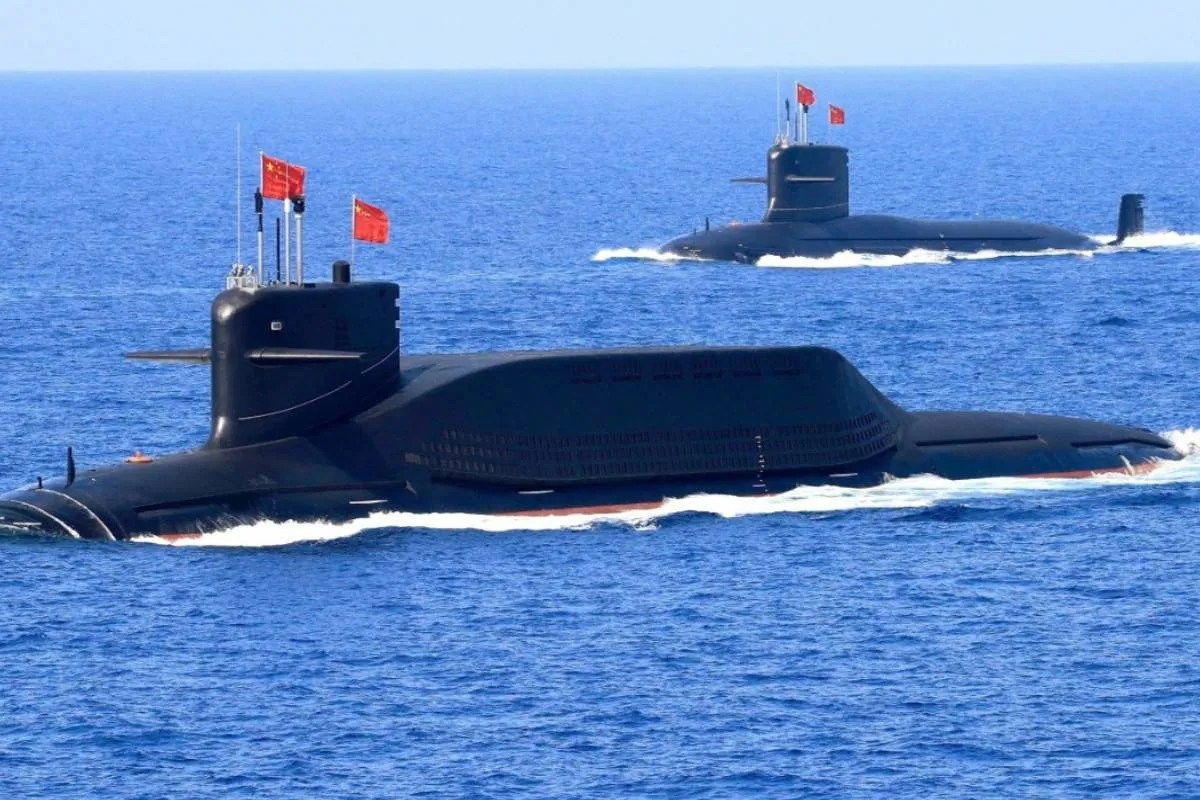
The expansion of the People’s Liberation Army Navy (PLAN) submarine fleet is not merely a reflection of increased defense spending; it represents a deliberate structural shift from a localized, green-water denial force to a deep-water power projection utility. Media characterizations frequently rely on alarmist terminology regarding hull counts and generalized regional panic. A rigorous strategic assessment, however, requires isolating the specific industrial mechanisms, technological transitions, and geographic realities that dictate China’s undersea trajectory. By analyzing the structural pillars of this expansion, regional defense planners can move past reactive posture changes and identify the precise operational choke points within China's maritime strategy.
The Three Pillars of PLAN Undersea Modernization
The expansion of China’s undersea capability relies on three mutually reinforcing vectors: industrial throughput, propulsion evolution, and geographic footprint extension. Each pillar addresses a specific historical limitation of the PLAN, converting vulnerabilities into calculated operational options.
1. Industrial Throughput and Hull Replication Scales
The velocity of PLAN submarine acquisition is fundamentally driven by infrastructure optimization at key production nodes, most notably the Huludao Shipyard. Unlike Western naval manufacturing, which frequently suffers from budgetary instability and supply chain fragmentation, China operates on a continuous production model.
This infrastructure configuration enables simultaneous assembly lines for both nuclear-powered attack submarines (SSNs) and ballistic missile submarines (SSBNs). The optimization of modular construction techniques—where internal sub-systems are integrated into hull segments before final welding—minimizes drydock time. This industrial capacity ensures that the PLAN can maintain a high tempo of fleet modernization without decommissioning legacy assets prematurely, creating a net positive hull-count trajectory.
2. Propulsion Dynamics and Acoustic Signatures
The qualitative shift within the PLAN fleet is defined by the transition from legacy diesel-electric hulls to advanced conventional Air-Independent Propulsion (AIP) systems and modernized nuclear architectures. This transition changes the operational cost function of undersea warfare in the Indo-Pacific.
- AIP Integration (Type 039A/B/C Variants): Conventional submarines utilizing Stirling engines or fuel cell systems decouple the vessel's endurance from the requirement to snort (inhaling atmospheric oxygen to recharge batteries). This significantly reduces the indiscretion rate—the percentage of time a submarine exposes itself on or near the surface—making detection via radar or visual means highly difficult in shallow littoral waters like the East and South China Seas.
- Nuclear Propulsion Evolution (Type 093B and Type 095): Historical PLAN SSNs were limited by high acoustic signatures, making them easily trackable by Western anti-submarine warfare (ASW) networks. Newer iterations incorporate natural circulation reactors, pump-jet propulsion, and advanced rafted isolation systems. These engineering modifications reduce the acoustic noise floor, narrowing the historical qualitative gap between Chinese and Western acoustic profiles.
3. Spatial and Range Extension Beyond the First Island Chain
The primary strategic objective of the modernized PLAN submarine force has evolved from defending continental approaches to enforcing access denial across the Western Pacific and establishing a persistent footprint in the Indian Ocean.
[First Island Chain: Littoral Denial via AIP]
       │
       ▼
[Second Island Chain: Open Ocean Interdiction via SSNs]
       │
       ▼
[Indian Ocean: Sea Lines of Communication (SLOC) Surveillance]
This geographic expansion is enabled by the increased endurance of modernized hulls. For regional neighbors, this means the threat vector is no longer confined to localized maritime disputes. The extended operational range allows PLAN attack submarines to conduct long-range anti-ship cruise missile (ASCM) strikes well outside the detection range of localized coastal defense networks.
Regional Recalibration and ASW Bottlenecks
The acceleration of Chinese undersea operations forces an immediate reassessment of maritime strategy among Indo-Pacific littoral states, specifically India, Japan, and Australia. The response mechanisms chosen by these nations expose critical systemic bottlenecks in regional security architectures.
The Indian Ocean Dilemma
For India, the regular deployment of PLAN conventional and nuclear submarines into the Indian Ocean Region (IOR) invalidates the historical assumption of natural geographic dominance. The PLAN utilizes logistics nodes in the western Indian Ocean and diplomatic access points in South Asia to sustain prolonged deployments.
The Indian Navy's response faces an immediate operational bottleneck: a deficit in conventional hull numbers and delayed procurement cycles for domestic project lines. To compensate, the strategy must pivot toward maritime domain awareness (MDA) through aerial assets like the P-8I Neptune. However, aerial surveillance is an episodic solution; it cannot substitute for the persistent, underwater counter-locational capability that only a matching submarine force can provide.
The Choke Point Architecture of the First Island Chain
Japan and allied forces command the critical geographic choke points—such as the Miyako Strait and the Bashi Channel—that the PLAN must traverse to reach deep water. This gives regional defenders a distinct structural advantage.
The Japanese Maritime Self-Defense Force (JMSDF) has optimized its fleet for high-end ASW, utilizing an extensive network of sound surveillance systems (SOSUS), advanced diesel-electric submarines (such as the Taigei class with lithium-ion batteries), and specialized surface combatants. The bottleneck here is not technological, but capacity-based. The sheer volume of PLAN transits threatens to saturate these defensive barriers, forcing defenders to allocate disproportionate resources to fixed geographic corridors at the expense of flexible open-ocean maneuvering.
Structural Vulnerabilities in the PLAN Undersea Strategy
A data-driven analysis must balance capability gains against systemic weaknesses. Despite significant progress, the PLAN's undersea strategy is constrained by distinct geographic, operational, and doctrinal friction points.
Geographic Confinement
The geography of the Chinese coast remains a permanent strategic disadvantage. To deploy into the deep waters of the Philippine Sea or the Indian Ocean, PLAN submarines must pass through narrow, heavily monitored maritime bottlenecks.
| Choke Point | Primary Monitoring Authorities | Operational Risk for PLAN |
|---|---|---|
| Miyako Strait | Japan (JMSDF) | High density of acoustic sensors and maritime patrol aircraft. |
| Bashi Channel | Taiwan / United States / Philippines | High risk of early detection during surface or shallow transits. |
| Malacca Strait | Singapore / Malaysia / Indonesia / India | Extremely shallow; forces conventional transits or surface movement for large vessels. |
These constraints mean that in a high-intensity conflict, a significant portion of the PLAN submarine fleet could be interdicted before achieving open-ocean deployment.
Command, Control, and Communication (C3) Deficits
Nuclear submarines operating at long ranges require secure, redundant, and ultra-low-frequency (VLF) or extremely low-frequency (ELF) communication networks to receive targeting data without compromising their positions. The PLAN's long-range C3 infrastructure is still developing. Furthermore, the highly centralized command structure of the PLA creates friction when applied to undersea warfare, which traditionally demands high levels of operational autonomy from individual boat commanders. A rigid command structure limits tactical flexibility in fast-moving underwater engagements.
Strategic Recommendation for Regional Defense Architecture
To counter the quantitative and qualitative expansion of PLAN undersea forces, regional militaries must abandon legacy procurement models that attempt to match China hull-for-hull. The financial and industrial costs of such a strategy make it unsustainable.
The optimal response requires the implementation of an Asymmetric Undersea Denial Framework. This strategy shifts investment from expensive manned platforms to distributed, autonomous sensor and strike networks.
- Distributed Autonomous Sensor Webs: Deploy high-density networks of uncrewed underwater vehicles (UUVs) and fixed acoustic arrays along known transit corridors. These systems act as tripwires, offloading the burden of initial detection from high-value manned assets like attack submarines or maritime patrol aircraft.
- Cross-Domain Targeting Integration: Establish unified data-linking protocols between regional partners to share raw acoustic data in real time. If a Japanese asset detects a PLAN submarine transiting the Miyako Strait, that telemetry must flow instantly to Indian or Australian assets tracking the vessel’s projected vector.
- Shallow-Water Denial Optimization: Utilize mine warfare and smart, loitering undersea munitions within littoral zones. By complicating the exit routes from Chinese naval bases, regional forces can contain the PLAN undersea threat within the First Island Chain, neutralising their range advantages before they can be leveraged in the open ocean.


