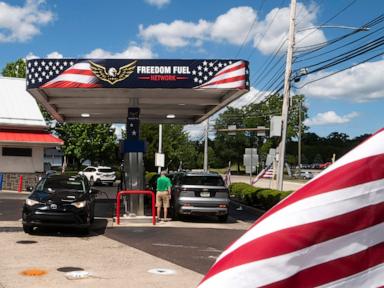
The convergence of retail fuel distribution and executive political signaling has manifested in the Philadelphia metropolitan area through the launch of the "Freedom Fuel Network". Promoted via official White House communications platforms, this 25-station footprint sells regular unleaded gasoline at a fixed price of $3.47 per gallon—approximately $0.50 below the regional baseline and nearly $0.30 below the national average. While populist rhetoric frames this as a direct victory for consumer purchasing power, an unblinking economic evaluation reveals a far more complex structural mechanism.
Understanding this phenomenon requires discarding the superficial debate over government interventionism versus corporate altruism. The administration openly concedes that no federal subsidies, public loans, or direct capital allocations support this network. Instead, the Freedom Fuel framework operates as a highly coordinated, privately funded syndication model designed to weaponize retail real estate for geopolitical and narrative leverage.
The Microeconomics of the Loss-Leader Pump
The retail fuel market operates on razor-thin net margins, typically fluctuating between $0.10 and $0.15 per gallon before accounting for credit card processing fees, labor, and overhead. Offering fuel at a fixed discount of $0.50 per gallon breaks standard cost-plus pricing structures. It forces a deliberate structural imbalance.
To analyze how a private entity—Freedom Fuel Network, LLC, registered in Delaware—sustains these metrics, one must look at the two primary variables governing downstream energy economics:
1. The Cross-Subsidization Index
Independent gas stations do not generate their primary net income from the fuel dispenser; they generate it from the convenience store footprint. Gross margins on convenience merchandise range from 30% to 40%. By creating artificial structural deficits at the pump ($3.47 per gallon), the network drives massive, non-linear increases in foot traffic. The economic hypothesis relies on an aggressive conversion rate: the assumption that a percentage of drivers idling in long queues will purchase high-margin items inside, offsetting the downstream loss on the commodity fuel.
2. Underwritten Margin Compression
A White House spokesperson indicated that the operating retailer is absorbing the deficit by accepting smaller margins. In professional commodity trading, this is known as an equity-backed market-share acquisition strategy. A private capital pool or a heavily consolidated regional distributor has converted 25 existing physical assets (previously carrying legacy flags like Sunoco, Valero, and BP) under a single unified banner. The upfront capital required to absorb a $0.50 loss per gallon across 25 high-volume locations suggests a finite promotional burn rate rather than an enduring, self-sustaining structural shift. If a single station pumps 4,000 gallons per day, a 25-station network incurs a collective gross deficit of roughly $50,000 daily. This is a corporate marketing expense masquerading as economic policy.
The Rockets and Feathers Bottleneck
The political imperative behind Freedom Fuel stems from executive frustration over asymmetric retail price adjustments, a well-documented economic phenomenon known as the "rockets and feathers" effect. When global macroeconomic shocks cause crude oil futures to spike, retail fuel prices rocket upward almost instantly. Conversely, when crude futures decline sharply—as seen with West Texas Intermediate hitting $68 per barrel—retail pump prices drift downward slowly, like feathers.
This lag is driven by distinct supply chain realities:
- Inventory Replacement Cost Accounting: Retailers price current fuel based on what it will cost to buy their next delivery batch, not what they paid for the volume currently sitting in their underground storage tanks.
- Risk Premium Buffering: Independent operators hold onto higher margins during a downward trend to build a capital cushion against the next volatile upward swing.
By demanding an immediate baseline reduction to a $2.50 national target and threatening Department of Justice price-gouging investigations, the administration is attempting to use regulatory intimidation to forcefully truncate the "feather" phase of the cycle. The Freedom Fuel Network serves as a physical proof-of-concept designed to shame institutional competitors into accelerating their margin compression.
Structural Vulnerabilities and Network Limits
The primary flaw in evaluating Freedom Fuel as a scalable blueprint for national energy policy lies in its inherent structural limitations. It is an optimized marketing campaign, not an infrastructure solution.
First, the model relies entirely on third-party refining and wholesale distribution networks. Because Freedom Fuel Network, LLC does not own upstream extraction assets or midstream refining capacity, it remains a price-taker on the spot market. It must purchase wholesale fuel at prevailing rack prices. If global supply constraints trigger another upward commodity shock, the spread between the wholesale acquisition cost and the $3.47 retail ceiling will widen, accelerating the cash burn rate to unsustainable levels.
Second, the geographic concentration introduces extreme regional bias. Confining the initial 25-station test matrix to Pennsylvania and South Jersey exploits localized supply dynamics near major East Coast refining infrastructure. Replicating this model in high-regulatory, high-tax environments like California—where state-level environmental mandates and cap-and-trade systems structurally add over $1.00 per gallon to the baseline cost—is mathematically impossible without direct capital insolvency.
To achieve a structural, nationwide downward shift in retail energy pricing, capital allocators cannot rely on localized retail stunts. Execution requires an aggressive expansion of domestic refining capacity, a structural reduction in midstream transit bottlenecks, and a systemic overhaul of regional fuel blending mandates that fracture the supply chain. Until those structural fundamentals change, initiatives like the Freedom Fuel Network remain high-visibility, short-horizon tactical maneuvers.
The optimal operational play for competing independent retailers is not to engage in a destructive price war with a subsidized or capital-backed political entity. Instead, operators must maximize convenience footprint optimization, leverage loyalty data to secure sticky customer relationships, and wait out the promotional burn period of the politically aligned competitor.