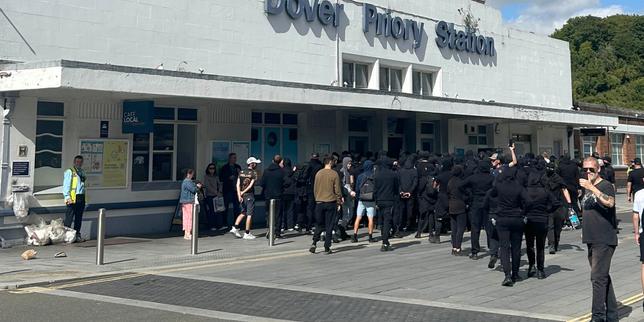
Strategic infrastructure nodes operate on hyper-optimized throughput models where a minor physical blockage triggers non-linear supply chain degradation. When dozens of masked demonstrators converged on the approach arteries of the Port of Dover, halting traffic along the A20 and Jubilee Way, the incident exposed more than a localized public order disturbance. It revealed the acute fragility of key cross-Channel logistics corridors when subjected to coordinated civil friction.
Understanding this disruption requires dissecting how nationalist political mobilization intersects with critical trade architecture. The Port of Dover handles millions of passengers and freight vehicles annually, representing a vital economic bridge between the United Kingdom and continental Europe. When tactical blockades are deployed at such chokepoints, the economic damage extends far beyond delayed holidaymakers.
The Mechanics of Infrastructure Chokepoints
Logistics networks rely on continuous flow to maintain operational equilibrium. The Dover-Calais corridor functions under strict scheduling parameters where freight inventory and passenger transit operate on tight turnaround times.
[Port Access Arteries (A20)]
       │
       ▼ (Physical Blockade / Paramilitary Posture)
[Throughput Stoppage]
       │
       ▼ (Queue Accumulation: 6.4km Threshold)
[Schedule Cascades & Economic Friction]
When access routes face sudden closure, the immediate operational cost function escalates across three distinct variables:
- Time Depreciation: Haulage operators absorb direct financial penalties from idling assets and missed slot allocations at ferry terminals.
- Network Saturation: Queues spilling onto National Highways create secondary congestion, disabling municipal transit and emergency response vectors.
- Psychological Deterrence: The visual deployment of individuals in black paramilitary-style dress and balaclavas introduces an intimidating variable that disrupts normal commercial behavior.
While ferry operators such as P&O maintained vessel schedules on the water, land-side access blockades severed the connection between the supply chain origin and maritime transit. This disconnect proves that physical ports are only as secure as their least protected terrestrial approach road.
The Political Economy of Border Rhetoric
The manifestation of these protests cannot be separated from the broader political economy surrounding small-boat migration across the English Channel. Hard-right entities, including organizations like Patriot Platform and political figures such as Nigel Farage, have systematically elevated border control into a dominant ideological touchstone.
By framing asylum seekers through catastrophic terminology, political actors generate an emotional urgency that motivates decentralized groups to transition from digital rhetoric to physical disruption.
Data from state authorities indicates a divergent reality from the crisis narratives promoted by extremist networks. Law enforcement metrics show that cross-Channel small boat arrivals decreased by over forty percent compared to previous baseline figures, driven by enhanced bilateral enforcement coordination between London and Paris. Yet, tactical street actions persist because the objective is signaling presence and exerting psychological pressure on state machinery rather than engaging with empirical crime or migration statistics.
Operational Response and State Vulnerability
The response mechanics deployed by Kent Police and national authorities during the Dover incident highlight the legal and tactical dilemmas inherent in policing spontaneous civil disobedience. Operating under standard public order frameworks, police prioritized containment and eventual dispersion, resulting in traffic flowing normally by midday without immediate arrests on-site.
This non-confrontational clearance strategy avoids escalating street confrontations into widespread riots, but it creates a permissive environment for tactical actors. When small groups can paralyze a multi-billion-pound trade artery with minimal immediate legal consequence, the risk-reward ratio heavily favors disruption.
Local representatives, including Dover MP Mike Tapp, have criticized the actions as counterproductive exercises that penalize local residents and workers rather than addressing systemic immigration policy. However, civic condemnation lacks the deterrent capacity required to neutralize highly motivated ideological cells.
To inoculate vital logistics hubs against similar disruptions, asset owners and municipal authorities must transition from reactive crowd management to predictive asset hardening. This demands restricted perimeter access enforcement along critical coastal approaches, real-time intelligence sharing between regional police forces and port operators, and automated traffic diversion protocols that prevent localized blockades from metastasizing into systemic highway gridlock.