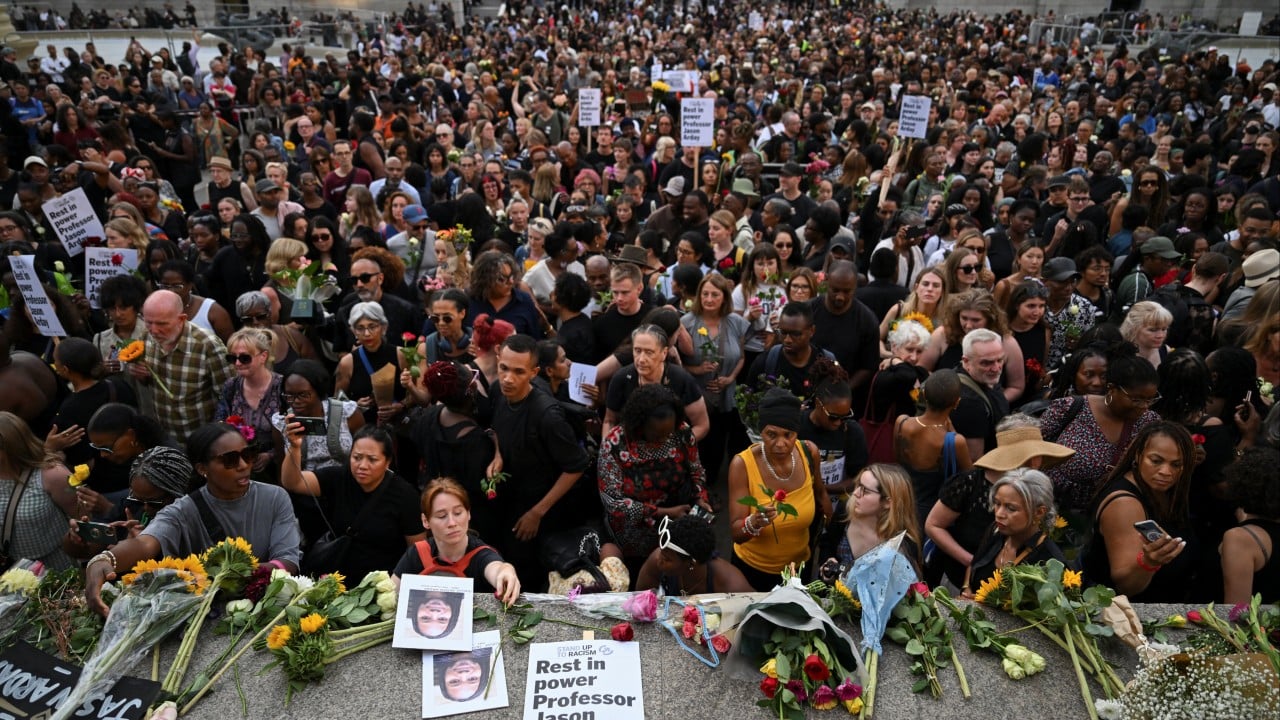
Tens of thousands of people packed into Trafalgar Square under a slate-grey London sky, carrying placards bearing a simple, defiant phrase: Rest in power. They had gathered to mourn Professor Jason Arday, the former Cambridge sociologist whose body was found in his south London home just days after a brutal, media-saturated resignation. Arday was forty-one. He was also Black, autistic, and, by any objective measure of institutional machinery, utterly unprotected by the ivory tower he had broken into.
The immediate narrative offered by mainstream outlets focuses heavily on the raw numbers of the vigil and the competing claims of institutional accountability. Yet that surface-level reporting misses the structural rot beneath. Arday’s death is not merely a tragedy of individual vulnerability colliding with hostile headlines. It is a clinical case study in how British academic institutions use tokenized appointments for public relations gold, only to abandon those same individuals to a howling media pack the moment scrutiny arrives.
The Manufacturing of a Wunderkind
To understand why Arday’s fall was so catastrophic, one must examine how he was built up. When Cambridge University appointed him as professor of sociology of education in 2023, he became the youngest-ever Black professor at the institution. The university press offices hummed with activity. Headlines celebrated his improbable trajectory—how he had learned to speak late, lived with severe developmental delays, and taught himself sociology while working flat out.
Institutions love a modern miracle. Universities under immense pressure to diversify their faculties often lean heavily on individual success stories to mask systemic inertia. Arday was marketed as living proof that meritocracy worked, a symbol of institutional evolution.
Symbols, however, are fragile. When allegations surfaced regarding his doctoral thesis, claims of plagiarism, and inconsistencies in his personal background narratives, the apparatus that had hoisted him onto a pedestal stepped backward. They did not shield him. They opened inquiries.
The Mechanics of a Digital Pillory
The backlash was swift and relentless. Over a span of mere weeks, hundreds of articles, columns, and online broadcasts dissected every facet of Arday’s life. Friends and colleagues noted that the campaign went far beyond a standard academic misconduct investigation. It assumed the characteristics of a public shaming ritual.
For an autistic scholar who had spent a lifetime managing intense psychological friction, the onslaught was fatal. Clinical psychologists who knew him noted that he experienced acute distress, sending desperate voice notes indicating he could no longer bear the weight.
Here lies the unspoken hypocrisy of the modern university. Elite institutions maintain elaborate departments dedicated to mental health, inclusivity, and pastoral care. Yet when public controversy strikes a high-profile staff member, those internal support mechanisms vanish. The priority shifts entirely to institutional self-preservation. Legal teams take over. Communications departments draft defensive statements. The individual is left isolated, exposed to a digital ecosystem optimized for maximum outrage.
The Institutional Abandonment
Cambridge officials expressed profound shock at his passing. Other universities that had hastily announced their own investigations into his past credentials issued sympathetic statements of condolence. These expressions ring hollow against the backdrop of institutional cowardice.
When an academic is accused of errors or misconduct, standard disciplinary procedures exist for a reason. They are designed to be methodical, confidential, and fair. By contrast, the public feeding frenzy relies on swift execution in the court of public opinion. By capitulating to the external pressure and immediately launching stacked inquiries, universities signal that their primary allegiance is to their brand equity rather than their duty of care.
Arday’s family stated plainly that the public cruelty he endured was too heavy for any man to bear. They asked for quiet, but the public anger in London remains palpable. Crowds at Trafalgar Square did not just grieve a gentle scholar; they indicted a system that extracts brilliance from the margins while refusing to guard the doors once they are opened.
The flowers left beneath Nelson's column will wither. The statements from vice-chancellors will fade from the headlines. Unless elite universities fundamentally alter how they treat vulnerable scholars who deviate from the traditional white, upper-class archetype, the machinery will simply spin up again, waiting for the next symbol to consume.


