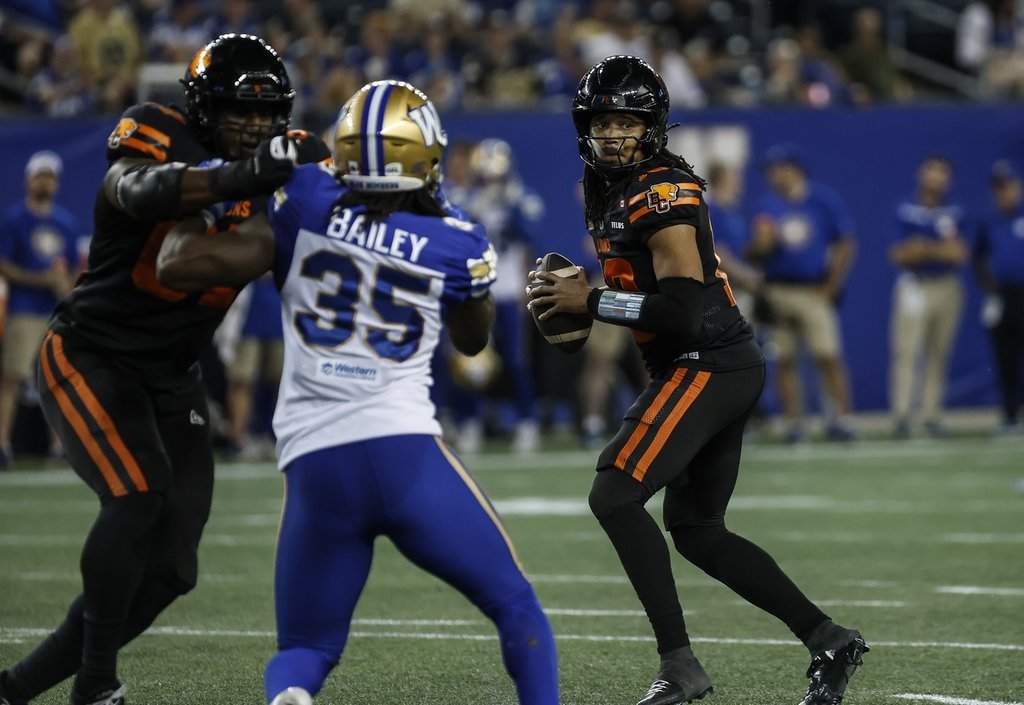
Operating a professional football franchise through a primary quarterback injury cycle exposes structural vulnerabilities in roster depth and offensive architecture. When the BC Lions confirmed that rookie Kaidon Salter would make his first career Canadian Football League start against the Winnipeg Blue Bombers, it marked an emergency pivot for a 1-5 club searching for operational stability. Analyzing this transition requires stripping away narrative-driven journalism to examine the systemic mechanics of cascading quarterback injuries, offensive line reconfiguration, and the defensive constraints facing an unproven signal-caller on a short week.
The Cascade Effect of Position Scarcity
Quarterback scarcity functions like a supply chain bottleneck. When a franchise player like Nathan Rourke suffers a shoulder injury, the structural integrity of the entire offensive system fractures. Backup plans are tested under maximum stress. The Lions initially turned to Chase Brice, whose ineffective performance against the Toronto Argonauts forced an in-game evaluation of Salter.
Salter's promotion is not merely a personnel swap; it is a forced tactical iteration. Salter completed nine of 15 pass attempts for 121 yards and added four rushes for 12 yards in relief duty. While those metrics offer a baseline, evaluating his readiness involves analyzing two distinct operational variables:
- Processing Speed: The transition from the collegiate tier—split across Liberty and a stint at Colorado—to the professional Canadian game demands rapid identification of zone coverages on a 110-yard field with 12 men per side.
- Athletic Leverage: Salter profiles as a dual-threat asset, evidenced by his rushing totals at the collegiate level. Offensive coordinators typically lean on designed quarterback movement to mitigate pass-protection breakdowns when breaking in a rookie.
Roster Restructuring and Offensive Line Friction
A rookie quarterback does not operate in a vacuum. To insulate Salter, the BC coaching staff enacted sweeping lineup changes, introducing six new starters, including three along the offensive trenches and backfield. Emani Bailey steps in at running back for the injured James Butler, while Anu Una and Tyran Walker-Hunt enter the starting blocking scheme at left guard and right tackle, respectively.
This introduces a high degree of variance. Cohesion along the offensive line is the primary determinant of passing efficiency. Introducing multiple new blockers simultaneously against a disciplined Winnipeg defensive front creates communication vulnerabilities. Blitz pickup assignments and stunts executed by veteran defensive fronts routinely exploit rookie interior linemen and unaccustomed depth pieces.
The strategic objective for BC is minimizing third-and-long situations. If the offensive line fails to establish a run threat via Bailey—utilizing his compact 5-foot-7, 202-pound frame to grind out yardage—Salter will face predictable, heavy-pressure packages that inflate turnover risks.
Defensive Counter-Strategies and Tactical Exposure
Winnipeg enters this matchup countering with Dru Brown under center in place of the injured Zach Collaros, yet the Blue Bombers defensive scheme remains a known benchmark of discipline. Defensive coordinators facing a debutant quarterback typically deploy specific defensive frameworks:
- Disguised Coverages: Post-snap rotations designed to confuse the quarterback's pre-read assessment, forcing hesitation and holding the ball beyond the allowable pass-protection threshold of 2.5 seconds.
- Edge Containment: Restricting Salter's scramble lanes by keeping defensive ends in disciplined rush lanes, forcing him to win strictly from the pocket rather than escaping horizontally.
- Encouraging Intermediate Throws: Forcing a rookie to prove he can consistently beat tight-window zone drops outside the numbers before adjusting into more aggressive single-coverage safety alignments.
The Lions' decision to shuffle personnel extends to the defensive side as well, with Colby Taylor starting at defensive end and Josh Hagerty at safety. This wholesale roster churn across both units illustrates a team in evaluation mode, attempting to find a winning combination before the season slips entirely out of reach.
Deploy maximum play-action constraints early in the first quarter to freeze Winnipeg's linebackers, utilize quick-game perimeter throws to establish Salter's rhythm, and restrict deep-developing pass patterns until the interior blocking scheme proves it can neutralize the Blue Bombers' front-four rush.