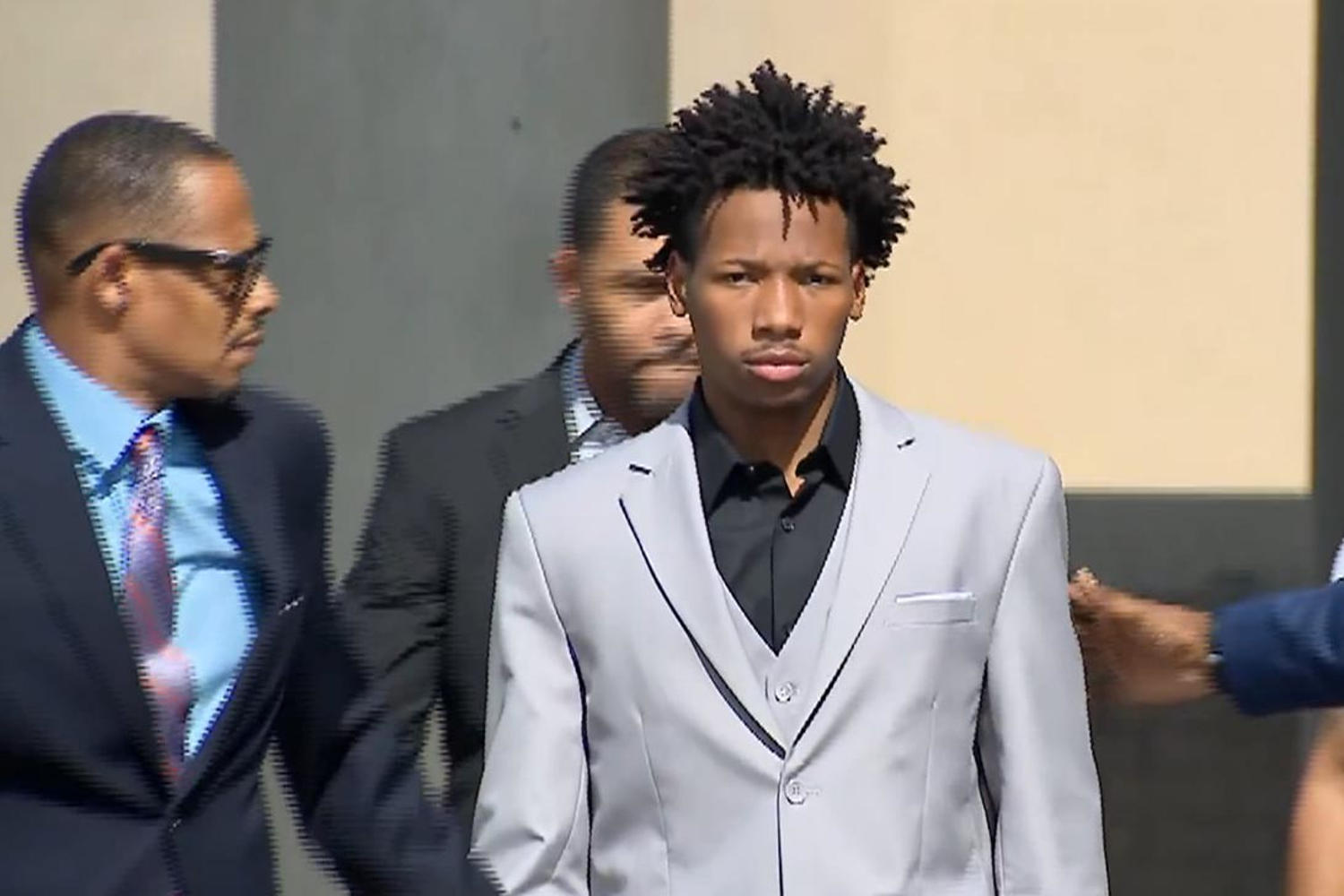
In Texas criminal jurisprudence, the boundary between first-degree murder and justifiable homicide rests on the precise execution of Texas Penal Code Section 9.32. The trial of Karmelo Anthony for the April 2, 2025, fatal stabbing of Austin Metcalf at a Frisco Independent School District track meet isolates this legal boundary. While media narratives frame the case as a conflict of personal portraits, an analytical assessment reveals that the verdict will not depend on characterizations, but on a strict mathematical and behavioral calculus of proportional force, imminent threat, and the duty to retreat.
The state must prove beyond a reasonable doubt that Anthony intentionally and knowingly caused the death of Metcalf under Texas Penal Code Section 19.02. The defense bears the initial burden of production to proffer sufficient evidence supporting a justification defense. Once produced, the burden of persuasion shifts back to the prosecution to disprove self-defense beyond a reasonable doubt. The structural layout of this legal battle operates across three distinct analytical pillars: the genesis of physical contact, the proportionality of the responsive instrument, and the post-incident behavioral metrics. If you liked this piece, you should check out: this related article.
The Micro-Timeline of Escalation and Spatial Dynamics
To evaluate the validity of a self-defense claim, the fact-finder must analyze the physical interaction through a strict micro-timeline. In this case, environmental variables and spatial constraints accelerated the transition from a verbal dispute to a fatal kinetic event.
A sudden thunderstorm created a spatial bottleneck at David Kuykendall Stadium. Multiple sports teams sought shelter under specialized team tents located in the bleachers near the 50-yard line. This environmental constraint forced an intersection between Anthony, a student at Centennial High School, and Metcalf, a student at Memorial High School, under the Memorial team tent. For another perspective on this story, refer to the recent update from TIME.
The subsequent confrontation developed through a predictable four-stage escalator mechanism:
- Spatial Intrusion: Anthony positioned himself under the Memorial High School team tent to avoid the downpour.
- Verbal Mandate: Metcalf issued a verbal directive for Anthony to vacate the team's designated space. Witnesses state Anthony reached into his bag and issued a verbal counter-warning: "Touch me and see what happens."
- Physical Initiator: Metcalf initiated physical contact by grabbing or pushing Anthony to forcibly remove him from the tent structure.
- Lethal Response: Anthony deployed a concealed black knife, delivering a single penetration wound directly to Metcalf’s chest before fleeing the immediate perimeter.
The defense strategy hinges entirely on Step 3, positioning Metcalf as the initial physical aggressor. Under Texas law, however, a physical push does not automatically grant a legal license to deploy lethal force. The court must evaluate the objective reasonableness of Anthony's perception of an imminent threat of death or serious bodily injury.
The Proportionality Function and Deadly Force Thresholds
The core legal failure or success of the defense rests upon the proportionality function. Texas Penal Code Section 9.31 permits the use of non-lethal force when and to the degree the actor reasonably believes the force is immediately necessary for protection against another's use or attempted use of unlawful force. However, Section 9.32 elevates the threshold for deadly force.
$$\text{Use of Deadly Force} = f(\text{Reasonable Belief of Imminent Deadly Force} \lor \text{Prevention of Aggravated Crime})$$
A defendant can only legally leverage deadly force if they reasonably believe it is immediately necessary to protect against the other's use or attempted use of unlawful deadly force, or to prevent the imminent commission of aggravated kidnapping, murder, sexual assault, aggravated sexual assault, robbery, or aggravated robbery.
The structural challenge for Anthony's defense counsel is the qualitative gap between a push and a blade. A push or a grab represents non-deadly force. To bridge this gap, the defense must establish that Metcalf's physical stature, positioning, or surrounding peers created an objective environment where a reasonable person would fear serious bodily injury or death. Metcalf was an MVP linebacker for his football team; his physical metrics and athletic capacity will be heavily leveraged by the defense to argue a disparity in physical force.
Conversely, the prosecution will exploit the structural bottleneck of Section 9.32(b). Under Texas law, an individual is generally not required to retreat before using deadly force if they have a right to be present at the location, did not provoke the person against whom the force is used, and are not engaged in criminal activity at the time. The prosecution will target two vulnerabilities in this structure:
- Provocation: The prosecution will argue that Anthony’s statement, "Touch me and see what happens," coupled with reaching into his bag, constitutes intentional provocation designed to create a pretext for violence, which forfeits the right to self-defense under Section 9.31(b)(4).
- Lawful Presence: Because the tent was explicitly designated for Memorial High School personnel and athletes, the state will challenge whether Anthony maintained a lawful right to remain within that specific micro-enclosure after being ordered to leave.
Post-Incident Behavioral Metrics and the Admission Framework
A critical bottleneck for the defense is the immediate post-incident data stream. In standard criminal defense protocols, flight from a scene indicates consciousness of guilt, a metric the prosecution will heavily emphasize. Surveillance footage from Frisco ISD captures Anthony fleeing the bleachers immediately after the single blow was delivered, leaving the weapon behind in the upper stands where police later recovered it behind a blue tarp.
Furthermore, Anthony's immediate verbal statements to law enforcement present a complex evidentiary hurdle. Upon being detained by responding officers, the arresting deputy stated, "I have the alleged suspect." Anthony immediately interjected: "I'm not alleged, I did it." He subsequently followed this statement by telling police he acted to protect himself after Metcalf placed hands on him.
From a prosecutorial standpoint, this immediate, unprompted admission eliminates any evidentiary ambiguity regarding identity or actus reus (the guilty act). The state does not need to expend resources proving who inflicted the wound. The trial is narrowed exclusively to the mens rea (the mental state) and the legal justification.
Anthony's defense will attempt to frame his statement ("I'm not alleged, I did it") as the transparent, unvarnished reaction of an individual who believed his actions were entirely justified, rather than the calculated evasion of a murderer. However, in a courtroom setting, explicit admissions of factual guilt shift the jury's focus entirely to the hyper-technical parameters of the self-defense statute.
Courtroom Contaminants and Procedural Safeguards
The institutional architecture of the Collin County 296th District Court, overseen by Judge John Roach Jr., has implemented strict procedural protocols designed to isolate the jury from external socio-political variables. The case has generated significant extrajudicial commentary, fractured along racial dynamics—Anthony is Black, and Metcalf was white—creating a high risk of systemic bias entering the trial process.
To insulate the trial from these external pressures, the court has established a highly restrictive procedural framework:
| Procedural Variable | Court Mandated Restriction | Legal Objective |
|---|---|---|
| Gag Order | Strict limitation on extrajudicial statements by counsel, witnesses, and affiliated parties. | Prevention of jury pool contamination via media echo chambers. |
| Electronic Ban | Complete prohibition of cellphones, recording devices, and live-streaming from the courtroom. | Elimination of real-time public pressure on witnesses and jurors; preservation of decorum. |
| Media Cap | Maximum of nine credentialed media members allowed inside at any single time, via staggered entry. | Minimization of a carnival atmosphere; maintaining controlled physical security. |
| Evidence Hold | Trial exhibits barred from public or media release until after the formal conclusion of proceedings. | Prevention of out-of-context public analysis that could influence sequestered or non-sequestered jurors. |
The jury selection framework reflects this defensive positioning. The court initiated proceedings with an expansive pool of approximately 600 potential jurors. This pool was systematically compressed using a multi-phase filtration model. First, a three-hour private screening removed individuals with clear statutory disqualifications. Second, a comprehensive three-page questionnaire was deployed to isolate internal biases, media exposure, and ideological preconceptions. The defense and prosecution subsequently utilized this data to prune the remaining pool down to 250, ultimately seating a final panel of 12 jurors and 6 alternates.
The operational objective of this mechanism is to enforce what Judge Roach termed "compartmentalization." Jurors are legally required to purge all external digital data, social media commentary, and cultural narratives, executing their evaluation solely on the evidence admitted within the four corners of the courtroom.
Strategic Trajectory and the Verdict Horizon
The resolution of this trial will depend on how successfully each side manages the technical parameters of the jury instructions. Because Anthony was 17 at the time of the offense, he is classified as an adult under the Texas criminal justice system for prosecution purposes, exposing him to a sentencing range of 5 to 99 years or life in prison if convicted of first-degree murder. Statutory protections for minors prevent the application of capital punishment or life without parole, but the operational exposure remains absolute.
The state’s optimal path to a conviction requires proving that the transition from a verbal dispute to a lethal stabbing was a disproportionate escalation. The prosecution will systematically demonstrate that a single physical push from an unarmed peer does not satisfy the statutory definition of an imminent deadly threat. They will use the forensic evidence of the single, direct stab wound to the heart to argue a calculated, intentional mental state.
The defense's critical play is to establish that the physical disparity, the confined spatial dynamics of the tent during a severe storm, and the perceived threat of multiple opposing students created a psychological reality where a reasonable person in Anthony's position would believe that non-deadly force was insufficient to neutralize the threat. They must convince the jury that the knife was not an instrument of choice, but an instrument of immediate necessity.
The outcome will ultimately turn on the jury's interpretation of a few seconds of chaotic, physical friction. If the state successfully demonstrates that Anthony had a safe avenue of retreat that he ignored, or that his verbal conduct deliberately provoked the physical altercation, his self-defense framework collapses under Texas law, resulting in a first-degree murder conviction.


