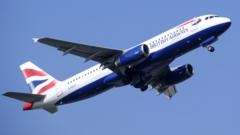
The cabin of British Airways flight BA919 was quiet. Outside the triple-paned windows, the grey quilt of an East London morning drifted by at four thousand feet. Passengers were reading magazines, checking connection times for Heathrow, or watching the map display trace a lazy arc toward home. One hundred and eighty souls suspended in the mundane magic of modern aviation.
Up front, the mood shifted instantly.
Without warning, the electronic voice of the Airbus A320 broke through the flight deck with a terrifying command. Stall. Stall.
To the untrained ear, a stall sounds like an engine failure. To a pilot, it is something far more insidious: an invisible boundary where the wings stop lifting, where air refuses to hold the heavy aluminum tube aloft, turning a multi-million-dollar machine into a falling stone.
The trouble had begun moments earlier with an Air Data Reference system failure. Think of the ADR system as the sensory nervous system of the aircraft. It feeds airspeed, altitude, and angle-of-attack data directly to the instruments and the central computers. When it failed on flight BA919, it didn't just blind the dials; it confused the machine's brain.
Modern commercial airliners fly under what engineers call Normal Law. In this state, sophisticated software acts as an invisible guardian angel. It watches the flight envelope and physically prevents a pilot from making an input that would push the aircraft past its safety limits. It is a digital bubble that makes flying remarkably safe.
But when the data goes corrupt, the bubble pops.
The A320 flight control system automatically reverted to Alternate Law. The digital guardian angels vanished. The automated stall protections were stripped away, handing raw, unbuffered physics back to the human hands on the flight deck.
The crew initiated a go-around, banking away from the concrete ribbon of Heathrow Runway 27L. They transmitted a PAN PAN call, the international radio signal for an urgent situation that is not yet an immediate threat to life. They were professionals managing a malfunction, buying time to breathe and run their checklists in a holding pattern above the metropolis.
Then came the second descent.
At approximately three thousand feet, as the aircraft responded to control inputs during the subsequent approach sequence, the alarm shrieked again. This time, it was paired with an abrupt, violent change in pitch.
In high-stress environments, cognitive tunnel vision can creep into even the most disciplined minds. According to preliminary reports and aviation safety filings being investigated by the UK Air Accidents Investigation Branch (AAIB), the situation deteriorated rapidly enough that the captain had to make a split-second, highly unusual physical intervention, overriding the first officer's control of the sidestick to force a recovery maneuver.
The jet dropped to roughly twenty-two hundred feet before the nose came up and the horizon stabilized.
The radio crackled again. The PAN PAN was upgraded to a MAYDAY.
A MAYDAY call is aviation's ultimate distress signal. It clears the skies. It turns airport emergency services outward, flashing red lights and roaring engines lined up along the tarmac, waiting for a worst-case scenario. It is a sound that makes air traffic controllers grip their consoles a little tighter.
Yet, thirty minutes after the initial aborted approach, flight BA919 touched down on the Heathrow runway.
The landing was smooth. The brakes hissed. The thrust reversers roared, bleeding off velocity until the aircraft turned off the active runway and taxied toward the gate like any other routine arrival. The passengers unbuckled their seatbelts, grabbed their carry-on bags from the overhead bins, and stepped out into the terminal terminal, completely unaware of how close they had danced to the edge of catastrophe.
There were no injuries. The metal hull was intact.
Behind closed doors, however, the fallout has been heavy. The AAIB has classified the event as a serious "Loss of Control In-Flight" incident. Investigators are currently scrubbing through the flight data recorder and cockpit voice recorder, parsing every millisecond of telemetry to understand why a routine commuter hop from Düsseldorf turned into a terrifying battle against invisible aerodynamics. The captain, shouldering the immense psychological weight of a low-altitude intervention, is currently on stress leave.
We tend to view commercial flight as an automated conveyor belt, a sterile routine where human beings merely supervise computers from takeoff to touchdown. We forget that underneath the composite panels and the automated flight paths, flying remains an elemental negotiation with gravity. When the screens go dark and the digital safety nets dissolve, survival still comes down to human reflexes, split-second friction, and the desperate, quiet will to pull the nose back up into the light.