The paradox of a record national science budget coexisting with severe operational reductions at world-class research facilities reveals a fundamental structural deficit in how large-scale research and development (R&D) is financed. Headline funding figures frequently obscure the distinction between capital allocation and the variable, non-discretionary costs required to sustain high-energy infrastructure. When public funding structures fail to index operational liquidity against macroeconomic shocks, major scientific assets are forced into artificial scarcity.
The UK Research and Innovation (UKRI) agency and its Science and Technology Facilities Council (STFC) are facing an estimated £162 million structural deficit by the 2029–30 fiscal year. This deficit is driving a 15 percent budget reduction across the nation’s core multidisciplinary scientific facilities over the next four years, alongside targeted operational reductions reaching up to 40 percent at specific national laboratories. Analyzing this crisis requires uncoupling political metrics from structural economic realities.
The Cost Function of High-Energy Research Infrastructure
To understand why a macro-level funding expansion triggers micro-level operational scaling, the spending architecture of major science facilities must be modeled as a distinct cost function. High-energy physics, synchrotron radiation sources, and neutron spallation infrastructure operate under a rigid distribution of fixed and variable inputs.
The total cost of operating an advanced scientific facility can be expressed through three primary vectors:
- Fixed Base Capital and Human Capital: The non-discretionary salaries of specialized technical staff, beamline engineers, and safety personnel required to keep a facility structurally viable.
- Volatile Operational Consumables: The direct variable inputs required for active experimentation, dominated heavily by baseload industrial electricity consumption and specialized cryogenics.
- International Sovereign Subscriptions: Legally binding, non-negotiable financial commitments to international consortia (such as CERN), which are pegged to foreign currencies.
The primary systemic failure in the current funding model is that while top-line allocations increased, the real purchasing power of that capital was eroded by three simultaneous macroeconomic shocks.
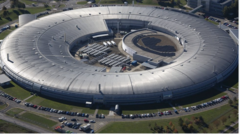
First, industrial energy price volatility structurally altered the utility overhead profiles for energy-intensive installations like the Diamond Light Source and the ISIS Neutron and Muon Source. Diamond Light Source, for example, has been forced to operate at approximately 80 percent capacity for two years due to electricity cost pressures, even prior to the formalization of the new cuts.
Second, domestic wage inflation pushed the baseline human capital costs upward, creating an immediate tension between maintaining headcounts and funding research activity.
Third, unfavorable foreign exchange rates amplified the real-term cost of international subscriptions. Because subscriptions to institutions like CERN are legally mandated to preserve international standing, UKRI is projected to absorb a 19 percent escalation in international subscription costs over the next four years. Because these international subscriptions act as a hard, non-discretionary budgetary floor, the entirety of any financial deficit must be absorbed by domestic operational variables.
The Three Pillars of STFC Portfolio Rebalancing
To stabilize its long-term financial position and achieve the required £162 million in cost savings, the STFC has executed a targeted prioritisation framework. This framework effectively divides the research ecosystem into three distinct pillars, shifting the burden of the deficit unevenly across the portfolio.
1. The Protected Core: Discovery-Led Research and Global Standing
The loudest advocacy within the scientific community centered on protecting core academic grants and international partnerships. Consequently, the Particle Physics, Astronomy, and Nuclear Physics (PPAN) core science budget will experience a minor reduction of only 2.7 percent over four years. Post-doctoral researchers funded under existing PPAN grants are protected at their financial year 2025–26 baseline levels, adjusting for inflation, while PhD studentships and fellowships remain intact. International subscriptions are fully funded. The strategic rationale here is to protect human capital pipeline and sovereign reputational equity; however, protecting this pillar necessitates disproportionate extraction from the remaining two.
2. Managed Decline: Multidisciplinary Infrastructure Efficiencies
The UK's primary multidisciplinary facilities—Diamond Light Source, the ISIS Neutron and Muon Source, and the Central Laser Facility—face a combined 15 percent budget reduction over four years. To prevent total structural failure, the STFC is attempting to transition these assets from fully subsidized state infrastructure into hybrid commercial operations. The strategy relies on two mechanisms:
- Operational Time Constraints: Reducing the active beamtime and running windows for facilities like ISIS to directly cut energy and consumable expenditures.
- Commercial Income Generation: Forcing facilities to monetize unallocated capacity by charging external corporate or international users market rates for beamlines and laser access.
If alternative commercial or international funding for specialized segments (such as the muon beamlines at ISIS) cannot be secured, those specific capabilities face decommissioning.
3. Acute Attrition: National Laboratories and Capital Deferral
The most severe, immediate cuts are concentrated within national laboratories and future infrastructure projects, where institutional protections are lowest. The operational budget for the Boulby Underground Mine will be reduced by 40 percent. Spending on particle accelerator development at the Daresbury Laboratory faces deep contractions, and the Clara facility—a highly advanced medium-energy electron beam testbed—will be mothballed.
Furthermore, the STFC National Laboratories and Estates budget reflects a sharp internal divergence: while overall laboratory costs will be slashed by 58 percent over four years, basic facility estates and maintenance costs must increase by 27 percent due to critical, long-deferred structural upkeep.
The Strategic Bottleneck of Deferral and Commercialization
The intervention strategy deployed by UKRI relies on a £135 million transitional cash injection to smooth the trajectory toward the 2029–30 targets, relying on in-year underspends and the deliberate deferral of new capital projects. This creates an operational bottleneck. Deferring asset modernization to fund short-term utility deficits creates a compounding technical debt.
The pausing of the Relativistic Ultrafast Electron Diffraction and Imaging national user facility at Daresbury is a prime example. While halting a new facility yields immediate cash preservation, it structurally degrades the nation's mid-term competitiveness in quantum materials and ultrafast chemical imaging.
The commercialization mandate for domestic facilities possesses clear economic limitations. While international or corporate user fees can offset localized operational expenditures, they introduce market volatility into basic scientific infrastructure. Corporate R&D budgets are highly cyclical. Relying on private sector revenue to fund the baseload costs of a national synchrotron introduces systemic revenue risk.
Furthermore, if a facility is operating at reduced capacity due to previous staff departures (Diamond has already suffered a 10 percent headcount reduction via unreplaced departures), it lacks the technical support capacity to effectively onboard and service high-value corporate clients.
Portfolio Realignment as the Only Viable Pathway
The immediate strategic path forward requires research institutions and facility directors to abandon the expectation of a macroeconomic bailout and aggressively restructure their operational footprints. Relying on flat-cash assumptions or hoping for a political reversal will result in unmanaged, catastrophic facility failures. Management teams must execute a rigid three-part optimization play.
First, institutional leaders must immediately conduct a strict viability audit based on the STFC’s mandated stress tests, modeling project survival at explicit funding decrements of 20, 40, and 60 percent. Resources must be stripped from non-viable mid-tier projects to insulate core capabilities where the institution maintains a global monopoly.
Second, facility operators must restructure their user-access models. Rather than distributing diminished beamtime evenly across all academic applicants—which dilutes research quality across the board—time must be concentrated into high-impact blocks. This minimizes the thermal cycle costs of restarting high-energy infrastructure.
Third, national laboratories must form immediate cross-institutional partnerships with private aerospace, defense, and pharmaceutical firms to co-fund operational overheads through long-term anchor tenancy agreements, rather than relying on transactional, ad-hoc user fees. Survival dictates an immediate shift from a model of state-subsidized curiosity research to a highly capitalized, ruthlessly prioritized industrial R&D framework.