Topical skincare delivery operates under a fundamental constraint: human skin acts as a selective barrier designed to keep external molecules out, while formulation chemistry attempts to drive active ingredients in. Evaluating whether hands remain the optimal vehicle for this transport mechanism requires examining the physical, mechanical, and biological variables at play. Most consumers approach skincare application as a passive ritual of smearing, yet the choice of applicator fundamentally dictates product bioavailability, micro-tears in the epidermal layer, and cross-contamination vectors. Manual application introduces variables of pressure, absorption loss, and bacterial transfer that systematically undermine the efficacy of active ingredients like retinoids, ascorbic acid, and peptides.
The Absorption Cost Function of Manual Application
The primary operational failure of using bare hands for product distribution stems from the stratum corneum of the fingertips versus the palmar surface. Human fingertips possess a dense concentration of sweat glands and a thick stratum corneum, making them surprisingly porous and absorbent to lipid-soluble compounds. When a consumer dispenses a high-cost serum or cream onto their palm or fingertips, a measurable percentage of that formulation never reaches the facial epidermis.
Instead, the kinetic energy of massage drives the product into the micro-grooves and ridges of the finger friction skin. This creates an immediate systemic loss of product efficiency. A clinical analysis of product recovery reveals that up to twenty-five percent of a liquid or gel formulation is absorbed by the stratum corneum of the hands before the product ever makes contact with the target treatment zone.
Furthermore, manual application introduces uncontrolled mechanical shear stress. The skin on the face, particularly around the periorbital and perioral regions, requires minimal displacement force to avoid stretching the extracellular matrix. Fingers apply uneven pressure profiles across the facial plane. High-pressure points over-compress capillaries and stretch fragile dermal fibers, while low-pressure zones leave active ingredients unblended. This uneven distribution breaks down the uniform film formation required for sustained-release formulations, leading to localized irritation where concentrations pool and zero efficacy where coverage thins.
Microbial Load and the Vector of Contamination
Dermatological health relies on maintaining a stable cutaneous microbiome. Introducing hands into the application loop shatters this stability through predictable pathways of contamination. Despite thorough handwashing, the subungual spaces—the areas beneath the fingernails—harbor diverse microbial communities, including Staphylococcus aureus and various environmental spores.
When a consumer dips unwashed or even washed fingers directly into a jar or touches the dropper nozzle of a serum bottle, they inoculate the vehicle with a biological load. This triggers preservative depletion within the formulation. Preservatives in cosmetics are calibrated to handle a baseline level of consumer exposure, but introducing an active bacterial colony accelerates the breakdown of these chemical preservatives. Once preservatives fail, microbial proliferation alters the pH and chemical composition of the product, turning a restorative treatment into an inflammatory agent.
The secondary vector involves cross-contamination between zones. Touching environmental surfaces, keyboards, and mobile devices immediately prior to touching the face deposits sebum, particulate matter, and transient bacteria directly onto skin that has been prepped and cleansed for treatment. This breaks the sterile chain of a targeted regimen.
The Mechanical Alternative: Silicone, Sponges, and Glass
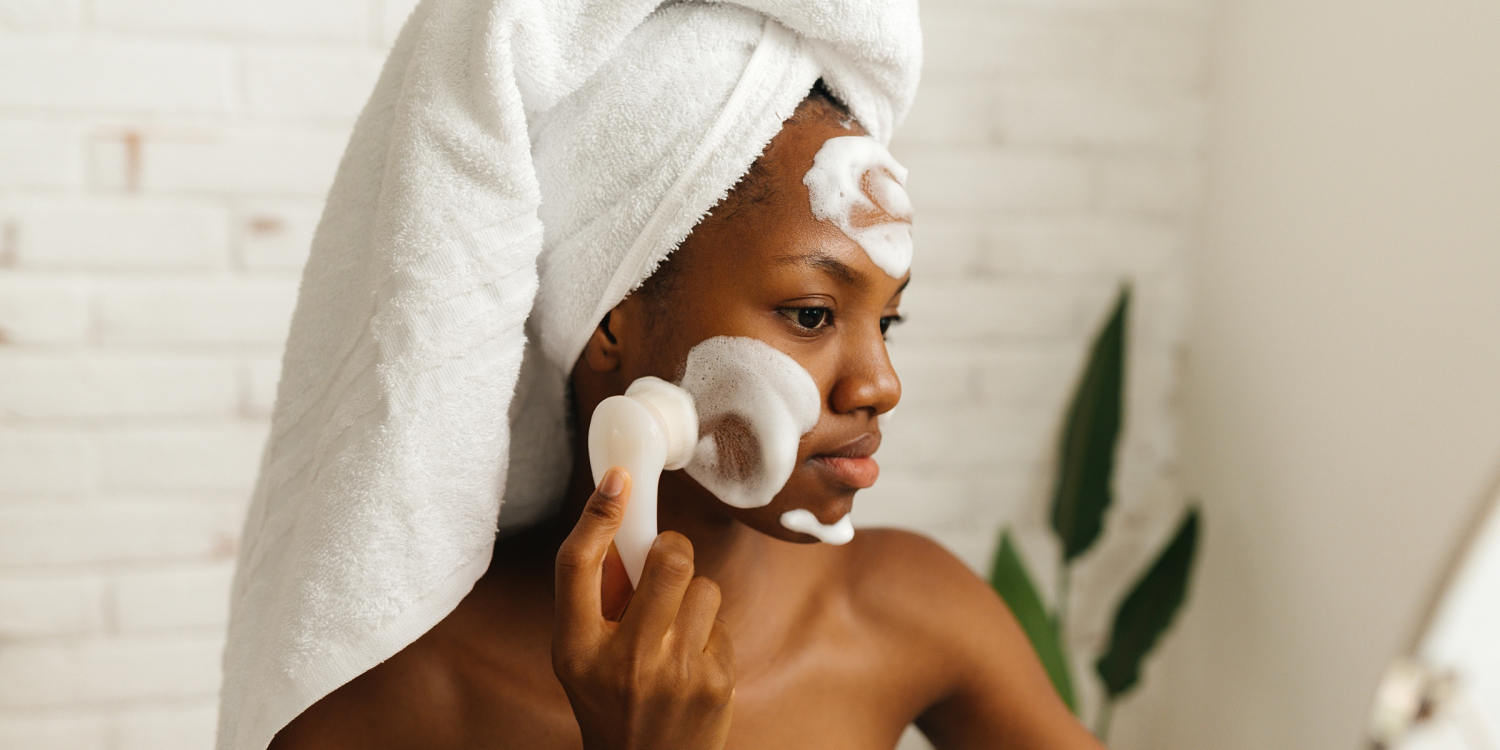
To eliminate the absorption loss and microbial transfer inherent to manual touch, alternative application tools introduce mechanical predictability. Silicone spatulas, antimicrobial brushes, and glass globes alter the cost-benefit equation of topical delivery.
Silicone applicators present a non-porous barrier. Unlike human skin, silicone absorbs zero percent of the formulation applied to its surface. This guarantees that one hundred percent of the dispensed product transfers to the facial epidermis. The mechanical rigidity of a silicone paddle also enforces a flat plane of distribution, smoothing active ingredients into an even, micro-thin film that matches the precise diffusion coefficients required by modern chemical formulations.
Antimicrobial synthetic brushes offer a different mechanical advantage. The individual filaments flex under minimal tension, eliminating the shear stress that causes dermal micro-tears during manual massage. These synthetic fibers do not harbor bacteria in the same manner as organic skin crevices, provided they undergo standard surfactant cleansing post-application.
However, these tools introduce their own operational friction. They require maintenance protocols, introduce washing time, and if neglected, become bio-films of bacterial accumulation worse than clean human hands. The choice between hands and tools is therefore not a binary upgrade, but a trade-off between biological convenience and mechanical precision.
Quantifying the Retinoid and Acid Delivery Delta
The debate over application methods intensifies when evaluating high-potency actives. Retinoids and direct acids operate within narrow therapeutic windows. Under-application yields no clinical remodeling of the dermis, while over-application triggers barrier disruption, erythema, and desquamation.
When applying tretinoin or high-strength glycolic acid with bare fingers, the user relies on tactile feedback to gauge coverage. This feedback is notoriously unreliable. Fingers absorb the vehicle faster than the facial skin, creating a false sensation that the product has dried or absorbed completely, prompting the user to dispense more product. This leads to localized accumulation in areas where the hand lingers longest, typically the cheeks and forehead, while missing the perimeter of the face and the jawline.
Mechanical applicators or precise dropper-to-skin delivery methods bypass this tactile illusion. By dripping the formulation directly onto the facial plane from a calibrated pipette and utilizing a non-absorbent spreading tool, the surface area concentration remains uniform. This ensures that the active molecules hit the stratum corneum at a consistent parts-per-million ratio across the entire anatomical canvas.
Operational Protocols for Regimen Optimization
Transitioning away from manual application requires a systemic redesign of the skincare routine. Consumers must evaluate their product formulations to determine which items justify mechanical intervention and which tolerate manual touch.
Water-based essences and lightweight toners suffer the highest loss coefficients when applied with hands, as the liquid pools in palms and evaporates or absorbs into finger ridges before facial contact. These formulations demand direct-pour techniques or non-porous pads. Conversely, heavy emulsified creams designed to melt under body temperature often rely on the friction and thermal energy of warm fingertips to activate their secondary emulsifiers. For these occlusive steps, hands remain a functional, albeit biologically imperfect, choice.
To operationalize this shift, isolate high-value, high-potency actives like antioxidants and cell-communicating ingredients from manual contact. Implement non-porous tools exclusively for these steps to protect the fiscal and chemical integrity of the formulation. Wash and sanitize these instruments with the same rigor applied to surgical or dental tools, treating them as extensions of a clinical delivery system rather than cosmetic accessories.
Evaluate the structural integrity of product packaging as the ultimate arbiter of application method. Airless pump mechanisms eliminate the need for fingers or external tools entirely, marrying the formulation directly to the skin via a closed-loop pressure system. When packaging lacks this engineering, external applicators become mandatory to preserve the baseline efficacy of the chemistry inside.
Deploy barrier-repair serums exclusively via clean, non-absorbent distribution planes to prevent the mechanical friction of fingers from exacerbating an already compromised lipid matrix. Prioritize low-shear distribution for any step involving active exfoliation or cellular turnover.