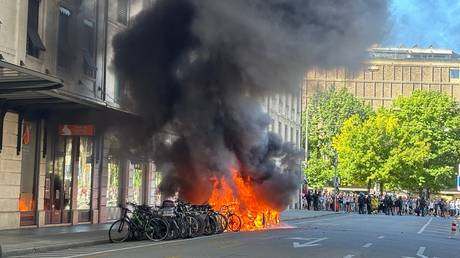
Mass demonstrations targeting multilateral summits are frequently covered through a purely narrative lens, focusing on the surface-level friction between state security and civilian dissidents. This approach obscures the underlying operational systems. The mobilization of an estimated 20,000 protesters in Geneva, Switzerland, on June 14, 2026—acting as a staging ground against the Group of Seven (G7) summit in nearby Évian-les-Bains, France—offers a clear study in irregular logistics, asymmetric tactics, and trans-border crowd dynamics.
To evaluate these events accurately, one must look past the ideological monoculture presented by organizer coalitions. Instead, the situation must be parsed into its functional components: the fragmentation of coalition objectives, the decentralized deployment model of the Black Bloc, and the tactical constraints dictating the state’s security apparatus.
The Asymmetric Friction Matrix
State security architectures and decentralized protest coalitions operate on fundamentally opposing operational models. When these models intersect within a high-density urban corridor, the resulting friction follows a predictable progression.
The structural dynamics of this confrontation can be mapped across three distinct phases of escalating intensity:
[Phase 1: Institutional Symmetrical Management]
  ├── State: Containment within permitted transit corridors, intelligence screening at border checkpoints
  └── Coalition: Structured negotiation with local magistrates, distribution of tactical handbooks
         │
         ▼
[Phase 2: Tactical Decoupling]
  ├── Shift: Deployment of low-signature Black Bloc cadres (approx. 600 actors) within the 20,000-person mass
  └── Action: Insertion of anonymous physical friction via high-velocity projectiles and structural sabotage
         │
         ▼
[Phase 3: Kinetic Rebalancing]
  └── State: Transition from passive spatial denial to kinetic dispersal (water cannons and tear gas)
1. The Coalition Integration Deficit
The "No G7" coalition in Geneva represents an agglomeration of more than 60 distinct unions, environmentalist organizations, feminist groups, and geopolitical advocacy factions. While logistically unified under an administrative umbrella to secure municipal marching permits, the coalition suffers from an integration deficit.
The front of the procession comprised non-violent advocates focused on systemic economic imbalances, climate policy, and labor equity. However, the administrative scaffolding of this large group inadvertently creates a shield for sub-state militant actors. Because large-scale civilian movements demand significant geographic space, they inherently restrict the line-of-sight and physical mobility of local law enforcement.
2. The Black Bloc Exploitation Vector
The presence of roughly 600 masked, black-clad militants—commonly categorized as Black Bloc actors—demonstrates a highly calculated operational strategy. The Black Bloc is not an organized group with a centralized command structure; it is a tactical doctrine centered on absolute anonymity, high mobility, and opportunistic property destruction.
By embedding directly within the deeper layers of a permitted 20,000-person march, these actors exploit a human buffer zone. They utilize a distinct sequence to maximize tactical impact while avoiding immediate neutralization:
- Anonymization Phase: Transitioning into identical black hoodies, masks, and protective goggles to eliminate individual visual signatures, rendering real-time biometric identification ineffective.
- Target Selection: Identifying high-value corporate or state symbols adjacent to the transit corridor, such as standard targets like financial institutions or modern high-value assets.
- Kinetic Execution: Executing rapid, localized property destruction—such as breaching the protective barriers of the Banque du Léman or using accelerants to incapacitate vehicles—before retreating back into the peaceful civilian mass.
This cycle shifts the tactical burden onto law enforcement. Police forces must either accept property damage or risk fracturing the peaceful demonstration via indiscriminate kinetic intervention.
The Infrastructure Target Selection Matrix
During the Geneva escalation, property damage was not random. Militants systematically bypassed localized small businesses and targeted institutions representing global financial integration (Banque du Léman) and corporate green technology (a Tesla vehicle positioned near a central transport artery). This indicates a highly specific ideological targeting matrix designed to yield maximum symbolic resonance for global media syndicates.
Quantification of Border Security Restraints
The geographic positioning of the G7 summit in Évian-les-Bains, directly across Lake Geneva from Switzerland, introduces a complex layer of trans-border security coordination. Because Switzerland is a member of the Schengen Area but maintains political sovereignty outside the European Union, cross-border policing requires strict administrative alignment.
The state response to this localized instability is governed by a strict resource allocation framework designed to minimize economic disruption while maximizing spatial control:
| Security Metric | Operational Volume | Strategic Objective |
|---|---|---|
| French Police & Gendarmes Deployment | 13,000 units | Perimeter isolation of the Évian-les-Bains summit zone |
| Swiss Army Personnel Activation | 4,000 units | Protection of critical civil infrastructure and UN sectors |
| French Border Control Surge | 800 active officers | Interdiction of high-risk foreign agitators at checkpoints |
| Border Crossing Suppression Rate | 80% (28 of 35 points closed) | Bottlenecking transit vectors to force predictable routing |
This massive security allocation creates structural bottlenecks. Closing 28 out of 35 regional roadway border crossings drastically reduces the throughput of goods and commuters, imposing an immediate economic tax on the local transit economy to safeguard the political elite.
The Limits of Kinetic Dispersal
When the Geneva Police deployed water cannons and CS tear gas, the tactical objective was not mass arrest, but spatial reclamation. Indiscriminate mass arrests in an urban center like Geneva present significant legal and logistical bottlenecks, overloading detention centers and violating strict European civil liberties frameworks.
Therefore, crowd control units rely on chemical irritants and high-pressure water streams to alter the physical environment. By lowering visibility and making specific geographic zones physically untenable, police force the crowd to segment into smaller, manageable groups.
The core limitation of this strategy is its displacement effect. Dispersing a militant cadre from a primary avenue does not neutralize their disruptive capability; it merely pushes them into secondary commercial or residential sectors, spreading the security footprint across a wider, less predictable urban grid.
Strategic Forecast and Operational Outlook
Looking forward, the tactical evolution observed in Geneva indicates a rising baseline of sophistication for future transnational protests. Activist networks are increasingly using open-source, encrypted handbooks that map municipal security zones and provide legal protocols for detention scenarios. This reduces the information asymmetry that law enforcement historically relied upon.
For municipal authorities and corporate enterprises situated near future geopolitical summits, standard defensive postures are no longer sufficient. Relying solely on temporary plywood barriers to protect storefronts yields low defensive utility against targeted Black Bloc tactics.
The structural recommendation for corporate asset protection requires moving away from reactive boarding and toward proactive, decentralized risk mitigation. This involves removing vehicles from predicted march routes, utilizing reinforced security glass, and temporarily shuttering physical branches to eliminate high-value targets during periods of acute civil unrest.
Ultimately, state security apparatuses will be forced to transition away from mass-force deployments toward high-precision, real-time tracking of militant nodes to prevent the strategic exploitation of peaceful civilian majorities.