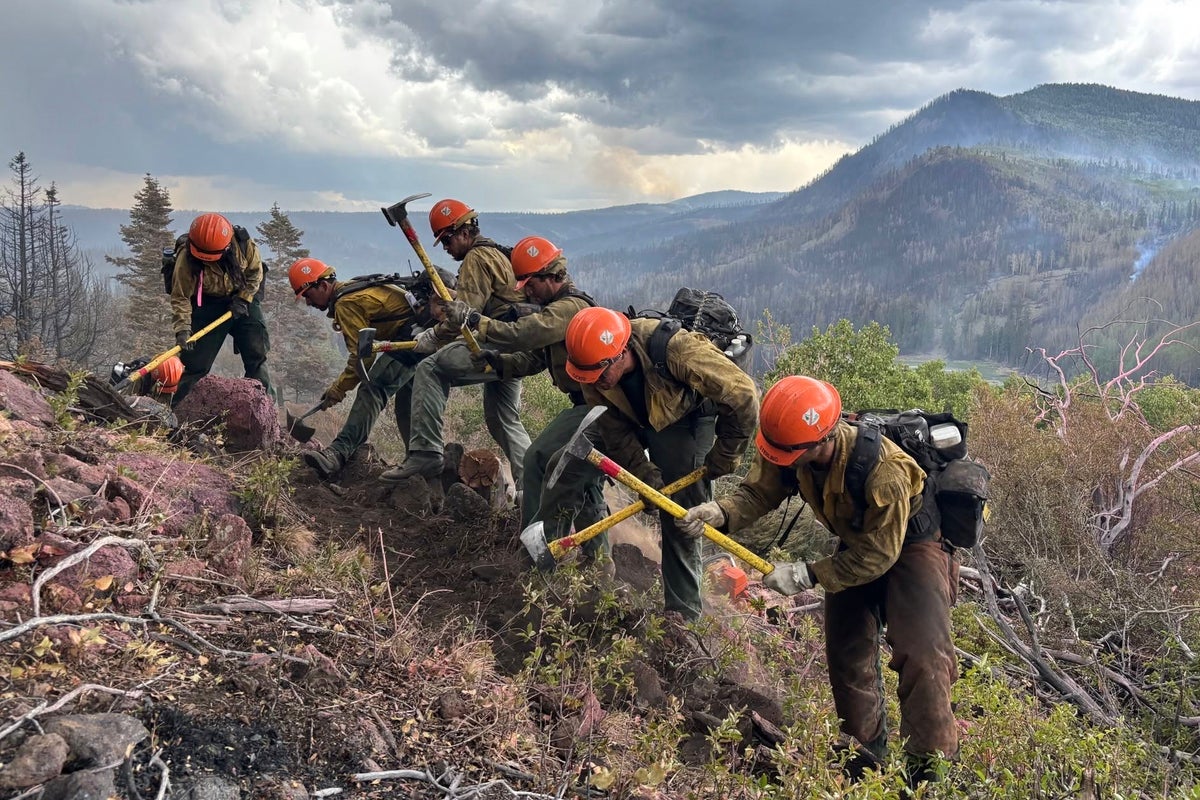
The declaration of a statewide emergency in Utah on June 25, 2026, exposes a critical failure framework in modern disaster management: the breakdown of historical predictive models under multi-variable environmental stress. When Governor Spencer Cox enacted an emergency executive order to strip local municipalities of fireworks autonomy and centralize authority under the state forester, the decision was driven not by political choice, but by a mathematically unsustainable collision of fuel dynamics, extreme atmospheric velocity, and completely exhausted response capacity.
The epicenter of this systemic stress is the Cottonwood Fire near Beaver, Utah, which expanded to over 112 square miles within four days of its June 22 ignition. Operating at 0% containment, the fire represents the largest active blaze in the United States, inflicting severe structural damage on critical infrastructure, including the Eagle Point ski resort, and forcing the total evacuation of rural communities. The crisis is not merely an isolated geographic event; it serves as an empirical case study in how concurrent compounding factors create a regional containment bottleneck.
The Fire Behavior Formula: Breaking Down the Volatility
Traditional wildland firefighting relies on predictable flame lengths and rate of spread vectors. The conditions observed in late June 2026 defy these historical baselines due to three interconnected physical inputs.
1. The Fuel Load Paradox
Utah’s previous winter season left deep fuel reserves that, under prolonged drought conditions and a compounding June heatwave, reached critical moisture depletion thresholds. When live and dead fuel moisture content drops below 5%, the vegetation transitions from a carbon sink into a volatile accelerant.
2. High-Velocity Atmospheric Driving Forces
On June 26, the National Weather Service in Salt Lake City issued the first "Particularly Dangerous Situation" (PDS) Red Flag Warning in its history. This metric, traditionally reserved for high-probability tornado environments, was triggered by sustained winds of 35 miles per hour coupled with localized gusts exceeding 45 miles per hour. Wind speeds of this magnitude alter fire topology through two distinct mechanisms:
- Crown Running: The transition of flames from surface fuels (grass and brush) into the upper canopy of forested areas. Canopy fires generate independent thermal dynamics, rendering ground-based cutting lines obsolete.
- Spotting: High winds loft burning embers up to a mile ahead of the main fire front, bypassing established containment lines and igniting secondary blazes. This renders standard forward-line defensive positioning highly dangerous for ground crews.
3. Thermal Microclimates
The scale of the Cottonwood Fire allows it to create localized weather patterns. Massive smoke columns generate pyrocumulus cloud formations, which induce erratic downbursts, shifting wind directions rapidly and unpredictably, trapping personnel and asset deployments.
The Operational Bottleneck and Supply-Side Failures
The strategic rationale behind the Governor's emergency declaration lies directly in supply-side constraints of emergency resources. In wildland firefighting, resource allocation is managed via tiered Incident Management Teams (IMTs) and the National Interagency Coordination Center. The system breaks down when multiple large-scale ignitions occur simultaneously within the same geographic basin.
Utah faced nine active large-scale wildfires simultaneously, burning across more than 143,000 acres. This includes the Iron Fire southwest of Salt Lake City, which forced the evacuation of Eureka, and the Wild Goose Fire near Holden.
[Simultaneous Ignitions (9 Active Fires)]
                    │
                    ▼
[Resource Saturation (Personnel/Equipment Exhaustion)]
                    │
                    ▼
[Grounding of Aerial Support (Sustained >35mph Winds)]
                    │
                    ▼
[Total Containment Failure (0% Cottonwood Containment)]
This operational gridlock is exacerbated by mechanical limitations. High-velocity winds do not merely accelerate flame spread; they mechanically ground aerial suppression assets. Fixed-wing air tankers and Type 1 heavy helicopters cannot safely drop fire retardant slurry or water when wind gusts exceed 40 miles per hour, as the wind disperses the droplets before they hit the canopy, rendering the deployment ineffective and risking airframe structural failure.
Consequently, when aerial support is grounded, the burden falls entirely on ground crews operating Type 1 engines and handline cutting operations. Because the human element is finite, regional dispatch centers hit absolute capacity. Governor Cox noted that if additional ignitions occurred within the Salt Lake Valley during early July, the state would possess zero uncommitted units to dispatch, risking unmitigated urban-interface destruction.
Regulatory Centralization and Risk Mitigation Engineering
The legal mechanism deployed under the state of emergency explicitly targets the primary point of failure within human control: ignition prevention. State wildfire data indicates that out of 376 recorded wildfire ignitions in Utah during the 2026 season, 273 were directly human-caused. This represents a 72.6% human-ignition index.
The executive order temporarily suspends a statutory law enacted in 2024 that prevented the state forester from overriding local municipal ordinances regarding pyrotechnics. This systemic adjustment alters the state's risk mitigation framework through tactical centralized governance:
- Statewide Centralization of Prohibitions: The state forester now holds universal jurisdiction to ban personal fireworks through July 5, removing the regulatory fragmentation where one municipality enforced a ban while an adjacent town permitted sales.
- Localized Safe-Zone Exceptions: To balance economic and cultural pressures, local fire chiefs retain the authority to carve out precise, high-density urban zones where fireworks may be discharged, provided they are geographically isolated from wildland-urban interfaces (WUI) and backed by on-site suppression assets.
- Infrastructure De-energization: To prevent mechanical sparks from grid infrastructure during high-wind events, utility providers like Rocky Mountain Power implemented Public Safety Power Shut-offs (PSPS) across central, eastern, and southern Utah. While effective at dropping ignition risk to zero along transmission corridors, PSPS grids introduce secondary liabilities, including disabling local culinary water pumps and knocking out emergency communication arrays.
Strategic Structural Weaknesses in Current Modeling
The primary limitation of the current emergency response is its structural reliance on retrofitted historical baselines. Standard fire behavior models, such as the Rothermel surface fire spread model, assume predictable fuel continuity and steady-state wind inputs. These equations fail when applied to modern megachamber environments where crown runs and multi-directional spotting dominate the landscape.
Furthermore, decentralized municipal expansion into the wildland-urban interface creates an immediate tactical deficit. When a fire threatens a community like Marysvale or Eagle Point, incident commanders are forced to reallocate scarce resources away from perimeter containment to execute defensive structure protection and civilian evacuation management. This structural pivot guarantees that the macro-containment percentage remains at zero for prolonged periods.
The Real-Time Tactical Playbook
Incident commanders must immediately abandon standard frontal containment paradigms and transition to an asymmetric defensive posture. First, teams must establish deep, mechanized secondary contingency lines using heavy bulldozers outside the active spotting radius, using natural geographic barriers like the Interstate 15 corridor or barren ridge lines rather than chasing the active perimeter.
Second, utility providers must maintain absolute enforcement of Public Safety Power Shut-offs through the duration of any PDS Red Flag window, prioritizing grid de-energization over economic continuity until sustained wind vectors drop below 25 miles per hour. Finally, the state forester must extend the fireworks prohibition mandate through the July 24 Pioneer Day holiday window without waiting for post-July 5 evaluations, as the underlying fuel moisture deficit cannot be mathematically remediated by mid-July weather projections.