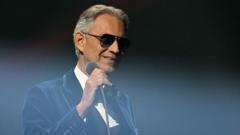
Italian tenor Andrea Bocelli will perform his first-ever headline concert in Wales on May 8, 2027, anchoring the inaugural Land of Song Festival at Cardiff's Principality Stadium.
For a nation that aggressively markets itself as the historic "land of song," the mathematical reality of classical booking omissions is stark. It has been more than two decades since Bocelli last sang in the Welsh capital. Local promoters have spent years trying to bridge that gap. When tickets go on sale for this fully seated indoor stadium spectacle, they will test whether a country renowned for its grassroots choral identity will shell out major-market arena prices for a global crossover icon.
Anatomy of a Twenty-Year Drought
The classical music touring circuit operates on strict demographic predictability. Promoters look at disposable income, venue infrastructure, and historical ticket yields. Cardiff possesses a world-class indoor arena in the Principality Stadium, complete with a retractable roof that effectively neutralizes British weather patterns and transforms a drafty rugby ground into an acoustically contained auditorium.
Yet, major international classical headliners routinely bypass Wales in favor of London, Manchester, or Edinburgh loops. Logistics play a part, but economics dominate. Operating a massive touring entourage alongside a full symphonic backing crew requires guaranteed sell-out margins. Bocelli's absence from Welsh stages since 2005 was not born of malice or oversight; it reflected a conservative booking strategy that viewed Welsh audiences as a regional extension of English tour legs rather than a standalone market worth targeted investment.
The 2027 booking shatters that precedent. By pairing Bocelli with the Orchestra of Welsh National Opera and a massive regional choir, the event organizers are anchoring the Italian tenor's global commercial appeal directly into local institutional pride.
The Institutional Architecture Behind the Stage
Mega-concerts do not materialize out of thin air. They are engineered by commercial incentives and institutional alignments. The Land of Song Festival is not merely a single-night booking; it is a biennial concept designed to institutionalize Cardiff as an international vocal capital.
The structural backbone of this festival relies on a calculated two-day programming rhythm. Saturday belongs to Bocelli, pulling in international tourists, high-net-worth classical consumers, and casual fans drawn to hits from his landmark album Romanza. Sunday pivots sharply to community participation through the return of the Côr World Choir, pulling more than 20,000 choristers into a massed vocal gathering.
This juxtaposition reveals the underlying commercial strategy. Solo ticket sales for a classical megastar subsidize a massive participatory cultural event, while the participatory event guarantees local buy-in, municipal backing, and saturated regional media coverage. It is a symbiotic financial model that mitigates promoter risk by diversifying revenue streams across elite ticket tiers and grassroots community registrations.
The Acoustics Challenge of Stadium Opera
Putting a classical voice inside a 70,000-seat rugby stadium is an acoustic tightrope walk. Traditional opera houses rely on natural architectural resonance to carry unamplified or lightly reinforced vocals over an orchestra. Stadiums swallow sound.
To overcome this, the production relies heavily on the Principality Stadium's closed-roof configuration, combined with state-of-the-art distributed sound reinforcement arrays designed to preserve the dynamic range of Bocelli's tenor without turning the performance into an open-air rock concert. Audiences paying premium rates expect the warmth of a recital hall coupled with the scale of a global event. Sound engineers face the immense pressure of balancing the Orchestra of Welsh National Opera against modern digital delay towers so that fans in the upper tiers experience crisp articulation rather than muddy reverberation.
Furthermore, Bocelli’s setlist carries its own historical weight. With the performance arriving on the heels of ongoing international dates celebrating the enduring legacy of his 1997 breakout record Romanza, the artist is leaning into nostalgia. Nostalgia is a powerful currency in the post-pandemic live entertainment economy, but it demands technical perfection to satisfy purists who remember his vocal peak from decades past.
The Broader Cultural Gamble
The success of this venture will dictate whether Wales can sustain a high-end biennial music festival capable of competing with established European classical gatherings. For years, critics have argued that Welsh cultural policy spends too much energy looking backward at traditional male voice choirs and too little on capturing high-value contemporary cultural tourism.
By fusing a world-famous crossover artist with a massive grassroots choral gathering, the Land of Song Festival attempts to prove that heritage and commercial spectacle can coexist. If the tickets move swiftly this week, it will signal to international booking agents that Welsh audiences are ready to command global attention on their own terms. If it falters, it will expose the financial ceiling of regional classical markets in an era of soaring ticket inflation.
The microphone is finally moving to Cardiff. The rest depends on whether the box office can match the rhetoric of the land of song.