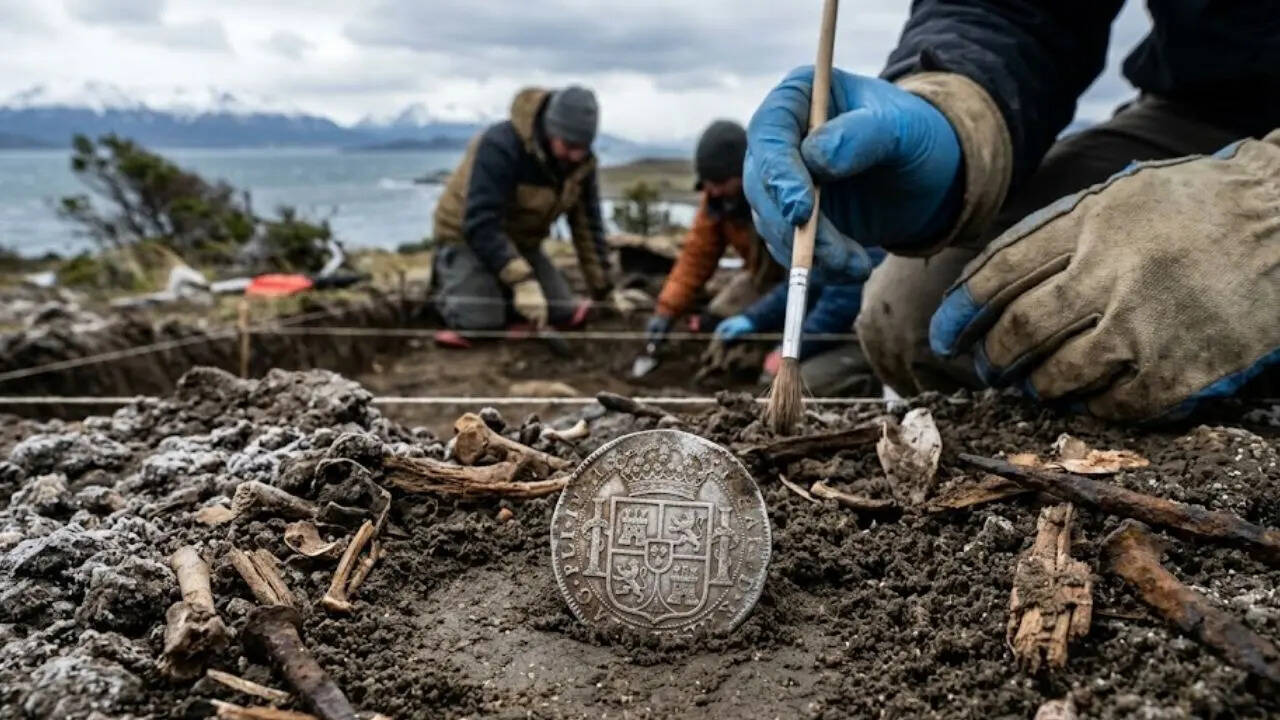
The 1584 failure of Rey Don Felipe, a Spanish settlement in the Strait of Magellan, was not a singular event of misfortune but a systemic collapse of supply-chain logistics and environmental adaptation. Historically labeled "Puerto del Hambre" (Port Famine), the colony's demise has long been attributed to a vague combination of isolation and starvation. However, the recent recovery of a mid-sixteenth-century Spanish coin—a silver real minted in Potosí—provides a quantitative pivot point for re-evaluating the site’s failure. This artifact serves as a proxy for the colony’s initial economic capitalization and its eventual transition into a closed-loop system of diminishing returns.
The Strategic Imperative of the Strait of Magellan
Spanish expansion in the late 16th century was driven by a geopolitical necessity to secure the "South Sea" (Pacific Ocean) against English privateering. Following Francis Drake’s 1578 circumnavigation, the Spanish Crown identified the Strait of Magellan as the sole choke point capable of being militarized to protect the silver flow from Peru. The colonization of this region was an attempt at defensive infrastructure, not agricultural expansion.
The mission, led by Pedro Sarmiento de Gamboa, relied on a high-risk logistical model. It required the simultaneous coordination of:
- Naval Superiority: Sustaining a fleet capable of navigating the most volatile maritime corridor on the planet.
- Resource Inversion: Transporting every calorie of food and every unit of building material to a subantarctic environment that lacked indigenous agriculture.
- Personnel Retention: Maintaining discipline among soldiers and settlers in a high-attrition climate where the mortality rate exceeded replenishment capabilities.
Forensic Analysis of the Potosí Real
The discovery of the 440-year-old coin at the site of Rey Don Felipe provides empirical evidence of the colony's specific timeline and its link to the Potosí mint. Potosí, located in modern-day Bolivia, was the engine of the Spanish Empire’s monetary system. The presence of this coin confirms that the settlers were equipped with the standard currency of the Viceroyalty of Peru, intended to facilitate internal trade and wage payment within the new settlement.
In a functional colony, currency circulates to stimulate local economies. At Rey Don Felipe, the coin became a stranded asset. Because there was no local market, no indigenous trade network willing to accept Spanish silver for food, and no returning supply ships, the real transitioned from a medium of exchange to a piece of useless metal. This reflects a fundamental failure in Resource Elasticity. The Spanish arrived with financial capital but lacked the "biological capital"—the seeds, livestock, and environmental knowledge—required to survive in a region with a growing season of near-zero duration.
The Three Pillars of Colonial Attrition
To understand why the colony collapsed while others succeeded, we must analyze the specific variables that created a terminal feedback loop.
1. The Logistical Latency Gap
The distance between the Strait of Magellan and the nearest supply hubs in Chile or the Río de la Plata created a massive latency gap. A request for supplies sent in year one might not be fulfilled until year three, assuming the dispatch vessel survived the voyage. This created a "Just-in-Time" supply chain with a lead time that exceeded the shelf life of the colony’s stored provisions.
2. Metabolic Deficit
Surviving in the subantarctic requires a high caloric intake to maintain thermoregulation. The settlers' diet, primarily based on hardtack and salted meat brought from Europe, was insufficient. When these stores failed, the settlers attempted to forage for shellfish and wild celery. The energy expenditure required to forage in freezing temperatures and high winds often exceeded the caloric value of the food recovered. This created a Negative Metabolic ROI, where the act of searching for food accelerated the onset of starvation.
3. Thermal and Structural Degradation
The Spanish built Rey Don Felipe using Mediterranean construction logic, which was ill-suited for the relentless wind and moisture of the Strait. Without constant maintenance—impossible for a starving population—the structures provided declining protection against the elements. Chronic hypothermia leads to cognitive decline and loss of motor skills, further reducing the colony's ability to repair its defenses or procure food.
Technological Limitations in 16th-Century Navigation
The failure was compounded by the inability to accurately measure longitude, a technical bottleneck that made returning to the exact coordinates of the colony nearly impossible for relief ships. While latitude could be determined via the astrolabe or quadrant, the lack of chronometers meant that supply ships often overshot or undershot the entrance to the Strait.
The recovery of the coin via modern archaeological methods—including ground-penetrating radar and precision metal detection—allows for a spatial mapping of the colony that contradicts earlier, more chaotic descriptions of the site. The artifacts are found in structured clusters, suggesting that even as they died, the settlers maintained a rigid military hierarchy. This adherence to social structure in the face of biological collapse highlights the psychological rigidity of the Spanish colonial model.
The Archaeological Blueprint of Failure
Modern excavations have revealed that the "mystery" of the colony was never about where they went, but how they died. They didn't vanish into the wilderness or integrate with local populations; they stayed at their posts until the end. The distribution of skeletal remains and artifacts suggests a managed decline.
The coin discovery is significant because it allows us to calculate the Decay Rate of Utility.
- Month 1: The coin represents purchasing power and status.
- Month 12: The coin represents a hope for the arrival of a merchant vessel.
- Month 24: The coin is an inert object, its value supplanted by the value of a single dry match or a handful of grain.
This transition from a monetary economy to a primitive survival economy is the hallmark of colonial failure in extreme environments.
Comparative Analysis with Contemporary Settlements
Comparing Rey Don Felipe to the successful Spanish settlement at San Agustín (Florida) or the Portuguese outposts in the Azores reveals the critical differentiator: Interconnectivity. Successful colonies were nodes in a network. Rey Don Felipe was an island in a sea of geographic isolation.
The Spanish Crown’s mistake was treating the Strait of Magellan as a static fortification rather than a dynamic ecological challenge. They applied a 1D solution (a fort) to a 3D problem (sustenance, climate, and distance). The Potosí real is the physical evidence of this misplaced confidence. It was the "cutting-edge" financial technology of 1584, and it was entirely worthless in the face of a subantarctic winter.
Structural Bottlenecks in the Colonial Model
The collapse was also accelerated by the Spanish "Encomienda" mindset. The settlers expected to find or coerce a labor force to produce food. When they encountered the nomadic Kawésqar and Aonikenk peoples, who had no surplus food to be seized and no interest in silver, the Spanish economic model broke. They could not pivot to self-sufficiency because their organizational DNA was predicated on the extraction of value, not the creation of it from a harsh environment.
This lack of Adaptive Capacity is why the discovery of a single coin is more than a curiosity. It is a data point proving that the settlers were prepared for a world of commerce that did not exist at the tip of South America.
Strategic Archeological Forecasting
To prevent similar failures in modern high-stakes environments—such as isolated research stations or future space colonization—we must look at the Rey Don Felipe data as a cautionary framework. The "Silver Real Fallacy" is the belief that high-value assets or superior technology can compensate for a broken logistical tail.
Future excavations at the site should prioritize the recovery of organic residues over metal artifacts. While the coin provides the date, the isotopes in the soil and the wear patterns on discarded tools will provide the "How." Analyzing the transition from manufactured European tools to improvised local materials will quantify the exact moment the colony's supply line was officially severed.
The tactical move for historians and archaeologists now is to stop treating "Puerto del Hambre" as a tale of tragedy and start treating it as a study in Systemic Fragility. Every artifact recovered is a variable in an equation that explains how the most powerful empire on Earth failed to secure a 30-mile stretch of water.
Investment must shift toward high-resolution mapping of the surrounding coastline to identify the "Foraging Radius" the settlers were restricted to. By determining the maximum distance a starving human could travel from the fort and return, we can define the precise geographic boundaries of their death trap. This spatial data, combined with the presence of high-value currency, completes the profile of a settlement that was financially rich but biologically bankrupt.



