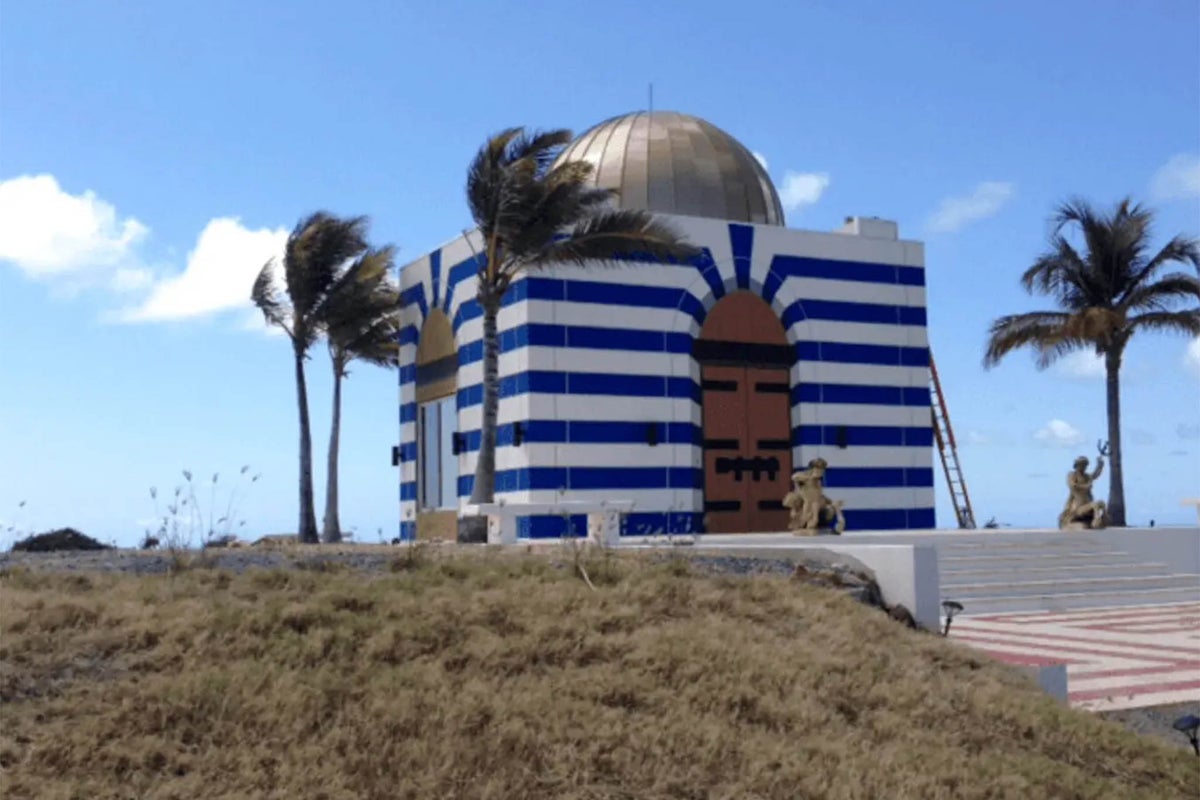
The construction of the blue-and-gold structure on Little St. James serves as a primary case study in the use of architectural semiotics to mask functional intent. While media narratives focus on the aesthetic "unusualness" of the building, a structural analysis reveals a deliberate synthesis of cultural misappropriation, high-security engineering, and psychological signaling. The procurement of sacred or highly regulated materials from religious epicenters like Mecca is not a matter of spiritual devotion but a calculated acquisition of status symbols designed to project a specific form of untouchable global authority.
The Triad of Institutional Insulation
The presence of a "mosque-like" structure in a non-Islamic context, built by an individual with no known religious ties to the faith, suggests three distinct operational objectives: Also making waves recently: The Empty Pavements of Red Square.
- Diplomatic and Cultural Camouflage: By integrating specific religious iconography—minarets, domes, and imported sacred motifs—the property owner creates a layer of "sensitivity" around the site. This complicates standard law enforcement or journalistic scrutiny, as critiques or investigations can be framed as culturally insensitive or religiously biased.
- The Signal of Global Reach: Procuring authentic items from Mecca requires high-level logistical clearance and deep institutional connections within Saudi Arabia. The utility of these items is found in their provenance. They serve as "proof of access," signaling to visitors that the owner operates outside the constraints of standard international trade and religious boundaries.
- Architectural Misdirection: The building's exterior design—vibrant blue walls and a gold dome—diverges sharply from the surrounding Caribbean vernacular. This visual "loudness" acts as a cognitive decoy. While public attention fixates on the strange aesthetics of the "temple," the actual functional infrastructure (underground cabling, reinforced foundations, and secure communication nodes) remains unexamined.
The Logistics of Sacred Procurement
The acquisition of sacred items from restricted zones like Mecca follows a specific cost function that exceeds mere financial transaction. Because the sale of certain religious artifacts is prohibited or strictly regulated by the Saudi Ministry of Hajj and Umrah, the presence of such items on a private island in the U.S. Virgin Islands implies a breakdown in standard regulatory oversight.
This procurement process likely bypassed traditional auction houses, utilizing a "gray market" of cultural exchange where political favors are traded for tangible heritage. The mechanism here is influence arbitrage. The owner leverages relationships with high-net-worth individuals or state actors to obtain items that are "not for sale," thereby inflating their own perceived value within their social ecosystem. Additional details on this are explored by Reuters.
Structural Deviations and Functional Reality
Traditional mosques are defined by specific orientations (Qibla) and internal requirements (Mihrab, Minbar). The structure on Little St. James lacks the fundamental internal configuration required for Islamic worship, confirming its status as a facade.
The Security-First Design Philosophy
When analyzing the building through the lens of a security consultant, the "unusual" features become logical:
- Elevated Foundations: The structure sits on a reinforced plinth. This is common in high-security coastal installations to prevent flooding but also provides a crawl space or basement tier for concealed hardware.
- The Reinforced Door: Early photographic evidence showed a heavy, reinforced door with a large lock mechanism on the outside. In religious architecture, doors symbolize welcome; in private security, they symbolize containment or exclusion. This inversion of purpose suggests the building functioned as a secure server room, a vault, or a sound-proofed environment.
- Acoustic Isolation: The thick masonry and domed roof provide natural acoustic damping and echo control. For an individual concerned with surveillance, a standalone structure with no windows (as originally constructed) offers the ultimate "SCIF" (Sensitive Compartmented Information Facility) environment.
The Mechanism of Narrative Shielding
The "temple" or "mosque" label is a linguistic trap. By allowing the public to define the building through religious terms, the owner successfully diverted the conversation from utility to eccentricity.
In corporate strategy, this is known as "The Eccentricity Hedge." When an actor's behavior is categorized as "weird" or "idiosyncratic," observers stop looking for logical, profit-driven, or nefarious motives. They attribute the behavior to personal whim rather than operational necessity. However, the rigor of the construction—the use of heavy machinery, the importation of specific stones, and the high-grade electrical work—indicates a project with a defined ROI (Return on Investment), likely in the form of secure information storage or private meeting space.
Geopolitical Proximity and the Saudi Link
The specific choice of Meccan artifacts suggests a deliberate alignment with the Saudi power structure. During the late 1990s and early 2000s, the intersection of private intelligence, global finance, and Middle Eastern sovereign wealth created a vacuum where individuals like Epstein could act as intermediaries.
The artifacts functioned as social currency. In the high-stakes environment of global power-brokering, possessing something that cannot be bought—only gifted or permitted—is the ultimate marker of "insider" status. This creates a feedback loop: the artifacts attract high-level visitors, and the presence of those visitors further validates the artifacts' "sacred" status, regardless of their actual religious utility.
Quantifying the Anomaly
If we evaluate the building against a standard "Private Island Amenity Matrix," it fails every metric of leisure:
- Ventilation: The lack of windows in a tropical climate makes it uninhabitable for standard social gatherings without massive HVAC investment.
- Accessibility: The isolated positioning on the island's higher ground suggests a need for line-of-sight communication or a desire for visual dominance over the docks.
- Square Footage vs. Cost: The cost-per-square-foot for importing specialized religious motifs to a remote island is exponentially higher than building a standard luxury villa. This "premium for anomaly" is only paid when the anomaly itself provides a strategic advantage.
The Strategic Shift: From Aesthetics to Evidence
The removal of the dome and the subsequent modifications to the building following increased public scrutiny represent a "scrubbing" phase. In data-driven investigations, the modification of a structure is often more telling than its initial state. The transition from a highly visible "temple" to a more muted, functional-looking building suggests a pivot from projection (showing off power) to protection (minimizing legal exposure).
The artifacts from Mecca, if still present, represent a significant legal and diplomatic liability. They are "loud" evidence of non-standard international relations.
Investigative priority must shift from the aesthetic "why" to the logistical "how." Mapping the shipping manifests and the specific contractors involved in the "temple" construction would likely reveal a network of specialized firms accustomed to building secure, off-the-grid infrastructure for state actors. The building was never a mosque; it was an architectural performance of immunity, designed to signal to the world that the rules of borders, religion, and law did not apply within the perimeter of Little St. James.
The final strategic move for any entity investigating this site is to treat the building as an industrial asset rather than a cultural artifact. By stripping away the religious veneer, the structure is revealed for what it likely was: a hardened node in a private intelligence network, disguised as the whim of a billionaire.



