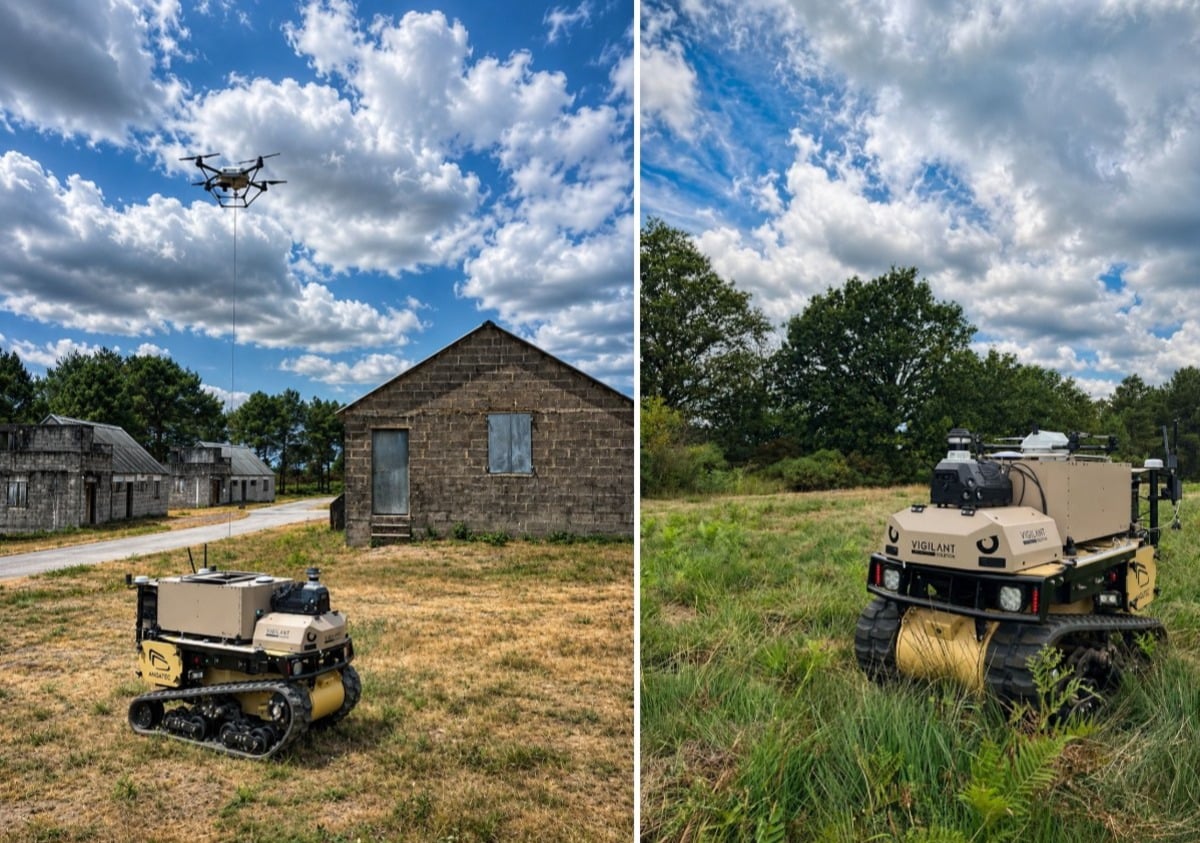
The physical limitations of human endurance, sensory processing, and survivability dictate the tactical boundaries of modern land warfare. In high-intensity conflicts, the traditional 120-soldier infantry company or cavalry squadron faces immediate saturation from precision artillery, electronic warfare, and first-person-view (FPV) loitering munitions. To mitigate this vulnerability, France has initiated Project Pendragon—managed by the Artificial Intelligence in Defense agency (AMIAD) and the Future Combat Command (CCF)—with the objective of fielding an experimental robotic combat unit (Unités de Combat Robotisées or UCR) by the summer of 2027.
The underlying thesis of Project Pendragon is an optimization problem: can a force replace 85% of its human manpower with distributed hardware while maintaining or exceeding the kinetic and reconnaissance capabilities of a legacy unit? The design parameter shifts the operational footprint from a standard 130-man company down to approximately 15 human operators commanding 10 wheeled or tracked ground-based robotic platforms and 60 aerial drones. This restructuring attempts to rewrite the cost function of battlefield casualties, replacing human attrition with industrial asset depreciation. Recently making headlines lately: The Economics of Net Based Rocket Recovery Demystifying Chinas Orbital Reusability Threshold.
The Three Pillars of Unmanned Tactical Command
Executing this operational shift requires solving fundamental engineering and command bottlenecks. The French military structure relies on three distinct technical pillars to move automated assets out of isolated technology demonstrations into integrated, collaborative combat units.
The Command and Control Network Architecture
The primary structural vulnerability of deploying 70 independent unmanned systems is cognitive overload. A human operator cannot manually pilot multiple assets simultaneously while assessing tactical threats. The Pendragon C2 platform utilizes machine-learning models to abstract individual platform mechanics away from the human loop. Operators do not input steering commands; they assign high-level objective parameters—such as establishing a reconnaissance perimeter or holding a specific geographic choke point. The C2 engine dynamically calculates pathfinding, assigns specific tasks to available assets, and arbitrates data streams to present a unified situational map. More insights on this are detailed by Engadget.
Cross-Domain Sensor Integration
Ground-based robotic platforms suffer from inherently restricted sensory horizons due to terrain contouring, vegetation, and urban obstacles. Project Pendragon solves this topological limitation through explicit cross-domain data pairing. The 60 aerial drones function as elevated sensory nodes, performing continuous top-down mapping and target identification. These aerial streams are processed and cross-referenced with the internal sensors (LiDAR and optical systems) of the 2-to-3-ton ground robots. The result is a dynamic three-dimensional vector map that allows ground platforms to calculate obstacle-avoidance vectors and intercept trajectories behind cover, neutralizing the line-of-sight disadvantage of ground-only robotics.
Logistical Resiliency via Hybrid Powertrains
Battery chemistry remains a bottleneck for multi-ton autonomous ground vehicles requiring extended operational range. To achieve necessary combat endurance, the ground platforms in the Pendragon trial utilize internal combustion engines or hybrid powertrains. This choice directly minimizes the mean time to repair (MTTR) and refueling cycle durations. While an all-electric platform demands hours of charging infrastructure or complex battery-swapping mechanisms under fire, a liquid-fuel architecture integrates directly into existing military supply lines, maintaining compatibility with forward-deployed fuel assets.
The Mathematics of Force Multiplication
The financial and operational metrics of the UCR prototype illustrate the structural trade-offs of modern defense procurement. France projects the unit cost of a single integrated Pendragon combat block at approximately €10 million.
[Traditional Infantry Company]         [Pendragon UCR Block]
   - Personnel: 120-130 troops           - Personnel: 15 troops
   - High human exposure risk            - High hardware exposure risk
   - Legacy armored transport            - 10 Ground Robots + 60 Drones
   - Saturated cognitive loop            - AI-mediated C2 abstraction
When evaluated against the lifetime cost of training, equipping, armored transport provision, and medical provisioning for a 130-soldier legacy unit, the hardware-dense model shifts capital expenditures from variable labor costs to fixed technology costs.
The primary operational constraint is bandwidth and electromagnetic spectrum availability. A system reliant on a centralized AI-driven C2 architecture requires a constant, low-latency data exchange between the rear command post, the aerial swarm, and the ground effectors. This dependence creates a single point of failure: electronic warfare (EW). If an adversary introduces dense, localized radio-frequency jamming, the distributed ecosystem runs the risk of degrading into isolated hardware nodes unable to coordinate kinetic or reconnaissance actions.
To counter this, French developers are designing the systems around relative autonomy. The ground assets must possess sufficient edge-computing capabilities to execute localized algorithms—such as autonomous mapping, route retracing, and infantry-following protocols—even when completely severed from the broader C2 network.
Structural Vulnerabilities and Kinetic Limitations
While Project Pendragon addresses human survivability, deploying autonomous systems into active combat environments introduces non-trivial technical challenges that legacy military doctrines are poorly equipped to handle.
- Terrain Negotiation Failures: Unlike aerial drones, ground platforms weighing 2 to 3 tons must continuously interact with chaotic physical surfaces. Mud, loose gravel, anti-tank ditches, and urban rubble can easily high-center or immobilize wheeled or tracked configurations. A disabled robot requires either recovery by human personnel—negating the goal of keeping troops out of danger—or remote explosive self-destruction, which accelerates asset depreciation.
- The Latency of Human-in-the-Loop Lethality: French military doctrine explicitly mandates that the decision to employ lethal force remains strictly under human control. Under the Pendragon framework, ground platforms may carry machine guns or remotely controlled munitions containers, but they cannot independently pull the trigger. In a fast-moving engagement where an enemy asset exposes itself for only fractions of a second, the latency introduced by transmitting telemetry data to a rear human operator, awaiting cognitive processing, and transmitting the fire command back to the platform can create a critical tactical bottleneck.
- Sovereign Supply Chain Fragility: The integration of advanced AI chips, LiDAR sensors, optical tracking systems, and high-frequency communication arrays exposes the program to component scarcity. Unlike standard steel armor plates, the electronics required for algorithmic combat units rely on specialized semiconductor foundries. This dependency informs France’s emphasis on a sovereign national pathway under initiatives like Artemis IA, aiming to reduce exposure to external geopolitical supply shocks.
Strategic Deployment Blueprint
The operational integration of these platforms will not occur as an immediate, wholesale replacement of standard forces. Instead, transition parameters dictate a phased deployment model.
The immediate tactical play for the 2027 experimental unit lies in low-complexity, high-risk operational profiles: localized area denial, perimeter surveillance, and forward scouting along high-threat axes. By assigning the UCR block to map enemy firing positions and draw initial kinetic strikes, commanders can systematically preserve the organic combat power of human-staffed legacy units positioned in secondary echelons. Defense planners must prioritize hardening the local mesh network variants connecting the drones and ground assets, ensuring that localized algorithmic coordination can persist even within a completely contested electromagnetic environment.