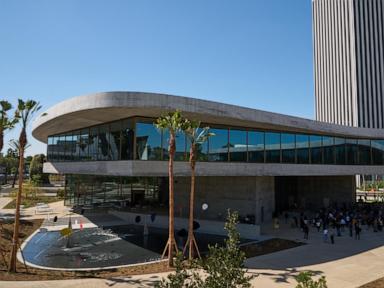
The David Geffen Galleries at the Los Angeles County Museum of Art (LACMA) represent a fundamental departure from the traditional encyclopedic museum model, shifting from a hierarchical, chronological structure to a horizontal, non-linear system of cultural display. Designed by Peter Zumthor, the $715 million project replaces four legacy buildings with a single, elevated 347,500-square-foot concrete structure that spans Wilshire Boulevard. This architectural intervention is not merely a replacement of square footage but a radical re-engineering of the "museum as a machine of discovery," prioritizing spatial democratization over departmental silos.
The core thesis of the Geffen Galleries rests on the elimination of the "back of house" aesthetic and the decentralization of history. By lifting the primary exhibition floor thirty feet above the ground on eight concrete "feet" or pavilions, the design forces a physical and conceptual transparency. The traditional museum "black box" is replaced by a glass-walled perimeter, subjecting the art to the external environment of the city and subjecting the city to the internal logic of the institution.
The Three Pillars of Spatial Reorganization
The Geffen Galleries operate through three distinct structural mechanisms that redefine how a visitor interacts with a permanent collection.
1. The Horizontal Plane and Non-Hierarchical Mapping
Traditional museums utilize a "tree structure" where visitors move through a trunk (main lobby) into various branches (European Art, Islamic Art, Modern Art). The Geffen Galleries utilize a "rhizomatic" model. The single exhibition level removes the vertical hierarchy associated with prestige—where, in older models, the "Great Masters" might occupy the grandest second-floor galleries while contemporary or regional works are relegated to the basement or periphery.
In this horizontal plane, every culture and era occupies the same atmospheric volume. The cause-and-effect relationship here is clear: the architecture dictates a "cross-pollination" of viewing. A visitor walking from a gallery of 18th-century French painting may immediately encounter pre-Columbian ceramics without passing through a transitional lobby. This forces a comparative analysis rather than a sequestered one.
2. The Perimeter Circulation and the "Kitchen Cabinet" Model
The building's floor plan features a continuous glass-walled corridor that wraps around the entire structure. Zumthor utilizes this perimeter as the primary circulation vein. Unlike the Guggenheim’s spiral or the Louvre’s enfilade, the LACMA design allows for "entry points" at various intervals.
The interior is divided into three types of gallery spaces:
- The Outer Circle: Glass-walled galleries exposed to natural light, intended for light-insensitive works (sculpture, ceramics).
- The Inner Core: Protected, climate-controlled "dark zones" for sensitive materials (textiles, works on paper).
- The Mezzanines: Smaller, intimate spaces tucked within the larger structural volumes.
This creates a "Cost Function of Engagement." The museum trades the total quantity of wall space—of which there is roughly 10% less than in the previous buildings—for the quality of light and the removal of "museum fatigue." By constantly re-orienting the visitor toward the outdoors, the building prevents the psychological claustrophobia common in massive cultural institutions.
3. The Urban Span as Institutional Branding
The decision to bridge Wilshire Boulevard is an act of civic engineering disguised as architecture. By physically straddling a major arterial road, the museum converts the "drive-by" experience into a curated viewing experience. The underbelly of the building creates a new public plaza, effectively turning the ground level into a shaded, open-air lobby that is accessible without a ticket. This maximizes the museum's "Footfall Conversion Rate," attracting local residents into the sphere of the institution even if they never pay for an exhibition.
The Technical Reality of Curatorial Compression
While the "machine of discovery" narrative focuses on the visitor experience, the operational reality is one of extreme curatorial compression. The transition from 390,000 square feet of legacy space to 347,500 square feet in the new building creates a functional bottleneck that forces a re-evaluation of the museum's 150,000-object permanent collection.
The Conservation Constraint
The pervasive use of floor-to-ceiling glass creates a massive thermal and UV management challenge. The cost of maintaining a stable microclimate within a glass-wrapped concrete shell is significantly higher than in traditional masonry structures. The "Thermal Bridge" effect in the concrete floor slabs requires a sophisticated HVAC system integrated directly into the structural columns.
From a curatorial standpoint, this creates a "Natural Light Penalty." Objects must be rotated more frequently to avoid light damage, or the museum must rely heavily on automated shading systems, which can interrupt the very transparency the design seeks to celebrate. The building is a high-performance instrument that requires constant calibration.
The Concrete Mass and Acoustic Engineering
The building is constructed primarily of sand-colored architectural concrete. While this provides seismic stability—crucial for its location adjacent to the La Brea Tar Pits—it presents an acoustic nightmare. Parallel concrete surfaces create standing waves and high reverberation times.
To mitigate this, the design utilizes:
- Acoustic Ceiling Treatments: Micro-perforated panels disguised as structural finishes.
- Textile Integration: The use of heavy curtains and tapestries within galleries to absorb mid-range frequencies.
- Variable Floor Finishes: Specific zones use wood or stone to break the acoustic uniformity of the concrete.
The Economics of the "Span"
The decision to bridge the street was not purely aesthetic; it was a response to the geographic constraints of Hancock Park. The "opportunity cost" of not bridging Wilshire would have been a smaller, taller building that lacked the horizontal sprawl necessary for Zumthor’s vision of non-linear discovery.
The financial model of the Geffen Galleries relies on the "Bilbao Effect" evolved for the 21st century. It is an "Iconic Asset" strategy. The building itself is the primary draw, intended to drive membership and donations through its status as a global architectural landmark. However, the limitation of this strategy is the "Maintenance-to-Revenue Ratio." Large-scale, custom-poured concrete buildings in high-seismic zones have escalating long-term repair costs compared to modular or steel-frame structures.
Decoding the "Discovery" Logic
The competitor's claim that the building is a "machine" implies a predictable output. In this case, the output is "serendipity." By removing the guided path, the museum shifts the labor of meaning-making from the curator to the visitor.
- The End of the Master Narrative: In a traditional museum, the sequence of rooms tells a story of progress (e.g., from the "primitive" to the "sophisticated"). The Geffen Galleries’ layout disrupts this by making all rooms equidistant from the perimeter.
- The Transparency of Labor: The eight pavilions that support the building are not hollow. They house the elevators, stairs, and—crucially—visible conservation labs and storage. This "exposed infrastructure" demotes the museum from a temple of hidden secrets to a workshop of public knowledge.
- The Atmospheric Variable: Because the galleries are open to the changing light of Los Angeles, the art looks different at 10:00 AM than it does at 4:00 PM. This introduces a temporal dimension to the viewing experience that static galleries lack.
Structural Bottlenecks and Potential Failure Points
The success of the "machine of discovery" depends on curatorial agility. If the museum staff attempts to map old, rigid departmental structures onto this fluid space, the building will fail its primary function.
- The Density Problem: With less total square footage, the museum risks "Over-Rotation." If the permanent collection is cycled too quickly to compensate for lack of space, the institution loses its role as a stable cultural anchor.
- The Wayfinding Paradox: Research into museum navigation shows that when visitors are given too many choices without a clear "main path," they often default to the perimeter and skip the core. The Geffen Galleries must use digital or subtle architectural cues to prevent the "Inner Core" from becoming a dead zone.
- The Public/Private Friction: The bridge over Wilshire creates a high-profile target for civic protest or logistical disruptions. The physical vulnerability of the "span" must be balanced against its symbolic strength.
The Strategic Shift in Cultural Consumption
The LACMA redesign is a bet on the "Experience Economy" over the "Archive Economy." It acknowledges that in an era of digital ubiquity, the value of a museum is no longer just the possession of objects, but the physical environment in which those objects are encountered.
The institutional play is to move from a "destination for study" to a "platform for presence." This requires a shift in key performance indicators (KPIs). Success will not be measured by the number of scholars in the library, but by the "Dwell Time" of the average Angeleno in the public plazas and the "Social Velocity" of the architecture in the global consciousness.
To optimize this transition, the museum must implement a "Dynamic Curatorial Protocol." This involves treating the Geffen Galleries as a modular stage rather than a fixed gallery. Every three years, the entire logic of the floor plan should be re-indexed—not just moving paintings, but re-defining the relationship between the inner core and the perimeter. The architecture allows for this radical flexibility; the institutional culture must now rise to meet the fluidity of its own walls. The final measure of the "machine of discovery" will be whether it discovers new ways for the public to own their history, or if it simply becomes a very expensive, very beautiful hallway.