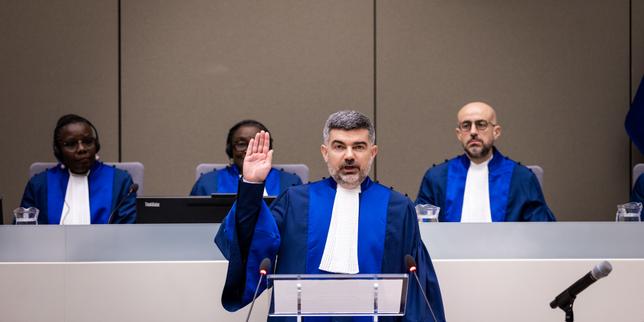
The European Union’s inability to mount a unified defense of the International Criminal Court (ICC) against United States sanctions is not a failure of diplomacy, but a structural inevitability of the Euro-American economic asymmetry. When the Trump administration targets the ICC, it exploits a fundamental friction between the EU’s normative commitment to international law and its material dependence on the US financial system. This creates a paralysis where European statements of "deep concern" are the only affordable currency, as any tangible counter-measure triggers a cost-benefit calculation that the EU is currently designed to lose.
The Trilemma of Extraterritoriality
To understand why the EU struggles to react, one must map the three conflicting forces acting upon European decision-makers. This trilemma dictates that any two objectives can be pursued only at the total expense of the third:
- Juridical Sovereignty: The ability to uphold the Rome Statute and protect ICC personnel (prosecutors and judges) from foreign coercion.
- Transatlantic Economic Stability: Maintaining frictionless access to the US dollar-denominated clearing systems and the American consumer market.
- Internal Political Cohesion: Achieving the required unanimity among 27 member states, many of whom prioritize bilateral security guarantees from Washington over collective Hague-based idealism.
The US sanctions framework—specifically the use of the Office of Foreign Assets Control (OFAC) to designate ICC officials—effectively weaponizes the global financial architecture. Because European banks are deeply integrated into the US financial system, a US sanction against a prosecutor in The Hague creates an immediate "compliance contagion." European financial institutions, fearing secondary sanctions or loss of correspondent banking relationships, will preemptively de-risk. The EU’s primary tool for defense, the Blocking Statute (Council Regulation (EC) No 2271/96), is functionally obsolete in this scenario because it cannot shield a private bank from the existential threat of being severed from the dollar.
The Mechanics of Financial Coercion
The US executive branch utilizes a mechanism of "secondary sanctions" that shifts the enforcement burden from the state to the private sector. The logic follows a specific sequence of escalation that the EU lacks the infrastructure to interrupt.
The Compliance Chokehold
When the US Treasury Department sanctions an individual, it does not merely prohibit US persons from dealing with them; it threatens to penalize any foreign entity that facilitates a "significant transaction." For a European bank, the cost of processing a €10,000 transaction for a sanctioned ICC official is not the potential fine, but the risk of losing its banking license in New York. The bank’s internal risk-weighting will always prioritize US regulatory favor over EU political directives.
The Sovereign Security Discount
The EU’s internal fragmentation regarding the ICC is driven by a security-for-sovereignty trade. Central and Eastern European member states often view the US security umbrella (NATO) as their primary existential requirement. For these nations, challenging US sanctions on the ICC is a high-risk, low-reward maneuver. This creates a "veto-point" within the European Council, preventing the adoption of the forceful measures required to signal true deterrence.
Structural Defects in the EU Blocking Statute
The Blocking Statute was designed to neutralize the effects of the extra-territorial application of foreign laws. However, its application to the ICC case reveals three critical failure points:
- The Enforcement Gap: The statute forbids EU entities from complying with the specified foreign sanctions. This puts European firms in an impossible position: comply with the US and face EU fines, or comply with the EU and face US exile. Historically, firms choose the latter, as the US enforcement mechanism is swifter and more punitive than the fragmented regulatory oversight of EU member states.
- The Private Right of Action: While the statute allows for the recovery of damages caused by foreign sanctions, the process is litigious, slow, and provides no immediate liquidity to a firm facing a US asset freeze.
- Lack of an Independent Clearing Mechanism: The failure of INSTEX (the special-purpose vehicle designed to bypass Iran sanctions) proved that unless the EU creates a completely sovereign financial rail that does not touch the dollar, it cannot bypass US jurisdictional reach.
The Cost Function of Divergence
The EU’s hesitation is also rooted in the high "exit cost" of the current international order. If the EU were to effectively shield the ICC by imposing counter-sanctions on US officials or restricting US financial entities, the resulting economic decoupling would lead to a contraction in GDP growth and a spike in transaction costs across the Eurozone.
We can model the EU's reaction function as $R = f(S, E, P)$, where:
- $S$ represents the perceived threat to the International Legal Order.
- $E$ represents the economic exposure to US retaliation.
- $P$ represents the degree of internal political alignment.
Currently, $E$ (Economic Exposure) is the dominant variable, effectively nullifying any increase in $S$ (Legal Threat). The EU cannot protect the ICC because the "Price of Protection" exceeds the "Value of Normative Consistency" in the eyes of enough member states to block action.
Strategic Divergence in Global Governance
The conflict over the ICC highlights two competing visions of international law. The EU views the ICC as a cornerstone of "rules-based multilateralism," where the law is a constraint on power. The current US posture, particularly under a nationalist executive, views international law as an "instrumentalized asset"—useful when it constrains adversaries, but illegitimate when it affects domestic interests or allies.
This creates a "Jurisdictional No-Man's Land." The ICC relies on state cooperation for everything from evidence gathering to the execution of arrest warrants. If the world’s largest economy and military power actively sabotages these processes, the court's operational capacity is reduced to symbolic adjudication. The EU’s inability to stop this erosion signals a shift from a multilateral world to a "minilateral" one, where legal protections are only as strong as the economic bloc willing to enforce them.
The Institutional Bottleneck
The European Commission’s role is primarily technical, while the High Representative for Foreign Affairs (HR/VP) is responsible for the political direction. This split creates a lag in response time. By the time the Commission conducts a "legal review" of US executive orders, the chilling effect on the ground has already taken hold. International organizations, NGOs, and legal practitioners have already shifted their behavior to avoid the US Treasury's crosshairs.
Furthermore, the EU lacks a centralized "Financial Intelligence Unit" comparable to OFAC. This means the EU is playing defense with a decentralized, bureaucratic shield against a centralized, aggressive financial sword.
The Path to Juridical Autonomy
To move beyond the current state of performative diplomacy, the EU must transition from a reactive posture to a structural one. This requires the development of "Economic Sovereignty Tools" that do not rely on the goodwill of the US executive branch.
1. Centralizing Sanctions Oversight
The EU must establish a singular European Sanctions Agency. This body would consolidate the 27 different national enforcement regimes, creating a "Fortress Europe" for financial regulation. This would allow the EU to issue credible counter-threats that carry the weight of the entire single market, rather than fragmented national responses.
2. Digital Euro and Sovereign Payments
The acceleration of a retail and wholesale Central Bank Digital Currency (CBDC) is the only long-term technical solution to dollar-dependency. A Digital Euro, cleared through a sovereign European infrastructure, would allow for transactions with entities like the ICC that are immune to US correspondent banking interference.
3. The "Anti-Coercion Instrument" (ACI) Refinement
The EU’s recently developed Anti-Coercion Instrument must be tested and expanded. This tool allows the EU to impose trade, investment, and specialized restrictions on third countries that use economic pressure to interfere with the sovereign choices of the EU or its members. However, its effectiveness is contingent on the EU's willingness to engage in a trade war—a prospect that currently lacks consensus.
4. Recalibrating the Rome Statute Engagement
If the EU cannot protect the ICC from US sanctions, it must pivot to bolstering the Court's resilience internally. This includes increasing direct funding to offset any losses from sanctioned individuals or obstructed assets and providing "diplomatic safe harbor" for all ICC personnel within the Schengen Area, regardless of US travel bans.
The current crisis is a stress test for the concept of European Strategic Autonomy. The ICC is merely the first major casualty of a world where economic interdependence is used as a weapon of legal destruction. If the EU continues to prioritize the avoidance of short-term economic friction over the protection of its core normative values, it will find its legal and political influence permanently tethered to the domestic political cycles of the United States. The solution is not more dialogue; it is the construction of a financial and legal infrastructure capable of sustaining a multi-polar world.
The EU must choose between being a global moral arbiter that pays the price for its convictions or a secondary market that follows the rules set by those who control the currency. There is no middle ground where the ICC remains relevant while the EU remains passive.