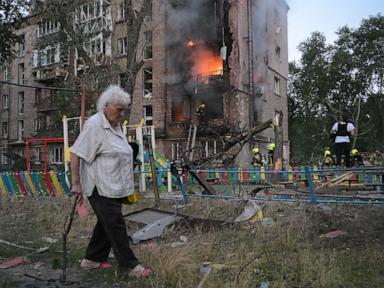
The mainstream media has fallen into a predictable, lazy rhythm when reporting on the war in Ukraine. A tragic Russian missile strike hits a civilian center in Kyiv, killing dozens. In the same breath, journalists report on Ukrainian drone strikes hitting oil refineries deep inside Russian territory. The implied narrative is comfortable, balanced, and utterly wrong: a war of attrition where both sides are successfully battering each other’s critical infrastructure.
This parity is an illusion.
By treating a horrific war crime in Kyiv and a strategic economic strike on Moscow's energy sector as two sides of the same coin, analysts miss the brutal, underlying calculus of modern asymmetric warfare. Russia’s reliance on terror bombing is a confession of strategic stagnation. Ukraine’s precision campaign against Russian oil is a masterclass in economic castration. To view them as equivalent is to misunderstand how this war will actually be decided.
The Fatal Flaw of the "Terror as Strategy" Consensus
Western military analysts often evaluate Russian missile strikes through the lens of traditional air campaigns. They count the dead, measure the crater depth, and analyze the interception rates of Patriot missile batteries. The conventional takeaway? Russia is successfully degrading Ukrainian morale and exhausting its air defenses.
This view ignores a century of military history. Terror bombing from the air historically achieves the exact opposite of its intended goal. From the London Blitz to the Allied bombing of Germany, killing civilians hardens public resolve; it does not break it.
When a Russian Kh-101 cruise missile strikes a crowded apartment building or a children's hospital in Kyiv, it represents a massive expenditure of high-end, sanctioned technology for zero functional military gain. It does not stop a single Ukrainian brigade from advancing. It does not disrupt the flow of Western arms to the front lines. It is a temper tantrum disguised as a military operation, executed because Russia’s ground forces lack the tactical competence to achieve decisive breakthroughs on the battlefield.
I have watched defense pundits analyze these strikes for years, treating every tragic civilian casualty spike as a sign of shifting strategic momentum. It is not. It is a static, horrific background noise that masks Russia's inability to achieve true air supremacy.
Refineries, Not Regimes: The Nuance of Ukrainian Drone Warfare
Now look at the counter-narrative: Ukrainian drone strikes targeting Russian oil infrastructure. The lazy critique from risk-averse Western bureaucrats is that these strikes are dangerous provocations that risk spiking global energy prices or inviting harsher retaliation.
This argument collapses under the weight of basic economic reality. Ukraine is not engaged in symbolic tit-for-tat retaliation. They are systematically dismantled the primary engine of the Russian war machine.
Russia is a petro-state with an army attached. Its ability to pay soldiers, purchase Iranian drones, and manufacture artillery shells relies entirely on hydrocarbon revenues. But more importantly, the Russian military runs on refined product—diesel, aviation fuel, and gasoline.
[Ukrainian Long-Range Drone] ---> [Russian Oil Refinery Distillation Tower] ---> [Supply Chain Collapse]
Ukraine is not targeting random buildings in Moscow to scare Russian citizens. They are sending low-cost, domestically produced long-range drones directly into the distillation towers of Russian oil refineries. A distillation tower is not a component you can easily replace with a black-market shipment from China. These are massive, highly complex pieces of industrial engineering, many of which were built using Western technology that is now heavily sanctioned.
When Ukraine knocks out a refinery in Samara or Ryazan, they are creating a localized supply shock. Russia is forced to choose between supplying its front-line tanks with diesel or keeping fuel prices stable for civilians in Moscow. That is true strategic asymmetry.
Dismantling the Premium Air Defense Myth
The "People Also Ask" columns on search engines are flooded with variations of a single, flawed question: Why can't Ukraine's air defenses stop every Russian missile?
The question itself betrays a deep misunderstanding of military economics. Air defense is a losing game of financial exhaustion. A single American-made Patriot interceptor missile costs roughly $4 million to $5 million. A Russian-adapted Iranian Shahed-136 drone costs about $20,000. Even a sophisticated Russian cruise missile is significantly cheaper than the advanced western interceptors required to bring it down reliably.
If Ukraine uses its limited stock of high-end air defense missiles to protect every square inch of its airspace from low-cost saturation attacks, it will run out of ammunition. Russia knows this. Their strategy is not to hit specific targets, but to force Ukraine to expend its most valuable defensive assets.
Conversely, look at how Russia protects its own airspace. Despite boasting about the mythical capabilities of their S-400 systems, Russian air defenses have proven remarkably porous against low-flying, composite-material Ukrainian drones. Ukraine is exploiting a structural blind spot in Soviet-heritage radar design, which was built to track high-altitude, fast-moving NATO jets, not lawnmower-engined drones hugging the tree line.
The Hard Truth About the Escalation Trap
Every contrarian take requires an admission of risk, and here is the dark side of Ukraine's strategic success: the closer Ukraine gets to choking off Russia’s domestic refining capacity, the more desperate the Kremlin’s responses will become.
Western leaders live in terror of this escalation cycle. They fear that if Russian oil revenues drop precipitously, Vladimir Putin will resort to non-conventional weapons or asymmetric attacks against Western infrastructure. This fear has led to the absurd policy of restricting Ukraine from using Western-supplied weapons to strike targets inside the Russian Federation.
But this policy created a sanctuary for Russian aggression. It allowed Russia to launch missiles from the safety of its own airspace while Ukraine was expected to fight with one hand tied behind its back. By developing their own long-range drone program, Ukraine effectively bypassed Western vetoes and redefined the geography of the conflict.
The risk of escalation is real, but the risk of allowing a genocidal war of attrition to continue indefinitely on Ukrainian soil is far higher. Ukraine's strikes inside Russia are not a distraction from the main fight; they are the only viable mechanism to force a conclusion to the war by making the economic cost of occupation unbearable for the Russian elite.
Stop measuring this war by the volume of explosions or the grim tally of civilian casualties. Russia's strikes on Kyiv are acts of terror born of strategic impotence. Ukraine's strikes on Russia's oil sector are acts of surgical economic warfare designed to cripple an empire. They are not the same. One is a dying regime flailing in the dark; the other is the future of kinetic leverage.