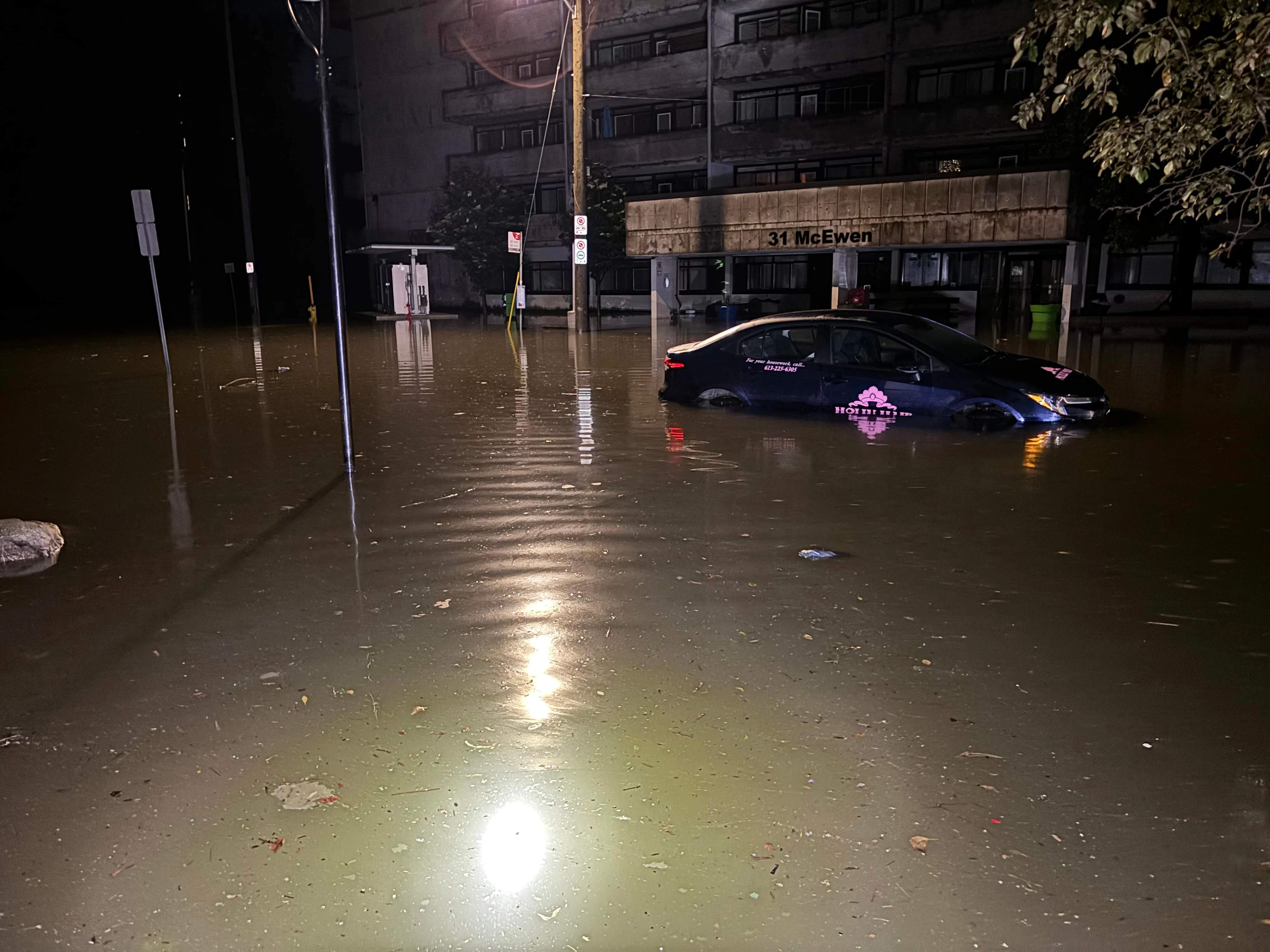
Ottawa just swallowed over 100 mm of rain on Canada Day, and the predictable chorus of outrage has already begun. Neighbors are trading horror stories over ruined drywall. Politicians are issuing somber press releases about "unprecedented weather events." Media outlets are running standard-issue segments on the tragedy of backed-up floor drains.
They are all asking the wrong question. They want to know why the city’s infrastructure failed.
It didn't.
As a civil systems analyst who spent a decade modeling municipal runoff networks, I can tell you the uncomfortable truth nobody wants to admit: those flooded basements mean the engineering worked. Your sub-grade living room was sacrificed to save the city's critical water treatment plants from total, catastrophic collapse.
When a century-storm dumps a month’s worth of water in a single afternoon, the volume has to go somewhere. Civil engineers design municipal systems with a brutal, utilitarian hierarchy. If the main trunk lines overload, the system is engineered to back up into the lowest available relief points. Those points happen to be your finished basement.
Stop blaming the sky. Stop blaming the mayor. Let’s talk about how water infrastructure actually handles a crisis, and why our collective denial is making the problem worse.
The Myth of the Infinite Pipe
The public operates under a comforting delusion: that given enough tax dollars, engineers can build a drainage system capable of swallowing an ocean.
They can't.
Municipalities use standard design storms—typically 2-year, 5-year, or 10-year return periods for local sewers, and up to 100-year events for major overland flow routes. If we engineered local neighborhood pipes to handle 100 mm of instantaneous rainfall without choking, the diameter of the subterranean pipes would need to triple.
The financial reality? It would bankrupt the city. The physical reality? You cannot fit those pipes beneath existing utility corridors without ripping up every gas line, fiber optic cable, and hydro main in the urban core.
When the system hits capacity, physics takes over.
Combined Sewers vs. The Real World
Older sections of major Canadian cities rely on combined sewer systems (CSS), which carry both sanitary sewage and stormwater in a single pipe. Newer areas use separated systems. But during an extreme event, that distinction blurs.
- Inflow and Infiltration (I&I): Rainwater forces its way into separated sanitary systems through cracked maintenance holes, broken cleanouts, and illegal sump pump connections.
- The Surcharge Event: When the volume in the main sewer exceeds its hydraulic capacity, the pipe enters a state called "surcharge." The water level rises above the top of the pipe, creating immense hydrostatic pressure.
- The Path of Least Resistance: That pressure pushes water backward through the lateral lines connecting your house to the street. If you lack a functioning backwater valve, the city's excess volume erupts from your basement floor drain.
By allowing this backup, the system relieves pressure. If it didn't, the hydraulic force would blow manhole covers off their frames, rupture main lines beneath the asphalt, and flood entire wastewater treatment plants, knocking them offline for weeks. A flooded basement is a localized financial disaster; a drowned treatment plant is a public health catastrophe.
Your Backwater Valve Is Probably Lieing to You
The standard advice from insurance companies and city checklists is always the same: install a backwater valve.
It sounds foolproof. A mechanical flap allows wastewater to leave your house but gates shut if water tries to rush back in from the street.
Here is what the brochures don't tell you: a backwater valve only works if you stop using your water.
Imagine a scenario where the city main is surcharged, and your backwater valve closes perfectly to protect you. You are safe. Then, realizing it’s pouring outside, you decide to run a load of laundry, start the dishwasher, and take a shower.
That graywater flows down your drains, hits the closed backwater valve, and has nowhere to go. You end up flooding your own basement with your own waste. The valve didn't fail; you simply misunderstood the mechanics of hydraulic isolation.
Furthermore, these devices require meticulous maintenance. If a single piece of debris, wet wipe, or hair clump gets caught under the flap, it won’t seal. The next storm hits, the valve sits open by a mere three millimeters, and the pressurized sewage bypasses it entirely.
The Financial Delusion of Over-Insuring
Homeowners view flood insurance as a safety net. It isn't. It is a lagging indicator of risk that is actively distorting how we build and buy homes.
Insurance aggregates risk across populations. But as extreme weather events increase in frequency, actuarial models are shifting faster than consumer awareness. If you live in a low-lying zone or a bowl-shaped cul-de-sac, your premium isn't just going up; your coverage is quietly being capped.
Relying on a payout to rebuild the exact same drywall-and-carpet setup in a below-grade space is financial insanity. If your basement has flooded once, it will flood again. The climate isn't changing in twenty years; the infrastructure limits are being reached right now.
How to Actually Protect a Sub-Grade Space
If you want to stop weeping over ruined family photo albums, you need to abandon the idea of a dry, suburban basement and adopt an industrial mindset. If a space is below the water table or below the street level, treat it like a boat hull.
1. Mechanical Redundancy
Do not trust a single sump pump. If the storm takes out the electrical grid—which severe storms regularly do—your primary pump is a useless hunk of plastic. You need a hardwired backup system running on an independent battery array or a water-powered backup pump that leverages municipal water pressure to evacuate the pit.
2. De-risk the Finishes
Stop putting carpet, laminate, and standard drywall in basements. If you choose to finish a basement in an area prone to surcharging, use closed-cell spray foam insulation, mold-resistant magnesium oxide boards instead of drywall, and polished concrete or ceramic tile floors. If it floods, you should be able to hose the room down, sanitize it, and move on with your week.
3. Disconnect from the Grid
If your property permits it, sever your reliance on gravity-fed municipal connections. Specialized residential pumping stations can lift your home’s wastewater up above the street’s surcharge level before discharging it, completely eliminating the physical possibility of a gravity-fed backup. It is expensive, invasive, and the only way to achieve true hydraulic independence.
The city is not coming to save your basement. Their priority is the structural integrity of the macro-network. Until property owners accept that their below-grade spaces are structurally vulnerable by design, the next 100 mm rain event will yield the exact same headlines, the exact same tears, and the exact same ignorance.