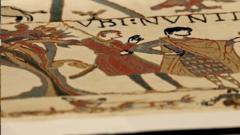
The British Museum just pulled off a heist movie plot in reverse.
In the dead of night, after an 11-hour, 350-mile journey shrouded in absolute secrecy, a specially designed truck backed into a London loading bay. Inside was a climate-controlled case cradling a 950-year-old masterpiece. The Bayeux Tapestry has officially returned to English soil for the first time since the 11th century.
French officials have confirmed the fragile embroidery survived the English Channel crossing in a "wonderful state." Honestly, it is a miracle. For months, critics argued that moving the 70-meter-long linen artifact was a massive, unnecessary gamble. Local Normandy politicians even released social media videos calling the trip "impossible" before quickly deleting them. Yet, here we are. The loan is locked in, the artifact is safe, and the exhibition opens this September.
Why does this ancient piece of fabric still draw a crowd big enough to crash ticket servers? Simple. It is the ultimate piece of political spin, and it tells the story of how modern Britain was born.
The Secret Journey Across the Channel
Moving something this old requires more than bubble wrap. The operation took months of intense planning between British and French museum teams.
The tapestry was folded accordion-style into a specialized shock-absorbing cradle. To throw off any potential security threats, the convoy used a decoy truck during its initial movement out of Normandy. The real cargo slipped across the Channel via the Eurotunnel train, escorted by a heavy police presence.
When the car-sized container finally hit the ground in London, diplomats and museum curators broke into spontaneous applause. British Museum Director Nicholas Cullinan called the loan an act that reaches far beyond standard cultural diplomacy. It is a massive gesture of trust from France, especially considering the artifact's history. The museum even projected a massive merci onto the White Cliffs of Dover to celebrate the arrival.
Bayeux Tapestry Transit Stats:
- Length: 70 meters (230 feet)
- Total transit time: 11 hours
- Distance covered: 350 miles
- Method: Eurotunnel vehicle shuttle
The embroidery will spend the next few weeks resting. It needs to acclimatize to the Sainsbury Exhibitions Gallery's environment before curators unpack a single inch of the fabric.
What the British Museum Got Right
The hype for this exhibition is real. Over 100,000 tickets sold out on the very first day they went live. People are paying £33 an absolute fortune for a museum ticket because they know they will probably never get this chance again.
If you missed the first wave, don't panic. The museum is holding back blocks of tickets for the January-to-July 2027 stretch, which will drop later this year.
The UK government also played its cards right by making this a true cultural swap. In exchange for the tapestry, Britain is sending the iconic Sutton Hoo treasures and the Lewis Chessmen over to France on loan. It balances the scales. It also keeps internet conspiracy theorists from claiming the British Museum plans to keep the tapestry forever.
The Art of 11th-Century Propaganda
Most people assume the tapestry is a French creation because it lived in Normandy for centuries. It's not.
Modern historians agree that English women, likely working in or around Canterbury, actually embroidered the piece. These women were famous across Europe for their incredible needlework. Yet, they were forced to stitch the story of their own defeat.
The narrative covers the brutal 1066 invasion, King Harold getting an arrow to the eye (or getting hacked to pieces, depending on how you read the overlapping figures), and William the Conqueror seizing the throne. It was commissioned by Bishop Odo, William’s ruthless half-brother, to justify a bloody invasion.
It is basically an 11th-century billboard. It frames a violent conquest as God's will. What makes it brilliant is the subtle rebellion stitched into the borders. While the main panels show noble knights and grand battles, the upper and lower margins are filled with strange creatures, fables, and scenes of everyday workers. Some historians think the English embroiderers used these margins to inject their own quiet commentary on their new Norman masters.
Spotting the Details
When you stand in front of the display this autumn, look past the main action. Notice the tiny details that standard history books leave out.
Look for Halley’s Comet streaking across the sky, which terrified people in 1066 who saw it as an omen of doom. Look at the details of the Norman longships; they are practically identical to Viking longships, showing the direct lineage of William’s raiders.
You should also look for Ælfgyva. She is one of only three women named in the entire narrative. Nobody knows exactly who she was or why she is there, though new research by British Museum curators suggests she might be Emma of Normandy.
Your Next Steps
If you want to catch this exhibition, sign up for the British Museum’s official newsletter immediately. That is where the next batch of tickets for the 2027 dates will be announced. Don't wait around for resale tickets, as the museum is enforcing strict ID checks at the door to stop scalpers. Book directly, get your timed entry slot, and see the fabric that rewrote English history before it heads back across the Channel.