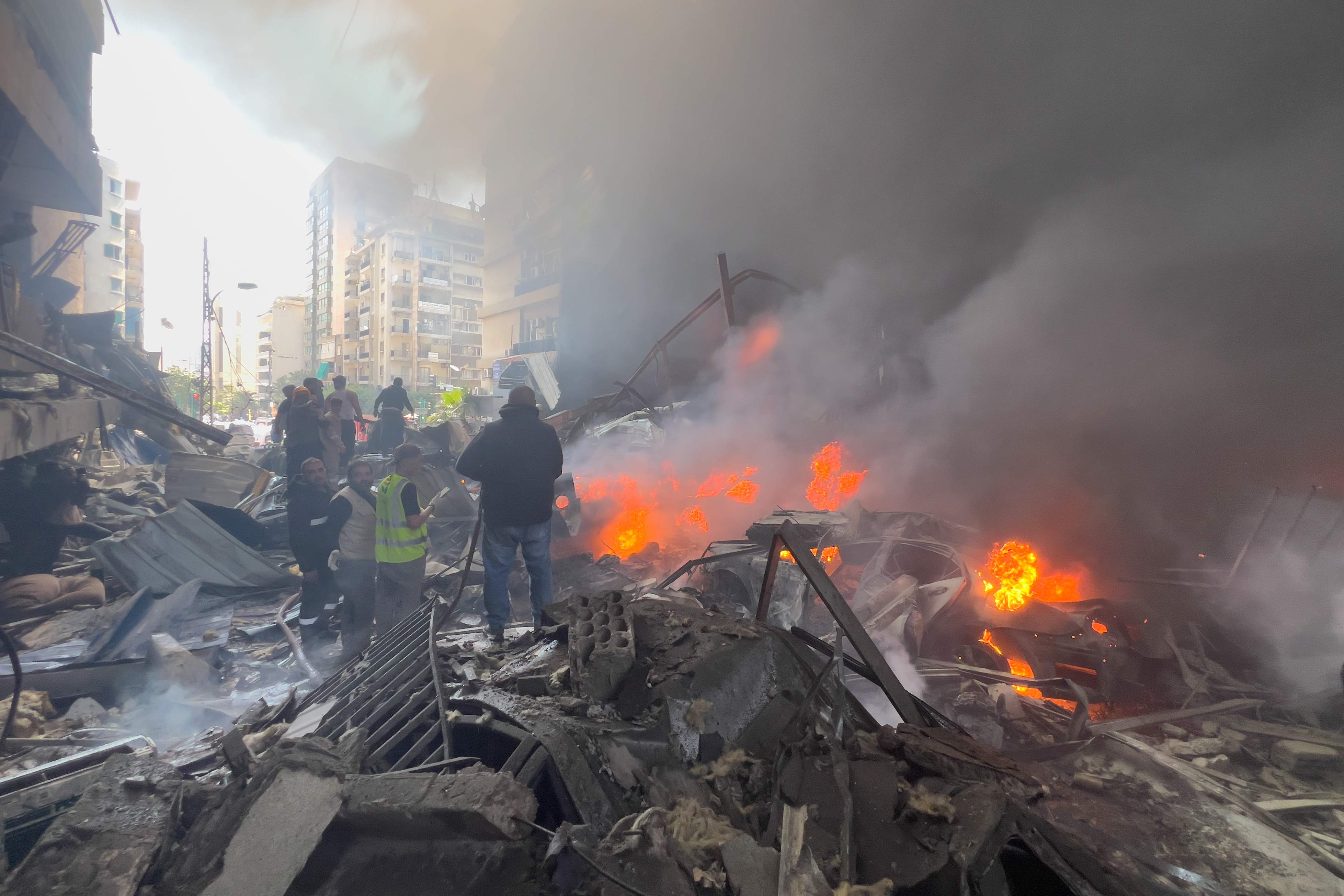
Israel’s decision to strike the heart of Beirut while simultaneously signaling a de-escalation with Iran reveals a brutal strategic decoupling that catches Lebanon in a vice. The bombs falling on the Bachoura district and central commercial zones aren't just tactical maneuvers against Hezbollah. They are a loud, kinetic declaration that the regional rules of engagement have changed. While Tehran and Tel Aviv engage in a high-stakes dance of measured retaliation, Lebanon is being carved out as a separate, more permissive theater of war where the old red lines no longer exist.
The core of the current crisis lies in a fundamental miscalculation by regional actors. Hezbollah’s leadership operated under the assumption that their fate was inextricably linked to Iran’s broader survival. They believed a ceasefire or a reduction in tensions between the Islamic Republic and Israel would naturally extend a protective umbrella over Lebanese soil. They were wrong. Israel has effectively stripped away that shield, treating the "Axis of Resistance" not as a monolithic entity to be bargained with, but as a series of targets that can be dismantled piece by piece.
The Strategy of Decoupling
For decades, the Middle East operated on the principle of linked fates. If one part of the pro-Iran network was hit, the others would react. This was the deterrent. That deterrent has shattered. By striking central Beirut—areas previously considered off-limits due to the presence of government institutions and civilian density—Israel is testing the limits of Iranian patronage.
Israel’s military command is operating on a specific logic. They see a window where Iran is too preoccupied with its own internal stability and the threat of direct hits on its energy infrastructure to intervene effectively for its proxies. The message to the Lebanese government is equally grim: your sovereignty is secondary to the neutralization of Hezbollah’s remaining mid-level command. This isn't a spillover of the Gaza war. It is a targeted, independent campaign designed to reset the border for the next twenty years.
The violence in the capital serves a psychological purpose. When the explosions rock the city center, away from the southern suburbs that have traditionally been Hezbollah strongholds, it sends a tremor through the Lebanese political class. It highlights the total impotence of the Lebanese Armed Forces and the state. It forces the population to confront a reality where no neighborhood is safe if a "target of interest" is suspected to be nearby.
The Intelligence Breach Nobody Wants to Discuss
How does a military strike a specific floor of an apartment building in a crowded metropolitan center with such precision? This points to a catastrophic collapse of Hezbollah’s internal security. The group that once prided itself on being a "black hole" for intelligence is now leaking like a sieve.
The strikes in central Beirut suggest that Israeli intelligence has moved beyond signals tracking and into deep human intelligence. They aren't just listening to phones; they have eyes inside the rooms. This level of penetration makes a ceasefire nearly impossible because Israel feels it has the momentum to finish the job. Why stop when the enemy’s directory is laid bare on your desk?
The Geopolitical Disconnect
Washington continues to talk about a 21-day ceasefire, but those words ring hollow in the streets of Beirut. There is a widening gap between diplomatic rhetoric and the reality of the munitions being deployed. The United States is attempting to manage a regional "cooling off" while Israel is heating up a specific front to the point of melting.
- The Iran Factor: Tehran is playing a long game, prioritizing the survival of the regime over the immediate protection of Lebanese infrastructure.
- The Domestic Pressure: Netanyahu’s government faces immense internal pressure to return displaced residents to the north, a goal that cannot be achieved through a soft truce.
- The Military Opportunity: The IDF views the current state of Hezbollah—decapitated and disorganized—as a once-in-a-generation chance to redraw the map.
The Logistics of Displacement and State Collapse
As the strikes move into the city center, the logistics of the human catastrophe become unmanageable. Lebanon was already a failed state before the first bomb fell. Its banking system is a memory, its currency is worthless, and its electricity grid is a joke. Now, you have hundreds of thousands of people moving into a central hub that was never designed to house them under siege conditions.
This creates a friction point that Israel is likely counting on. By pushing the war into the heart of the capital, they are accelerating the social collapse of the country. When the "host" population begins to turn on the "displaced" population due to fear and resource scarcity, Hezbollah’s social fabric begins to tear. This is counter-insurgency by way of urban pressure.
The idea that Lebanon could be spared because of a deal between larger powers is a fantasy. Israel has explicitly stated that the "Iranian ceasefire" does not apply here. This is a crucial distinction. It means the war in Lebanon is now an isolated conflict, divorced from the broader regional negotiations. It is a local liquidation.
The Broken Red Lines
In previous conflicts, particularly in 2006, there were unspoken rules. You didn't hit the airport. You didn't hit the central business district. You didn't hit the medical facilities in the heart of the city. Those rules are gone. The current Israeli cabinet views those old constraints as the reason they are still fighting this war decades later.
By removing the "Beirut Protection," Israel is signaling that there is no sanctuary. This is a total war mentality applied to a surgical strike environment. The civilian casualties are not seen by the IDF as "collateral damage" in the traditional sense, but as a byproduct of the total integration of Hezbollah into the civilian landscape. If the target is in a cafe, the cafe goes. If the target is in a high-rise, the high-rise goes.
The Myth of Iranian Intervention
Many in Beirut are still waiting for a massive Iranian response that will never come. The "Ring of Fire" strategy that Soleimani spent decades building was designed to protect Iran, not the other way around. Hezbollah was the shield for the nuclear program. Now that the shield is being chipped away, the person holding the shield has to decide if they want to get their own hand hit. So far, Iran has shown it would rather pull its hand back.
This leaves the Lebanese state in a vacuum. The Prime Minister, Najib Mikati, makes pleas to the UN, but he is a leader without a military or a mandate. He is a spectator in his own capital. The real negotiations aren't happening in the Lebanese Parliament; they are happening through the trajectory of missiles.
The Cost of Miscalculation
The tragedy of the current strikes is that they were preventable if the parties involved had a realistic understanding of their own leverage. Hezbollah overplayed its hand by thinking it could maintain a "low-intensity" war of attrition to support Gaza without triggering a full-scale invasion of its own territory. They assumed the international community would restrain Israel. They assumed wrong.
The international community is tired. The "Lebanon fatigue" in Western capitals is real. While there is a standard outcry over civilian deaths, there is very little appetite for the kind of massive diplomatic intervention required to stop the Israeli advance. Most regional powers are quietly content to see Hezbollah weakened, even if they must publicly condemn the methods.
The Ground Reality
In the streets of Hamra and Achrafieh, the sound of drones is a constant, buzzing reminder of the new normal. People are no longer asking when the war will end; they are asking which building is next. The strikes on central Beirut have destroyed the illusion of a "safe zone."
When a nation's capital is targeted with such frequency and precision, the concept of a "front line" vanishes. The entire country becomes a front. The distinction between a combatant and a resident becomes a matter of who is standing next to whom at a checkout counter or in an elevator.
The technical superiority of the Israeli Air Force is being used to conduct a psychological autopsy on Lebanon. They are finding every nerve and every tendon of the Hezbollah organization and severing them. The fact that this is happening while Iran sits on the sidelines is the ultimate indictment of the "unity of fields" doctrine.
The ceasefire that applies to Iran but not to Lebanon is the ultimate strategic trap. It allows the patron to survive while the proxy is dismantled. It allows the larger war to be avoided while the smaller country is incinerated. This is the reality of the new Middle Eastern order: the big players negotiate, while the small players pay the bill in rubble and blood.
The strikes on Beirut are not a prelude to a deal. They are the deal. Israel is buying its security with Lebanese sovereignty, and for the moment, no one is willing to outbid them. The fire in Bachoura is a signal fire, warning that the old protections are dead and the new map is being drawn in real-time, one city block at a time.
Stay away from the windows. The drones are not finished.