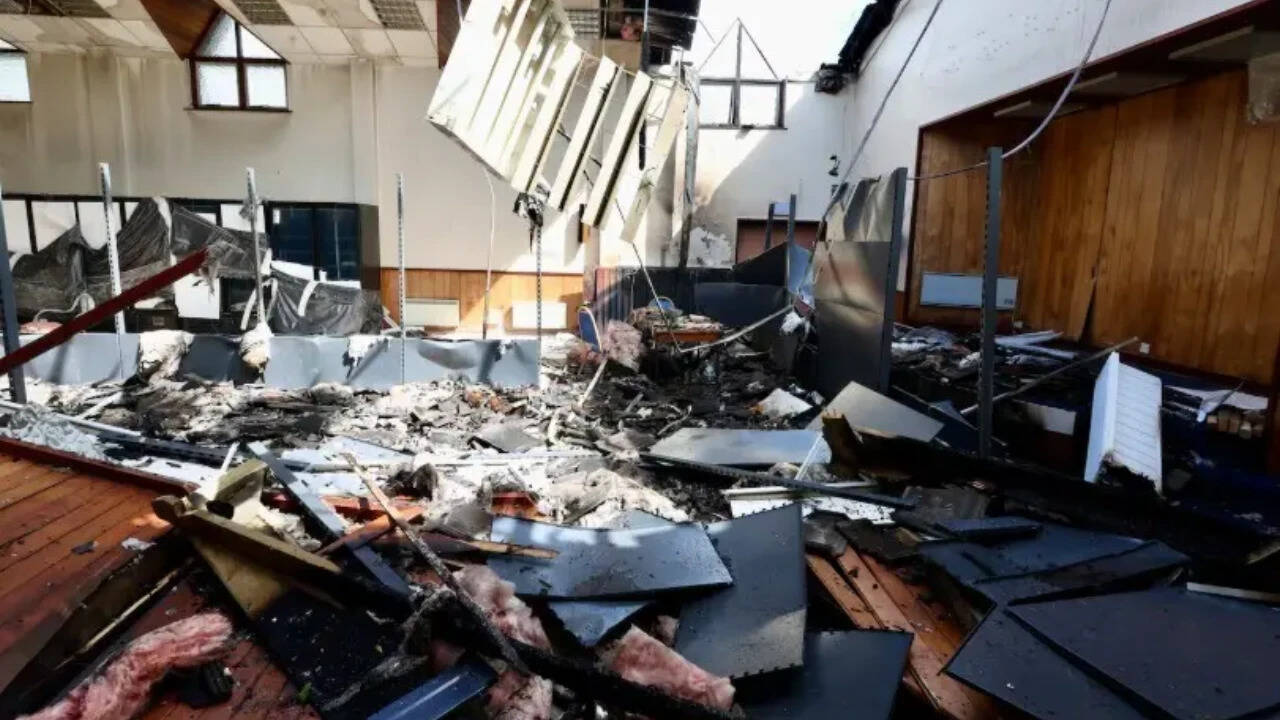
The media loves a predictable tragedy. When an immigrant entrepreneur’s business burns to the ground in a flashpoint city like Belfast, the narrative writes itself within minutes. The headlines scream about overnight hatred, sudden spikes in intolerance, and a shocking breakdown of community relations. We are told to look at the ashes and see a brand-new cultural failure.
They are looking at the wrong spark.
When you strip away the emotional manipulation of standard news coverage, a brutal truth emerges. The destruction of businesses in volatile urban environments is rarely a sudden, inexplicable eruption of localized malice. It is the predictable, systemic fallout of a failed economic strategy that parachutes capital into deeply fractured, under-regulated enterprise zones without structural security.
I have spent two decades analyzing market entries in high-risk, post-conflict zones. I have watched boards pour millions into expanding retail footprints into regions where peace is maintained by a fragile bureaucratic truce rather than genuine economic integration. The catastrophic mistake these founders make is treating a historically volatile geopolitical pocket as if it were a sterile, predictable corporate park.
The arson isn’t the anomaly. The expectation of safety without deep, localized risk-mitigation is the anomaly.
The Lazy Consensus of the Sudden Backlash
The prevailing narrative surrounding targeted commercial property destruction suggests that communities live in harmony until a sudden wave of external radicalization poisons the well. This premise is fundamentally flawed. It misdiagnoses the structural reality of post-conflict urban economics.
In areas like Belfast, tensions do not sleep; they are managed. When an outside entrepreneur enters a market that is hyper-localized, they are not just competing on price, product, and service. They are inadvertently stepping into a complex, multi-layered ecosystem of territory, extortion protection rackets, and historical grievances.
[Standard Narrative] -> Local Harmony -> Outside Agitation -> Arson -> Shock
[Economic Reality]   -> Unresolved Friction -> Insufficient Security -> Exploited Vulnerability -> Arson -> Predictable Outcome
To call the destruction of a business "unexpected" is to admit a total lack of due diligence. When a business burns and onlookers cheer, it is a grotesque display, yes, but it is not a statistical surprise. It is the venting of long-festering, socio-economic resentment that has been ignored by local governance and miscalculated by business owners.
The Fallacy of the Borderless Consumer
Modern business education pushes a dangerous lie: if you offer value, the market will accept you.
This corporate idealism fails catastrophically on the fringes of fractured cities. The consumer is never purely economic; they are tribal, political, and historical.
When international or minority entrepreneurs open shops in working-class neighborhoods undergoing economic stagnation, their presence is frequently weaponized by local bad actors. The business becomes a highly visible, soft-target proxy for broader frustrations—wage stagnation, lack of social housing, and political paralysis.
Consider the mechanics of high-risk commercial operations:
- The Visibility Trap: Main street retail operations provide maximum exposure for marketing, but they also offer maximum vulnerability to civil unrest.
- The Insurance Illusion: Most founders assume commercial insurance policy fire clauses protect them from total ruin. In high-risk zones, riot and civil commotion clauses are buried in jargon, often leading to protracted legal battles and bankruptcies before a single penny is paid out.
- The Enforcement Void: Police forces in divided cities often prioritize crowd control and maintaining a macro-level peace over protecting individual commercial storefronts. Your cash register is never their tactical priority.
If you scale an enterprise into an area with active underlying geopolitical friction, you must price the cost of systemic hostility directly into your operational model. If your margins cannot support private security, hardened infrastructure, and independent supply lines, you have no business operating in that zip code.
Dismantling the PAA Fallacies
The public discourse around these incidents is dominated by poorly framed questions that completely miss the systemic mechanics at play.
"Why don't local authorities do more to protect migrant businesses?"
This question assumes that municipal authorities possess the resources, political will, and tactical capability to police every square inch of a fractured city. They do not.
In post-conflict environments, law enforcement operates on a doctrine of containment, not prevention. When civil unrest scales up, the primary objective of the state is to prevent the collapse of government infrastructure and major transport links. Private retail assets are, by definition, expendable in the grand calculus of public order. Expecting the state to act as a personalized security detail for your startup is a fatal strategic error.
"Can community integration initiatives prevent commercial arson?"
No. Community integration initiatives, roundtables, and cross-cultural photo opportunities are public relations exercises that do nothing to alter the material conditions on the ground.
They do not disarm radical factions. They do not eliminate poverty. They do not stop a brick from shattering a plate-glass window at three o'clock in the morning. Relying on the goodwill generated by a local outreach program to protect a physical asset is brings a butter knife to a drone fight. The only thing that deters physical destruction is physical security and financial leverage.
The Hard Truth About High-Risk Market Entry
Let's look at the cold data of operating in contested territories. Look at corporate risk assessments by global firms like Control Risks or political risk indices. They do not evaluate a region based on whether the people seem friendly during a daytime site visit. They look at structural stability, emergency response times, historical arson statistics, and the strength of the rule of law.
If you are going to open a business in an area with a history of civil volatility, you must throw out the standard retail playbook entirely.
- De-center the Physical Footprint: The era of the highly vulnerable, customer-facing storefront in high-risk zones is dying. If you want to serve a volatile market, utilize decentralized distribution networks, dark kitchens, and e-commerce infrastructure that cannot be neutralized by a match.
- Hardened Infrastructure is Not Optional: If you must have a physical presence, it should resemble a fortress, not a boutique. Reinforced shutters, blast-resistant glass, independent power generation, and off-site, real-time data redundancy are the baseline costs of doing business.
- Weaponize Financial Interdependence: The only way to truly secure a business in a hostile environment is to make its survival in the financial interest of the locals who hold power. Hire locally, source from regional suppliers who have skin in the game, and integrate into the local supply chain so deeply that burning your shop down means cutting off the income of the neighborhood's most influential actors.
The Cost of Corporate Naivety
My approach is cynical, cold, and admittedly expensive. Hardening an enterprise against structural hostility drains capital that could otherwise go toward marketing or product development. It forces you to view your neighbors not as potential brand evangelists, but as elements in a complex risk equation.
But the alternative is what we see in the news cycles every single year: ruined livelihoods, smoking rubble, and shell-shocked founders weeping for cameras, wondering how this could have happened.
Stop expecting fractured societies to heal just because you opened a business. They won't. The hatred isn't new, the malice isn't sudden, and the cheering crowds aren't a surprise.
If you build a glass castle on a fault line, do not blame the earth when it shakes. Build a bunker or get off the mountain.


