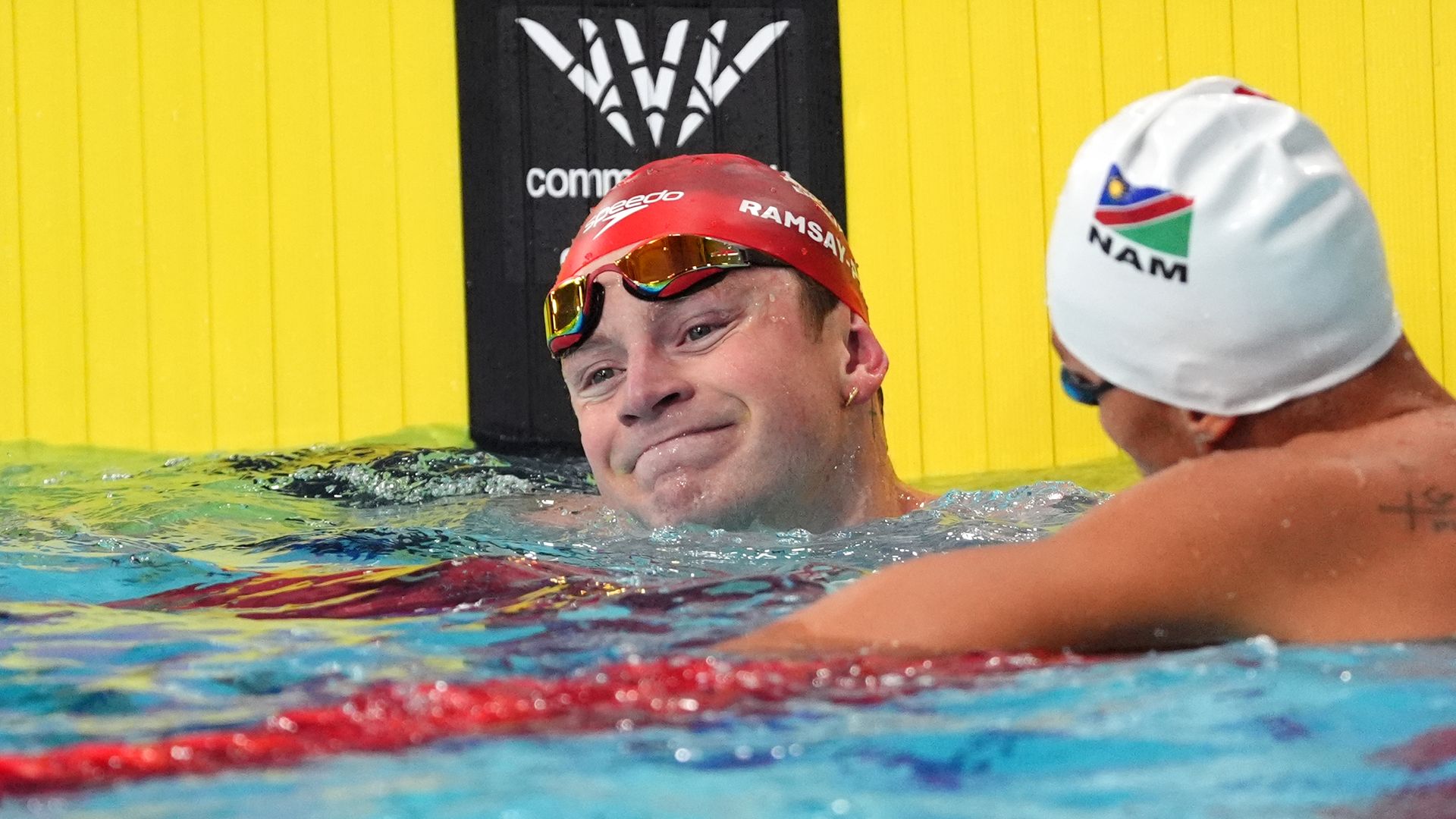
Elite athletic longevity is governed by a strict biological and neurological cost function, where the marginal energy required to maintain peak output increases exponentially past a certain physiological threshold. When Adam Peaty secured consecutive bronze medals in the 100m and 50m breaststroke events at the 2026 Commonwealth Games in Glasgow, public commentary defaulted to emotional narratives of heartbreak, age, and external pressure. A rigorous evaluation of the underlying race metrics, stroke mechanics, and training load reveals a different reality. Peaty's performance indicates a systemic misalignment between training output, neuromuscular efficiency, and race-model execution.
The Kinetic Deficit in Early-Race Acceleration
Peaty’s historical dominance in sprint breaststroke rested upon an anomalous early-race efficiency metric. At his absolute physical zenith, his capacity to generate explosive force off the blocks and establish an insurmountable lead within the first thirty meters created an unassailable advantage. In sports science, this is quantified as impulse generation relative to drag. Peaty's explosive start historically forced opponents into a wave-dampening vortex, rendering their back-half speed irrelevant.
In the Glasgow finals, that early-race dominance evaporated. During both the 100m and 50m events, split-time analysis exposed a critical kinetic deficit in the initial phase. Instead of launching into clear water, Peaty was buried in the field at the halfway mark, forced into an anaerobic deficit trying to salvage a podium position through sheer terminal velocity.
This shift points to a degradation in fast-twitch recruitment speed or a subtle alteration in streamline entry angle. At thirty-one years of age, minor losses in explosive power output compound rapidly in sprint events lasting under thirty or sixty seconds. When the initial impulse drops by even two percent, the swimmer's entire hydrodynamic profile shifts, increasing frontal resistance and forcing the athlete to expend finite metabolic energy fighting the water rather than gliding through it.
The Over-Training Feedback Loop
Peaty's post-race assessments highlighted a profound paradox: he reported working harder than ever in training block execution, yet yielded diminishing returns on the stopwatch. In high-performance physiological architecture, this inverse relationship between subjective effort and objective output is a textbook indicator of chronic over-reaching or maladaptive fatigue.
The human endocrine and central nervous systems do not distinguish between the physiological stress of heavy training loads and the systemic stress of managing a complex, high-pressure lifestyle that includes family commitments and public scrutiny. When an athlete attempts to bridge an age-related physiological gap by increasing volume or intensity without adequate neuromuscular recovery, the central nervous system down-regulates motor unit firing rates to prevent catastrophic cellular damage.
Peaty's assertion that "the harder you try, the slower you go" accurately describes the neurological bottleneck of fatigue-induced coordination breakdown. In sports science, sprint breaststroke is less a test of raw muscular force and more a masterclass in precise, high-frequency timing. If central nervous system fatigue delays muscle relaxation or alters the micro-timing of the kick-recovery cycle by milliseconds, hydrodynamic drag spikes exponentially. The athlete feels like they are exerting maximum effort because they are—yet the physical manifestation in the water is decelerated by internal mechanical friction.
The Cognitive Pivot and Strategic Adaptation
The transition from an undefeated, single-minded machine to a multi-dimensional human operating under a "human first, then athlete" framework introduces a complex psychological variable. Elite sports psychology traditionally treats distraction or lifestyle diversification as performance inhibitors. However, in veteran athletes, psychological load-sharing can serve as a necessary defense against burnout.
The operational challenge is structural. Peaty is attempting to bridge a two-year gap away from major international championship semifinals and finals while recalibrating his life's hierarchy. Match sharpness—the intuitive, reflex-driven execution of race strategy honed through continuous high-stakes competition—decays rapidly during extended absences. Training miles cannot replicate the hyper-oxemic stress and tactical pressure of international heats and finals.
The Strategic Blueprint for the Los Angeles Cycle
Reversing the trajectory toward the 2028 Los Angeles Olympics requires abandoning brute-force training methodologies in favor of targeted efficiency optimization.
First, training volume must be subordinated to movement velocity. If output on the stopwatch fails to match training wattage, the volume must be cut to clear the accumulation of central nervous system fatigue.
Second, the technical model of the race must be restructured. Relying on the historical blueprint of dominating the first thirty meters is mathematically flawed if the explosive start metrics have naturally regressed. Energy distribution must be re-engineered to maximize stroke efficiency across the middle twenty meters, accepting a slightly more conservative initial impulse to preserve terminal velocity for the final wall touch.
The bronze medals in Glasgow are not symptoms of terminal decline; they are quantifiable feedback data. They indicate that the old operating system has reached its physical limits, forcing a necessary evolution toward intelligent, data-led longevity.