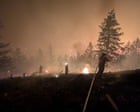
The media narrative surrounding Canadian wildfires follows a tired, predictable script. Whenever smoke chokes North American skylines, headlines shriek about unprecedented climate collapse, rogue infernos, and an out-of-control emergency demanding immediate government intervention. Thousands flee, politicians pledge billions, and the public is fed a single, unchallenged takeaway: nature is broken, and only heavy-handed bureaucratic management can save us.
That narrative is not just lazy. It is actively making the problem worse.
For decades, I have watched forestry management devolve into a spectator sport played by urban desk jockeys who cannot tell the difference between an ecological reset and a catastrophe. When the state steps in with a blank check and a mandate to suppress every flicker of flame, they are not protecting the wilderness. They are building a tinderbox.
The Fallacy of Absolute Suppression
Let us address the core misconception. People assume that a "good" wildfire season means zero fires, and a "bad" one means millions of acres burn. This is ecological illiteracy dressed up as public safety.
Forests are not static museums. They are dynamic, fire-dependent ecosystems. For over a century, federal and provincial agencies adopted a policy of total fire exclusion. Every spark was hunted down and extinguished with military precision. Forestry textbooks called this efficiency. Ecologists call it fuel loading.
Imagine a scenario where you never take out the trash in your kitchen. For years, everything looks clean. But every bag you shove into the pantry adds to an invisible, volatile heap of refuse. Eventually, a single stray spark from a toaster sets off a thermonuclear blast that destroys the entire house. That is what Canadian forest management has done on a continental scale.
When you prevent small, routine fires, you do not stop fires from happening. You merely defer them. And deferred interest compounds brutally. The underbrush thickens, dead timber piles high, and canopy ladders form, allowing surface fires to leap into the crowns of mature trees.
When the inevitable ignition finally occurs under dry, windy conditions, the resulting blaze is no longer a natural cleansing agent. It is an unstoppable wall of plasma that melts soil nutrients, sterilizes the earth, and releases staggering amounts of carbon all at once.
The Canadian government stepping in with more waterbombers and evacuation orders is treating the symptom while ignoring the disease.
The Bureaucratic Feedback Loop
Why do agencies keep doubling down on a failed strategy? Because failure funds the bureaucracy.
In emergency management, budgets expand in direct proportion to panic. When a wildfire season breaks records, agencies secure massive funding increases for aviation fleets, specialized personnel, and emergency infrastructure. There is zero institutional incentive to solve the root structural problem. If you actually solved the fuel-loading crisis through aggressive, widespread prescribed burning and indigenous land management techniques, your budget would shrink next year.
So instead, we get performative panic. Politicians stand at podiums in crisp shirtsleeves, looking grim, talking about unprecedented anomalies.
They are omissions by design. They omit the fact that Indigenous communities successfully managed these exact landscapes for millennia using low-intensity cultural burns. They omit the fact that modern timber management prioritizes commercial extraction of high-value lumber while leaving dense, hazardous slash piles rotting on the forest floor. They omit the reality that industrial zoning has pushed sprawling housing developments directly into high-risk interface zones without requiring defensible space buffers.
When thousands are forced to flee, it is a tragedy. But it is largely a human-made tragedy born of administrative cowardice and scientific willful blindness.
What Real Mitigation Looks Like
If we want to stop fleeing, we have to start burning.
Real wildfire resilience requires an uncomfortable cultural shift. We have to accept short-term smoke for long-term survival. That means authorizing massive, targeted prescribed burns during shoulder seasons. It means creating expansive fuel breaks around critical infrastructure, even if local residents complain about temporary aesthetic degradation.
It also means abandoning the fantasy that nature can be managed through remote control from Ottawa or provincial capitals. Localized, decentralized forestry management works. Top-down emergency response fails.
The next time the sky turns orange and the talking heads demand emergency powers, look past the smoke. The fire isn't out of control because the climate changed. It is out of control because we forgot how to let the forest breathe.
Stop waiting for the government to rescue you from a crisis they engineered.


