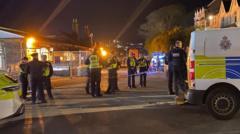
The recent mass stabbing at a major railway station, which left four individuals hospitalized after a chaotic outbreak of violence, is not an isolated flashpoint of urban disorder. It is a predictable outcome of a hollowed-out security infrastructure. While initial reports focused on the immediate carnage and the rush of emergency responders, the deeper reality involves a catastrophic failure in transit policing strategy and the physical design of modern transport hubs. Four people were knifed in broad daylight because the deterrents we rely on have become purely performative.
When violence erupts in a high-traffic transit corridor, the public is told that "lessons will be learned" and "patrols will be increased." These are the platitudes of an administration in damage control. The truth is that railway stations have become soft targets where the speed of travel is prioritized over the safety of the traveler.
The Illusion of the Secure Perimeter
Transport hubs operate on a high-volume, low-friction model. This is the fundamental tension that leads to bloodshed. To keep thousands of commuters moving every hour, security checkpoints are minimized or non-existent. Unlike airports, where the sterile zone is guarded by layers of technology and personnel, a railway station is an open ecosystem.
This openness is a civic necessity, but it has been exploited by a rising tide of localized gang activity and spontaneous aggression. The four victims in this latest incident were caught in a "disorder" that likely began miles away on a different carriage or via a digital feud, only to spill onto the platform where the crowds are densest and the escape routes are many. We are seeing a shift from premeditated crime to impulsive, high-stakes violence in public squares.
Security cameras are everywhere, yet they did nothing to stop the knives from being drawn. We have traded actual intervention for digital documentation. We can watch the crime in 4K resolution after the fact, but there was no one on that platform with the training or the mandate to intercept the aggressors before the first lunges were made.
Why Static Policing Fails the Modern Commuter
The traditional model of transit policing involves officers standing near the ticket barriers or tucked away in station offices. It is static. It is visible. And for the modern criminal, it is entirely easy to bypass.
The perpetrators of the recent station stabbing did not care about the cameras, nor were they deterred by the presence of a few transit staff in high-visibility vests. These staff members are frequently told not to intervene in physical altercations for liability reasons. When the policy is "observe and report," the "report" usually happens while the victims are already bleeding out.
To understand why this happens, we have to look at the budget shifts in municipal policing. Specialized transit units have been integrated into general patrol duties, diluting the institutional knowledge required to manage the unique geography of a railway station. A station is a labyrinth of blind spots, service tunnels, and crowded stairwells. Without a dedicated, proactive presence that moves through the crowds rather than watching them from a distance, the "disorder" reported in the headlines will continue to escalate.
The Weaponization of the Commute
The nature of the weapons used in these attacks is also changing. We aren't talking about pocketknives. We are looking at tactical blades and "zombie knives" designed for maximum tissue damage. The presence of such weapons in a transit hub suggests a total breakdown in the "stop and search" efficacy within the surrounding urban zones.
If a group of individuals can transit through multiple stops while carrying large blades without detection, the system is fundamentally broken. It implies that the transit network is being used as a safe harbor for the transport of illicit goods and weapons, precisely because the surveillance is passive rather than active.
Architecture of Vulnerability
We must talk about how we build these spaces. Modern stations are designed for aesthetics and "passenger flow," a term used by architects to describe how to move people toward retail outlets and platforms as quickly as possible. However, "passenger flow" is also "offender flow."
Large, open concourses with multiple exit points make it nearly impossible for law enforcement to contain a scene once a weapon is produced. In the recent four-person stabbing, the chaos was amplified by the station's layout, which funnelled panicked bystanders into the same narrow corridors the attackers were using to flee. We are building glass-and-steel traps.
Effective security architecture would include:
- Modular zoning that allows specific sections of a platform to be isolated instantly.
- Acoustic sensing technology that can identify the specific sound of a physical struggle or a scream and alert authorities faster than a manual button.
- Tactical positioning of security personnel at "choke points" where they can observe incoming crowds from an elevated or strategic vantage point.
Instead, we have wide-open spaces that favor the agile and the violent.
The Mental Health and Social Breakdown Factor
It is easy to blame "gangs" or "youths," but that ignores the atmospheric tension currently defining urban transit. The "disorder" mentioned in the official police statements is a euphemism for a broader social decay.
Post-pandemic transit ridership has seen a spike in aggressive behavior. There is a palpable irritability on platforms, fueled by delays, overcrowding, and a general sense of lawlessness. When four people are stabbed, it is often the culmination of a series of smaller, ignored escalations. A shove on a train, a verbal insult on the escalator, a heated exchange over a seat—these are the sparks. In an environment where there is no visible authority to de-escalate these minor frictions, they turn into homicidal violence.
We are asking transit workers—conductors and gate staff—to act as social workers, psychiatric evaluators, and security guards. They are none of these things. They are people trying to get a train from point A to point B. By offloading the responsibility of "public order" onto under-trained transit staff, the state has effectively abandoned the platform.
The Failure of the "See Something, Say Something" Campaign
For years, we have been bombarded with the slogan "See It, Say It, Sorted." This is perhaps the most cynical marketing campaign in the history of public safety. It shifts the burden of security from the state to the terrified commuter.
In the case of the recent mass stabbing, it is almost certain that someone "saw something" minutes before the blades were drawn. They likely saw a group of agitated individuals or noticed a weapon tucked into a waistband. But who do they tell? In a crowded station, finding a police officer is like finding a needle in a haystack. Texting a tip line is useless when a fight breaks out in thirty seconds.
The campaign creates an illusion of participation while providing no actual protection. It is a psychological band-aid for a gaping wound in our social contract. The public has done its part; it is the authorities who have failed to "sort it."
Beyond the Yellow Line
To fix this, we have to stop treating station stabbings as freak occurrences. They are the logical result of a security strategy that prioritizes liability over life and optics over outcomes.
We need a return to specialized transit police forces that are untethered from general municipal duties. These officers need to be trained in "behavioral detection"—identifying the precursors to violence before the first strike. This isn't about profiling; it's about spotting the individual who is scanning the crowd for a victim or the group that is posturing for a fight.
Furthermore, we need to rethink the "open station" concept. While total enclosure is impossible and undesirable, the implementation of "intelligent barriers" that can be locked down or used to redirect flow during an emergency is a baseline requirement for a 21st-century city.
The four victims of this latest attack are a warning. As our cities grow denser and our social fabric grows thinner, the railway station—the very artery of our economy—is becoming a theater of the macabre. We can either reinvest in the hard, physical presence of security and the architectural realities of safety, or we can continue to watch the CCTV footage of our own decline.
The next time you stand on a platform, look around. Not for a camera, but for a person who could actually help you if the worst happened. If you can't find one, you'll understand why those four people were stabbed. The system isn't failing; it was never designed to protect you in the first place.
Put down the phone, stop looking at the departure board, and watch the crowd. You are your own first responder now.