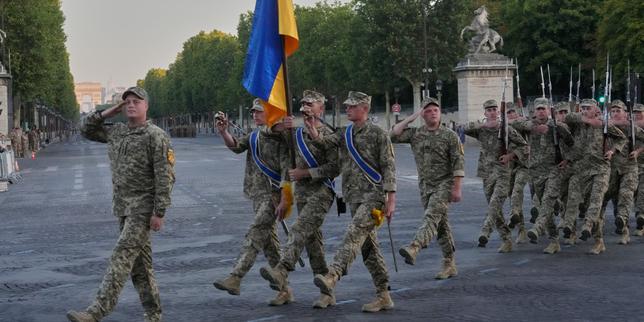
The cobblestones of the Avenue des Champs-Élysées have a distinct, haunting memory. Anyone who has ever stood by the barriers in the early morning fog knows the smell: damp asphalt, pressed wool, diesel exhaust, and the sharp, metallic tang of brass instruments catching the July sun. It is a sensory tradition that generations of Europeans recognize instantly.
But this year, the rhythm is broken.
Listen closely. Before the French foreign legion strikes their famously slow, hypnotic cadence, and before the Republican Guard passes by in a blur of horsehair and polished steel, a different sound will echo down the avenue. Five hundred pairs of boots, marching in absolute unison, but speaking a dozen different languages under their breath. They do not wear the traditional French kepi. They represent thirty-five separate nations, united under a single, highly urgent banner: the Coalition of the Volunteers.
For decades, the Bastille Day parade has been a grand exercise in national theater—a display of sovereign muscle and historical pride. This year, it morphs into something entirely different. It is an admission of vulnerability wrapped in a promise of steel. By placing 500 foreign soldiers at the absolute vanguard of France’s most sacred military ritual, Paris is sending a chillingly clear message to the world.
The era of going it alone is dead.
The Phantom Frontline
To understand why this matters, you have to look past the crisp uniforms and the gleaming medals. Consider a hypothetical soldier—let’s call him Lukas. Lukas is a Lithuanian infantryman. If you ask him what he is thinking as he prepares to lead the parade through the heart of Paris, he won’t talk to you about the French Revolution or the fall of the Bastille. He will tell you about the Suwałki Gap. He will tell you about the cold, sleepless nights on Europe's eastern edge, watching borders that feel more fragile by the day.
Lukas and his 499 comrades are not here for a ceremonial vacation. They are the human face of a quiet, massive geopolitical pivot known as the "strategic awakening of Europe."
The Coalition of the Volunteers was born out of raw necessity, a political initiative launched by France and the United Kingdom to forge an ironclad framework of security guarantees for Ukraine. It is a group designed to ensure that whenever the guns finally fall silent along the Dnieper, a shield of international resolve will instantly drop into place to prevent the frontlines from moving ever again.
But geopolitical treaties are just ink on paper. They are abstract. They are bloodless.
When those 500 soldiers take their first collective step down the avenue, that abstract treaty becomes flesh, bone, and marching leather.
When Competitors Talk of Solitude
"The competitors say that we are alone," noted General Loïc Mizon, the military governor of Paris, during a tense briefing ahead of the event. His voice carried the weight of a man who knows that traditional deterrence is no longer a matter of mere posturing. "That is not true. And we are going to show it alongside our partners and allies."
The word "competitors" here is a polite, diplomatic euphemism. Everyone in the crowd knows who the real audience is. The Kremlin watches the 14th of July with a hawk's eye, parsing the turnout, measuring the resolve, looking for the fractures in Western unity.
For months, the narrative broadcast from Moscow has been one of European fatigue. The story they sell is simple: the West is tired, its warehouses are empty, and its people are looking inward.
Then comes the counter-narrative.
Up in the Parisian sky, breaking the sound barrier, two Mirage 2000 fighter jets roar overhead. The crowd looks up, shielding their eyes. What the casual observer might miss is the detail in the cockpit: the pilots wearing those French-made visors are Ukrainian. Below them, 10,000 soldiers march in an oversized, muscular display that is fifteen percent larger than previous years. The armored columns stretching behind them are thirty percent deeper, packed with heavy Scorpion-class combat vehicles built for high-intensity warfare.
This is not a parade. It is an order of battle.
The Weight of the Invisible Coalition
It is easy to get lost in the sheer scale of the spectacle. The media will report the numbers—the 300 vehicles, the 120 aircraft, the endless sea of camouflage. They will focus on the choreography. But the real plot point of this day lies in the uneasy tension sitting in the diplomatic grandstands.
there are lines of fracture that no amount of marching can entirely hide.
Behind the scenes, the Coalition of the Volunteers is an intricate, agonizingly complex puzzle. It is one thing to invite heads of state to Paris for a glass of champagne and a fireworks display. It is another thing entirely to hammer out the granular reality of who provides what when the diplomatic honeymoon ends. Who supplies the air defense batteries? Who funds the massive industrial production lines required to keep a continent armed? Who sends their sons and daughters to train troops on the edge of a conflict zone?
The parade is a test. It forces every nation present to look at the soldiers out on the pavement and decide exactly how much skin they have in the game.
As the foreign contingent approaches the presidential grandstand, the clapping from the crowd softens into a respectful, heavy silence. The French onlookers realize that these 500 men and women are not just guests; they are a mirror. They represent a future where defense is no longer a localized budget item, but a shared continental burden.
The applause builds again, rising from the back of the crowd, tracking the progress of the flags down toward the Place de la Concorde. It is a collective exhale. The message has landed. The line has been drawn in the dirt of the capital, stepped out by five hundred pairs of boots that refuse to walk alone.



