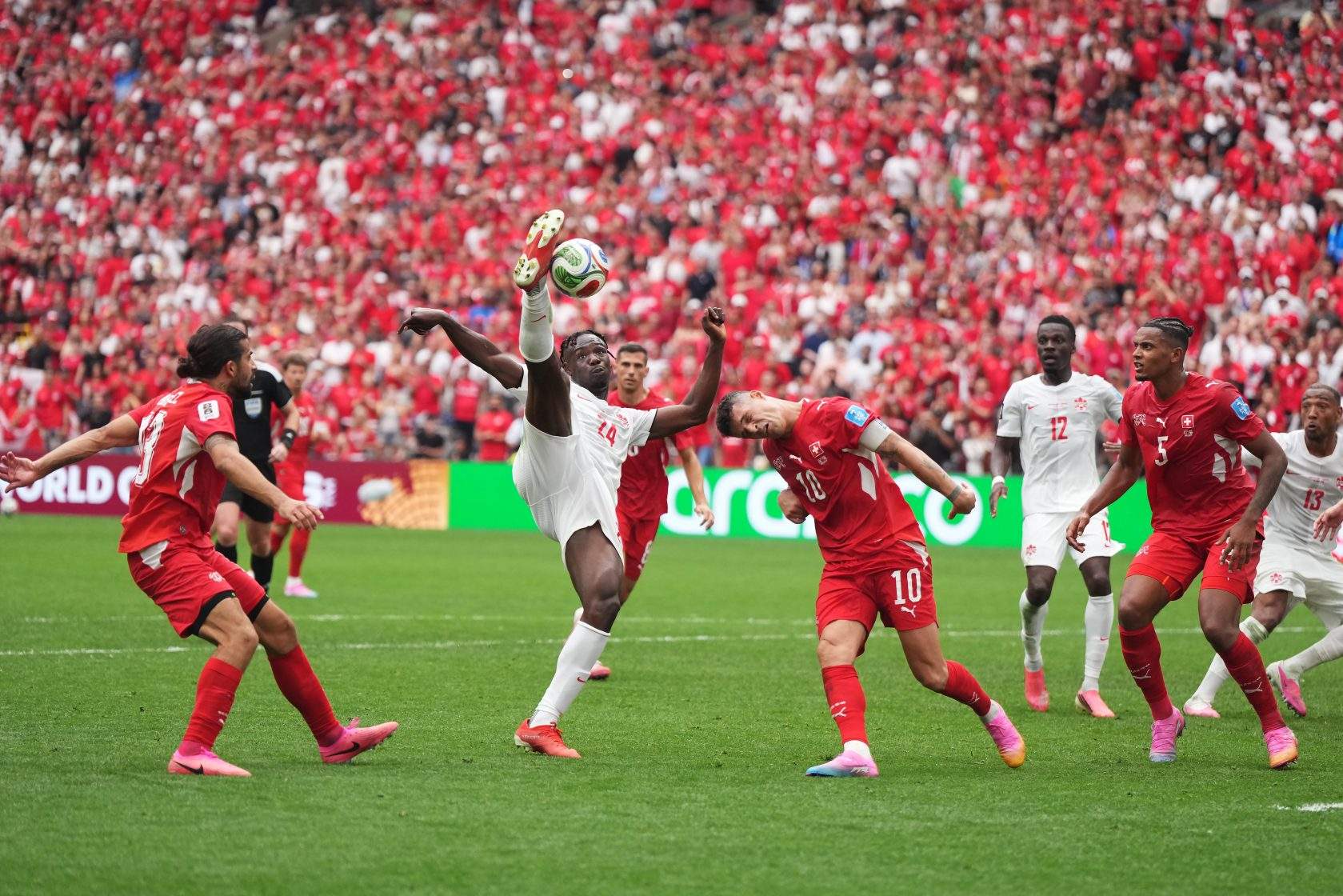
The air inside Los Angeles Stadium does not care about national identity. It is heavy, artificial, and smells of expensive stale popcorn and the faint, metallic tang of air conditioning running at maximum capacity. Down on the grass, a man is staring at his own boots.
Let us call him Thomas. He is not on the roster. He is a guy from Red Deer who spent his life savings on a ticket to see a soccer match in California, sitting in Row 24, holding a flag that suddenly feels very heavy. For weeks, Thomas and millions of others had the luxury of a safety net. The group stage of a World Cup is a cushion. You can drop a match to Switzerland, as Canada did on Wednesday, and still find yourself upright, breathing, and planning for the future. You can tinker with the machine.
Not anymore.
On Sunday afternoon, the safety net is being rolled up and stowed away. When Canada steps onto the pitch against South Africa, they are entering a space where the loser does not get to pack their bags slowly. They are erased from the tournament before the sun sets over the Pacific. It is the Round of 32. A simple phrase, yet it represents the first true elimination match in the history of Canadian men’s soccer.
To understand what that means, you have to look past the official FIFA rankings that place Canada at number 31 and South Africa at 54. Those numbers are abstractions created by algorithms in Switzerland. They mean nothing when the whistle blows. The real story is found in the physical reality of a squad that has run out of territory.
For the entirety of this tournament, Canada has been wrapped in the warm, loud embrace of home. They played their group matches on Canadian soil, fueled by the localized thunder of crowds in Toronto and Vancouver. Now, they have been pushed across the border. This is their first match of the tournament outside Canada. The geography has shifted, and with it, the psychological gravity.
Consider the modern professional athlete not as a collection of statistics, but as a biological system under immense stress. Jesse Marsch, the Canadian head coach, spent the days leading up to this match managing a delicate inventory of human flesh and bone. Alphonso Davies, whose explosive pace is usually Canada's primary argument on the pitch, has spent the week hovering between the training table and the starting lineup. His body is a map of minor traumas. Stephen Eustáquio, the midfield anchor who missed the Switzerland match with muscle tightness, knows exactly what is at stake. He admitted the team desperately wanted to stay in Vancouver. They wanted the comfort of the familiar.
Instead, they got Los Angeles. They got a stadium that belongs to everyone and no one.
Across from them stands South Africa, a team that arrived here by blowing up everyone else's predictions. Their 1-0 upset over South Korea was not a fluke; it was a masterclass in suffering. Bafana Bafana are comfortable without the ball. They are perfectly content to let an opponent pass themselves into exhaustion, waiting for the precise moment when a defender moves a yard too far forward. Teboho Mokoena, their midfield shield, operates like an engineer analyzing a bridge for structural failure. The moment Canada's fullbacks commit to the attack, Mokoena’s job is to trigger the trap, launching long, diagonal balls into the space left behind.
It is a clash of neuroses. Canada wants to press, to dictate, to run until their lungs burn. South Africa wants to wait, to breathe, and to strike when Canada loses its patience.
The history between these two nations is nearly non-existent, a single friendly match in 2007 that South Africa won 2-0. That was a different lifetime. None of the men on the field on Sunday remember it as anything other than a line in a media guide. What they feel now is the immediate pressure of the present.
If you look closely at the benches during national anthems, you can see the exact moment the reality settles in. The players stand shoulder to shoulder, but their eyes are fixed on the grass. They know that ninety minutes from now, one of these groups will be transformed into historical footnotes. The host nation’s romantic run could end in a neutral stadium three hours from the border, or South Africa’s renaissance could be cut short before they can truly savor it.
Thomas, up in Row 24, clears his throat and begins to shout. His voice is swallowed instantly by the roar of seventy thousand people, but he keeps shouting anyway. On the pitch below, twenty-two men take their positions, looking at each other across a green expanse that has suddenly become very small, and very final.