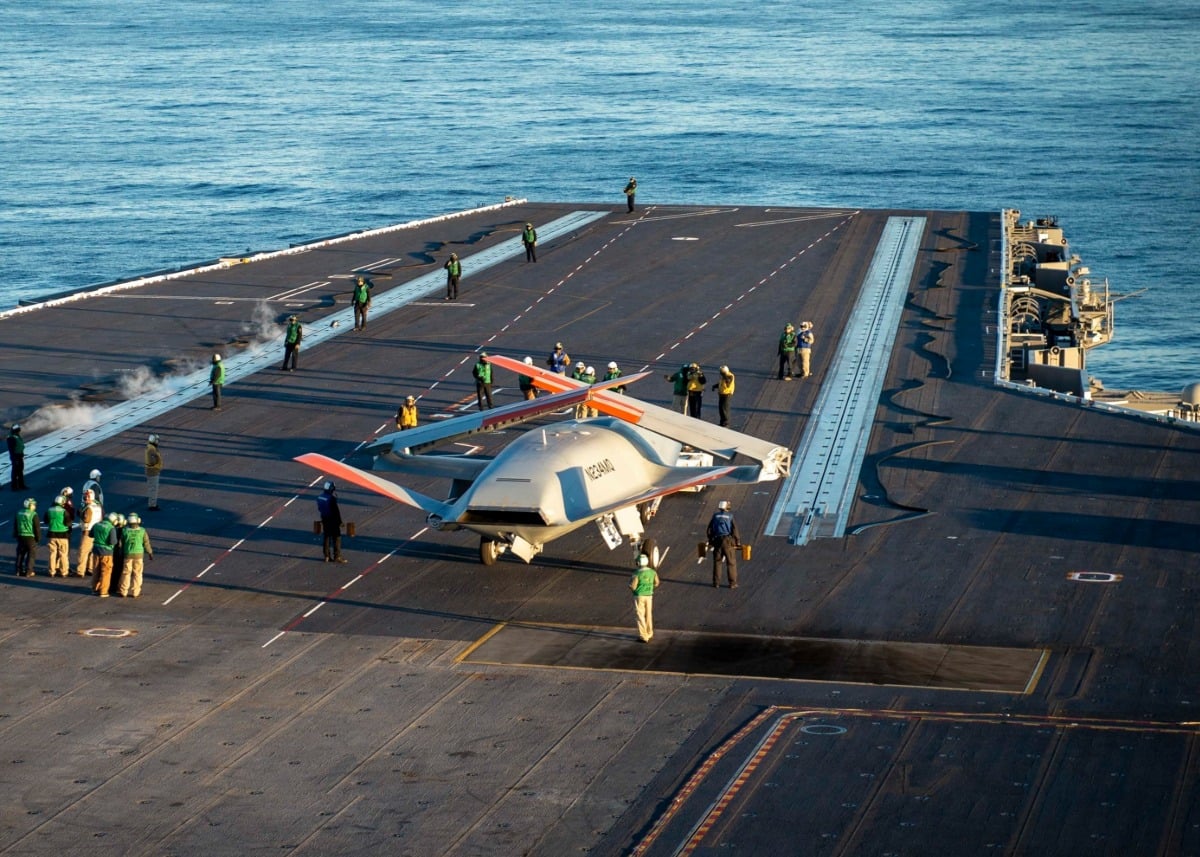
The United States Navy is quietly attempting to redesign the physics of power projection. Facing an increasingly lethal ring of Chinese anti-ship missiles, the Pentagon wants a fleet of unmanned, carrier-based fighter jets capable of flying 1,000 miles to strike targets and return. This massive range requirement—nearly double the combat radius of the current F/A-18 Super Hornet and F-35C fleets—is not a luxury. It is a desperate survival strategy. If carriers must park 1,000 miles away to avoid being sunk by land-based ballistic missiles, their planes must be able to fly that distance, fight, and fly back.
But this ambition is running headfirst into a wall of engineering and budget realities. Building a stealthy, uncrewed aircraft that can endure long-range flights while carrying heavy payloads requires overcoming massive aerodynamic, software, and industrial hurdles. The Navy's path forward is far more precarious than official statements suggest.
The Tyranny of Distance in the Pacific
For three decades, American aircraft carriers operated with near-total impunity. They could sail close to enemy shores, launch short-range strikes, and recover jets with predictable regularity.
That era is over.
The Chinese military has spent twenty years building an "anti-access/area-denial" network. It is designed specifically to keep American carriers at bay. At the heart of this strategy are weapons like the DF-21D and DF-26 "carrier killer" anti-ship ballistic missiles. These weapons have estimated ranges of 1,000 to more than 2,000 miles.
This creates a critical vulnerability. The current strike backbone of the carrier air wing, the F-35C, has a combat radius of roughly 600 nautical miles. If a carrier must stay 1,000 miles away to remain safe from missile barrages, its manned fighters cannot reach the fight.
Air-to-air refueling is the traditional solution, but it is a fragile one. Large, non-stealthy tankers like the KC-46 are incredibly vulnerable to long-range air-to-air missiles. Relying on them in contested airspace is a recipe for disaster. The Navy needs an organic, long-range platform that lives on the carrier deck.
Why Stealth and Extreme Range Fight Each Other
Designing an uncrewed combat aerial vehicle (UCAV) to fly 1,000 miles is not as simple as scaling up a drone. It requires a brutal compromise between stealth, fuel capacity, and payload.
To achieve extreme range, an aircraft needs high aspect-ratio wings—long and slender, much like a glider. This shape maximizes aerodynamic efficiency and fuel economy. However, long, slender wings are difficult to make stealthy from all angles. They also present massive structural challenges when landing on a pitching carrier deck, where planes must essentially crash land under control, arresting their speed via a steel cable.
Conversely, deep stealth designs require highly integrated, blended-wing-body shapes. These shapes are excellent for dodging radar but offer less internal volume for the massive fuel tanks needed to cover 1,000 miles.
Every extra gallon of fuel adds weight. More weight requires a larger engine or higher thrust, which consumes fuel faster. It is a vicious spiral of aerospace engineering.
[Increased Range] ➔ [More Internal Fuel] ➔ [Larger/Heavier Airframe] ➔ [Stiffened Landing Gear for Carrier Operations] ➔ [Reduced Stealth/Increased Engine Thrust Required] ➔ [Higher Fuel Consumption]
Furthermore, carrier aircraft must be compact. Deck space on a Nimitz or Ford-class carrier is some of the most valuable real estate on earth. If the Navy builds a drone with a massive wingspan to achieve its 1,000-mile goal, it will limit how many of these aircraft can actually fit on the ship. A weapon system that cannot be deployed in meaningful numbers is useless in a peer conflict.
The Software Crisis No One Wants to Discuss
The physical airframe is only half the battle. The far more complex challenge lies in the software required to operate an uncrewed fighter in a highly contested electronic warfare environment.
Military planners often speak of "collaborative combat aircraft" flying alongside manned fighters. But this assumes reliable communication links. In a high-end conflict with a peer adversary, the electromagnetic spectrum will be heavily jammed. GPS will be denied. Satellite communications will be degraded or severed entirely.
Under these conditions, a drone cannot rely on a remote human pilot sitting in a control room. It must possess a level of autonomous decision-making that does not currently exist in any deployed military system.
- Target Identification: The drone must distinguish between military targets and civilian vessels without human intervention.
- Tactical Maneuvering: It must execute defensive maneuvers when shot at, coordinating with other unmanned assets in real-time.
- Dynamic Routing: It must recalculate flight paths on the fly to avoid newly detected radar threats.
Developing software that can handle these variables reliably—without accidentally starting an unintended escalation or crashing due to a software glitch—is an incredibly expensive and slow process. The aviation industry is littered with programs that built working airframes but failed because the code could not keep up with the physical reality of war.
The Pentagon History of Broken Promises
The Navy's track record with carrier-based drones does not inspire immediate confidence. The service has spent nearly two decades shifting its requirements, moving the goalposts whenever a program got close to fruition.
In the early 2000s, the Joint Unmanned Combat Air Systems program showed massive promise. The experimental X-47B proved that an uncrewed stealth aircraft could successfully launch and land on a carrier. It even conducted autonomous aerial refueling. It was a remarkable technical achievement.
Rather than pushing that technology into production, the Navy got cold feet. Fearing that drones would undermine the role of manned fighter pilots, leadership downgraded the requirements. The program morphed into the Unmanned Carrier-Launched Airborne Surveillance and Strike effort, which was then downgraded again into the MQ-25 Stingray.
Instead of a stealthy, long-range strike platform, the MQ-25 became an unarmed aerial tanker.
X-47B (Stealth Strike Tech Demo) ➔ UCLASS (Armed Recon/Strike) ➔ MQ-25 Stingray (Unarmed Aerial Tanker)
The Navy spent billions of dollars and twenty years to turn a revolutionary stealth combat drone concept into a flying gas station. Now, realizing the immense threat posed by Chinese missiles, the service is scrambling back toward the original strike drone concept. This decades-long vacillation has cost the United States precious time that it can never recover.
The Industrial Base is at Its Breaking Point
Even if the Navy finalizes a design and writes the necessary software, a glaring question remains. Who is going to build these aircraft?
The American defense industrial base is consolidated, fragile, and plagued by labor shortages. Major aerospace programs are routinely years behind schedule and billions over budget. The F-35 program is a prime example, still struggling with supply chain bottlenecks and software integration issues decades after its inception.
Building a brand-new, highly advanced uncrewed fighter requires specialized engineering talent, rare-earth materials, and advanced manufacturing facilities that are already stretched to their limits.
Current Defense Industrial Bottlenecks:
- Chronic shortage of aerospace engineers and software developers.
- Fragile supply chains for advanced composite materials.
- Limited shipyard and aircraft manufacturing capacity.
- Long lead times for critical components like sensors and engines.
If the Navy attempts to rush a 1,000-mile drone into production, it will inevitably cannibalize resources from other vital programs, such as the Next Generation Air Dominance fighter or the Columbia-class submarine program. The Pentagon is attempting to build the future of naval warfare with an industrial base that is barely capable of maintaining the present.
The Carrier's Final Stand
The quest for a 1,000-mile uncrewed fighter is a tacit admission of a brutal truth. Without it, the multi-billion-dollar supercarrier risks becoming a massive, floating target in a future Pacific war.
If the Navy cannot solve the engineering, software, and industrial challenges required to build this long-range platform, the utility of the carrier fleet will be fundamentally compromised. The service cannot afford another decades-long development cycle characterized by shifting requirements and bureaucratic indecision.
Every mile that Chinese missiles push the carrier back is a mile that American airpower must claw back through sheer technological ingenuity. If the physics of flight and the realities of military procurement cannot bridge that gap, the strategic balance of power in the Pacific will shift permanently. The Navy is running out of time to prove that its carriers can still reach the fight.