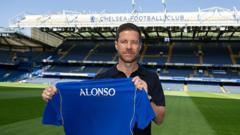
The air in the Drake Suite at Stamford Bridge is always slightly too dry, a clinical, air-conditioned draft that smells faintly of fresh paint and expensive expectations. On Monday, Xabi Alonso sat in the middle of it. He looked exactly as he always does: tailored, pristine, a man who seems to exist in a perpetual state of cinematic composure.
Yet, the questions directed at him were not about the blue shirt he was holding. They were about the red one he used to wear.
A journalist asked why he was sitting in West London instead of standing on the touchline at Anfield, a place where his name is still sung in the pubs along Walton Breck Road.
Alonso did not offer a grand, sweeping speech about projects or philosophies. He offered three words.
"It is about timings."
On the surface, it is the ultimate diplomatic dodge. It is the kind of quote designed to glide over the back pages without snagging on anything controversial. But if you look closely at the calendar of May 2026, those three words reveal the quiet, terrifying reality of modern football management. It is a world where careers are decided not by tactical genius, but by the cold, unyielding physics of a ticking clock.
The Two-Week Void
Imagine standing on a platform, watching a train pull into the station. You know another train—the one you actually want to take—might be coming. Or it might not. The schedule on the board is blank. The station agent refuses to look you in the eye. Do you step onto the train that is sitting open-mouthed in front of you, or do you stand on the freezing concrete, hoping for a headlight in the distance?
This was Alonso's reality in mid-May.
At Anfield, Arne Slot was drowning, but he had not yet gone under. The Liverpool board, managed by the meticulous, data-driven accountants of Fenway Sports Group, was paralyzed by indecision. They wanted to believe in Slot, or perhaps they simply hated the financial and logistical mess of admitting a mistake so quickly. Rumors swirled that Alonso was willing to wait, that he would linger in the shadows until Liverpool finally pulled the trigger.
But football does not tolerate a vacuum.
While Liverpool hesitated, Chelsea moved with the frantic, predatory energy of a club that views managers as highly combustible fuel cells. They wanted Alonso. They wanted him immediately.
Consider the timeline:
- May 17, 2026: Chelsea officially announces Xabi Alonso as their new manager.
- May 30, 2026: Exactly thirteen days later, Liverpool finally sacks Arne Slot.
Thirteen days.
In the grand scheme of a human life, a fortnight is nothing. It is a quick vacation, a brief illness, a couple of grocery trips. In the elite ecosystem of European football, thirteen days is an eternity. It is the difference between a secure four-year contract at one of the wealthiest clubs on earth and standing in the unemployment line, hoping your old flame decides to call.
Alonso could not afford to gamble his historic run at Bayer Leverkusen on a "maybe" from Boston. He took the bird in the hand, even if that bird was wearing a blue jersey and clutching a chaotic, bloated roster.
The Illusion of the Safe Choice
There is a romantic narrative that Liverpool fans wanted to believe: that Alonso would reject Chelsea out of pure, unadulterated loyalty to the Kop. We love to think that footballers and managers share our tribal passions, that they lie awake at night dreaming of Anfield’s legendary European nights just like the teenagers on the terraces do.
But sentimentality is a luxury for those who don't have their reputations on the line.
Consider what happens next when a manager chooses romanticism over reality: they become hostages to history. Returning to Liverpool as a savior is a beautiful story, but it is also a trap. You are not just competing against the eleven players on the pitch; you are competing against the ghost of Jürgen Klopp, the ghost of Bill Shankly, and the ghost of your own twenty-something self lifting the Champions League trophy in Istanbul.
At Chelsea, there are no ghosts of that kind. The history of Stamford Bridge is not a slow-cooked tradition; it is a series of short, intense, highly successful explosions. Managers arrive, they win trophies in a fever dream of Roman Abramovich or BlueCo cash, they burn out, and they leave.
It is a mercenary’s playground, but for a coach of Alonso’s clinical caliber, there is a strange, liberating honesty to it. He does not need to be loved in London. He just needs to build.
The Cobham Crucible
Now, the reality of Alonso's decision begins to bite.
He inherits a Chelsea squad that finished a miserable tenth last season, a team stripped of European football and devoid of the structural identity he so beautifully crafted in Leverkusen. The fans are mutinous, the ownership group is viewed with deep suspicion, and the dressing room is filled with expensive, disparate pieces that do not yet fit together.
Yet, in his first press conference, there was no panic in his eyes.
"We want to take important decisions, we need to build strong principles, a strong mentality and culture in the club," Alonso said, his voice level, almost hypnotic.
Without the distraction of midweek European trips, he has what every modern manager craves but is rarely given: time on the training pitch. He has Cobham, a state-of-the-art laboratory where he can dissect Chelsea’s broken machine and rebuild it in his own image.
Meanwhile, Liverpool has moved on to Andoni Iraola. The Anfield faithful will learn to love their new Basque manager, or they won't. But as the winter wind begins to howl and the fixtures pile up, there will always be that lingering, unspoken question in the back of every supporter's mind.
What if we had moved thirteen days earlier?
But the clock has already ticked past. The train has left the station. And Xabi Alonso is already wearing blue.