The mound at Hisarlik is not a city. It is a biological and architectural pileup of human stubbornness that refused to move for four millennia. While casual travelers often expect a grand, singular ruin like the Parthenon, the reality of Troy is a messy, vertical timeline of nine major layers and dozens of sub-phases. These layers represent 4,000 years of people building directly on top of the garbage, rubble, and corpses of their ancestors.
This was not a choice made out of reverence for the past. It was a tactical necessity driven by the geography of the Dardanelles. Troy sat at the mouth of the Scamander River, commanding the entry point to the Black Sea. If you controlled this hill, you controlled the bronze age equivalent of a global shipping lane. To abandon the site because of an earthquake or a fire was to surrender the most valuable toll booth in the ancient world.
The Engineering of Persistence
Building on top of older structures was the only way to maintain the height advantage required for defense. Each time a "city" fell—whether to the torch or the tectonic shifts common in Northwest Turkey—the survivors did not clear the site. They leveled the debris. They used the broken limestone walls of Troy II as the foundation for the homes of Troy III.
The result is a geological anomaly. The ground you walk on at the site is largely artificial. It is a "tell," a mound formed entirely by human habitation. Archaeologists have identified roughly 46 distinct occupational phases within the nine main layers. This creates a nightmare for preservation. When Heinrich Schliemann blasted through the center of the mound in the 1870s, his crude methods destroyed massive sections of the upper layers—the Troy of Homeric legend—just to reach the treasure-laden levels of the Early Bronze Age. He effectively killed the city a tenth time.
The Myth of the Homogenous Hero
We are taught to see Troy through the lens of a ten-year war between Greeks and Trojans. This narrative simplifies a much more complex and violent reality. The archaeological record shows that the site was under constant pressure not just from the west, but from the Hittite Empire to the east.
The Troy of the "Trojan War" is most likely Troy VIh or VIIa. Here, the walls were massive, sloped to withstand earthquakes, and topped with mudbrick. But the evidence of its fall isn't a wooden horse. It is a collection of unburied skeletons, piles of sling stones, and charred timber. These cities didn't end with a poetic flourish. They ended with the systematic slaughter of the inhabitants and the immediate, desperate rebuilding by the survivors.
The Bronze Age Collapse and the Dark Ages
The most telling part of the Trojan story isn't the height of its power, but its periods of squalor. Following the destruction of the celebrated Troy VI/VII, the site did not vanish. It shrank. The massive palatial structures were replaced by small, cramped houses with shared walls.
The international trade networks that brought tin from Afghanistan and copper from Cyprus had vanished. Troy VIIb shows a city in survival mode. The pottery becomes coarse. The luxury goods disappear. Yet, they stayed. Even when the "world" as they knew it ended during the general collapse of the Mediterranean civilizations around 1200 BCE, the inhabitants of Troy clung to that specific hill. They were waiting for the trade routes to reopen. They waited for centuries.
A Roman PR Campaign
By the time the Romans arrived, Troy was more a memory than a metropolis. The Romans, however, claimed descent from the Trojan hero Aeneas. This wasn't just a romantic notion; it was a political tool to legitimize Roman rule in the East.
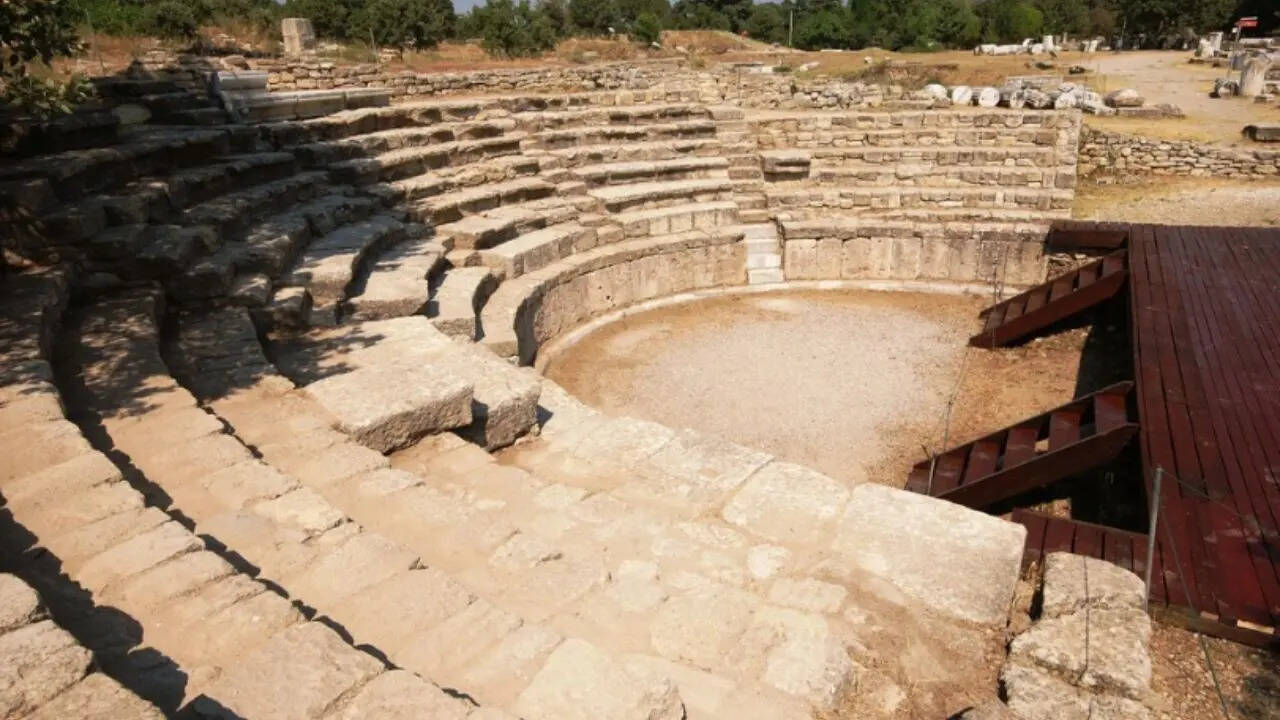
They transformed the site into "Ilium," a tourist destination for the elite. They leveled the top of the mound to build a massive Temple of Athena, inadvertently shearing off the highest (and most recent) archaeological layers. The Romans treated the site like a theme park, building theaters and baths over the Bronze Age fortifications. This layer, Troy IX, is the final layer of the stack. When the capital of the empire moved to Constantinople, the strategic value of the Hisarlik hill finally evaporated. The harbor had silted up, the trade routes shifted, and the 4,000-year cycle of rebuilding finally broke.
The Danger of the Modern Gaze
Today, the site is a victim of its own complexity. It is difficult for the human eye to process three millennia of history occupying the same square meter of space. You are looking at a trench where a wall from 2500 BCE sits directly beneath a Roman walkway from 200 CE.
This verticality is the true story of Troy. It isn't a story of beauty or architectural triumph. It is a story of a location so valuable that people were willing to live in the wreckage of their own history for a hundred generations. They lived, fought, and died on a mountain made of their own trash and the ruins of their fathers' houses.
The wind that blows across the Troad plain today carries the dust of those forty centuries. When you stand on the remains of the Northeast Bastion, you aren't just looking at a view of the Aegean. You are standing on the compressed remains of empires that thought they would last forever, only to become the floorboards for the people who came next.