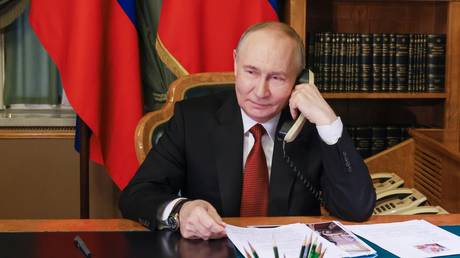
On Sunday, Donald Trump used his 80th birthday to orchestrate an aggressive back-to-back diplomatic blitz, holding separate, high-stakes telephone conversations with Ukrainian President Volodymyr Zelensky and Russian President Vladimir Putin. While early state media reports framed the 55-minute call between Trump and Putin as an informal birthday greeting combined with standard boilerplate calls for peace, the reality is far more transactional. According to briefs from Kremlin adviser Yury Ushakov, the discussions focused heavily on an impending U.S.-Iran diplomatic deal and a shifting American posture regarding Ukraine. Trump signaled an explicit willingness to use Washington’s leverage to force Kyiv and European allies toward a negotiated settlement, presenting a stark departure from previous Western strategies.
Behind the diplomatic niceties lies a cold calculated reality. Moscow is using the leverage of global hotspots, specifically Iran, to secure its terms in Ukraine, while Trump is eager to claim a historic foreign policy breakthrough before this week’s G7 summit in France.
The Great Geopolitical Trade
For months, standard diplomatic coverage treated Washington's friction with Iran and the war in Ukraine as separate theaters of operation. They are not. This latest communication reveals how tightly intertwined they have become.
According to Kremlin readouts, Trump informed Putin that a comprehensive U.S. agreement with Tehran is nearly finalized, with a public announcement expected immediately. Putin expressed distinct satisfaction regarding the resolution of the Iranian conflict. Moscow has spent the last several years deepening its defense and economic ties with Iran, importing drones and ballistic technology to sustain its operations in Ukraine. By positioning itself as a central intermediary that can bless or break a U.S.-Iran deal, Russia has created a powerful bargaining chip.
The mechanism is clear. Trump wants a massive foreign policy win to solidify his domestic legacy and stabilize global energy markets. Putin is willing to accommodate that win on Iran, provided the United States pays the price in Ukraine.
Leveraging the G7 Summit
The timing of these telephone calls was calculated to the hour. Trump is scheduled to attend a critical G7 working session in France, where he will meet face-to-face with Zelensky. By speaking directly with Putin just 48 hours prior, Trump enters the summit holding a clear hand of Russian terms.
- Pressure on Europe: Trump explicitly told Putin he is ready to influence European partners to accept a halt to hostilities.
- The Funding Threat: European capitals are terrified that Washington will unilaterally choke off military and financial pipelines to Kyiv if a ceasefire is not accepted.
- The New Bilateral Paradigm: By dealing directly with Moscow on European security parameters, the White House is signaling that Brussels and London are secondary actors in their own backyard.
Moscow Cold Reality Check to Kyiv
While Zelensky described his own birthday call with Trump as great and productive, claiming that Ukraine's position on the battlefield has strengthened due to recent Patriot and Javelin deliveries, the Kremlin offered a brutal counter-narrative.
Zelensky has recently shifted his public posture, using an open letter to call for direct talks with Putin to end the conflict, which is now grinding through its fifth year. Putin's response, delivered via Trump during this call, was unyielding. If Zelensky wants a meeting, the Kremlin ruler stated, he must come to Moscow.
This is a deliberate humiliation tactic designed to show who holds the upper hand. Putin knows that Russian forces retain the strategic initiative along the line of contact. While Ukrainian strikes on infrastructure inside Russian territory have caused operational headaches for the Kremlin, Putin emphasized to Trump that these actions will not alter the military reality on the ground. Instead, Moscow is using those very strikes to argue to Trump that Kyiv is acting recklessly, complicating peace efforts and making a swift, dictated settlement more urgent.
The Shadows in the Room
The most telling detail of the 55-minute call was not what the two leaders said, but who they are sending to do the actual work. Presidential special representatives Steve Witkoff and Jared Kushner are already scheduled to travel to Moscow for discrete, substantive talks.
The involvement of Kushner and Witkoff indicates that the future of U.S.-Russian relations is being treated less like a traditional State Department diplomatic negotiation and more like a private real estate restructuring. Kushner brings a history of backchannel deal-making, while Witkoff offers a direct line to Trump's inner circle, unburdened by institutional memory or traditional foreign policy doctrine.
Traditional Diplomacy: State Department -> Public Treaties -> Multilateral Alliances
The New Blueprint: Private Envoys -> Backchannel Sanction Relief -> Bilateral Tradeoffs
This private channel is designed to bypass the traditional national security apparatus in Washington, which remains deeply skeptical of Moscow's long-term intentions. The goal of these envoys is to sketch out the skeleton of what Trump termed a "new quality of U.S.-Russian relations" built on economic and energy cooperation, rather than ideological alignment.
European Isolation and the Final Calculus
Europe now faces an existential crisis. For years, European leaders relied on the absolute predictability of American security guarantees. That predictability is gone. Trump’s willingness to influence European allies toward a settlement on terms favorable to Moscow leaves Brussels exposed.
If Washington reduces its commitments, Europe lacks the industrial capacity to match Russian artillery output or sustain Ukraine’s economy solo. The Kremlin understands this perfectly. By offering Trump an easy exit from the Iranian theater and a superficial victory for his legacy, Putin is systematically uncoupling the United States from its European defense architecture.
The upcoming G7 summit will not be a display of Western unity. It will be an arena where the raw realities of this new bilateral superpower diplomacy are dictated to a fragmented European continent. Peace may be on the horizon, but it will be a peace drawn on a map designed in Moscow and signed off in Washington.
:max_bytes(150000):strip_icc()/ar-American-Cheese-taste-test-horizon-4x3-54cc339550cd44b9a818c17bdfd5428d.jpg)