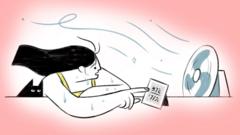
When a heatwave hits and you lack air conditioning, the humble electric fan becomes your frontline defense. To survive the swelter, you must understand a fundamental truth: a fan does not cool the air in your room, it only moves it. If the ambient temperature rises above a certain threshold, relying blindly on a fan will not just fail to cool you down—it can actively accelerate dehydration and heat exhaustion.
The mechanism is simple thermodynamics. Fans cool your body by accelerating the evaporation of sweat from your skin and replacing the warm air immediately surrounding your body with cooler ambient air. However, when the room's temperature surpasses your natural skin temperature—typically around 35°C or 95°F—the physics flip. Instead of removing heat, the fan begins blowing air that is hotter than your body temperature directly onto you, acting like a convection oven.
The Convection Oven Effect and the Limits of Sweat
Public health agencies frequently issue warnings about fan usage during extreme heat spikes, yet the nuance of these warnings rarely makes it to the general public.
When you sit in front of a fan in an overheated room, you are banking entirely on the process of evaporative cooling. As sweat evaporates, it absorbs latent heat from your body, lowering your core temperature.
But this system breaks down under two distinct environmental conditions:
- Extreme Dry Heat: If the air temperature is over 35°C (95°F) and the humidity is low, sweat evaporates almost instantly. If you blast a fan directly at yourself in these conditions, the air movement increases the rate of heat transfer from the hot room to your body faster than your sweat can counteract it. You dry out, your core temperature rises, and you move closer to heat exhaustion.
- Oppressive Humidity: When the air is saturated with moisture (high relative humidity), sweat cannot evaporate efficiently because the air is already holding as much water vapor as it can. The sweat pools on your skin. The fan moves wet, warm air around, but the crucial cooling phase—evaporation—never happens.
To use a fan safely when the mercury climbs, you have to look beyond the blade speed. You have to manipulate the entire microclimate of your living space.
Cross-Ventilation and the Aerodynamic Mistakes You Are Making
Most people place a fan in the center of a room, point it directly at their face, and crank it to maximum speed. This is an aerodynamic error.
If the air outside is cooler than the air inside—a common occurrence during the evening or early morning—you should be using a strategy called cross-ventilation.
[Hot Indoor Air] ---> (Fan Blowing OUT Window)
                                       ^
                                       |
(Open Window on Shady Side) ---> [Cooler Outdoor Air Enters]
To execute this properly, do not point the fan inward. Position the fan about two to three feet away from an open window, facing outward. By blowing the hot indoor air out of the room, you create a low-pressure zone inside. This vacuum forces the cooler outdoor air to rush in through other open windows or doors.
If you have a second fan, place it at a window on the opposite side of the house, pointing inward, to pull the fresh air in. This establishes a continuous, high-volume stream of air exchange.
The placement matters immensely. Putting the exhaust fan right against the window screen actually restricts air flow. Backing it up slightly allows the cone of moving air to encompass the entire window frame, maximizing the volume of hot air pushed outside.
Engineering an Artificial Heat Sink
The classic internet hack involves placing a bowl of ice or frozen water bottles in front of a fan to create a DIY air conditioner. It works, but usually not for the reasons people think, and rarely for very long.
When air passes over the ice, it transfers heat to the ice, causing it to melt. This process cools the air immediately surrounding the bowl, which the fan then projects toward you.
However, this method introduces a hidden penalty: humidity.
As the ice melts and evaporates, it increases the relative humidity of the room. If you are in a small, enclosed space, you are trading a slight, temporary drop in temperature for a significant rise in humidity. Within an hour, the air becomes muggy, rendering your body's natural sweating mechanism less effective.
If you want to use the ice trick safely, use completely sealed containers—like frozen gel packs or solid ice blocks in sealed plastic jugs. Wipe down the condensation on the outside of the containers frequently. This delivers the cooling effect of the thermal mass without dumping extra moisture into your air supply.
Managing Your Home as a Thermal Fortress
A fan is only as good as the air it has access to. If your walls, floors, and furniture have spent all day absorbing radiant heat from the sun, your fan is just circulating air over a giant radiator.
To stop your home from turning into a heat trap during the day, you must treat your windows like barricades.
Close the Barriers Early
Keep windows, blinds, and curtains completely shut the moment the outdoor temperature matches or exceeds the indoor temperature. This feels counterintuitive to many who want to "let a breeze in." But if that breeze is 32°C (90°F), you are merely inviting heat inside.
Optimize Your Fabrics
Standard plastic or metal blinds block some light, but they absorb heat and radiate it directly into the room. Heavy, light-colored curtains or dedicated thermal drapes reflect the solar radiation back through the glass.
Kill the Internal Heat Generators
Every appliance in your home contributes to the ambient temperature. Incandescent bulbs, desktop computers, television screens, and cooking appliances act as small space heaters. Turn them off. Run your fan on its lowest effective setting if you are sitting close to it, as even the fan's internal electric motor generates a small amount of heat over hours of continuous operation.
Choosing the Right Blade for the Job
Not all fans are built to handle the same cooling tasks, and using the wrong architecture compromises efficiency.
| Fan Type | Best Used For | Strategic Placement |
|---|---|---|
| Ceiling Fan | Forcing hot air upward or creating a gentle whole-room breeze. | Centered in high-traffic rooms; must run counter-clockwise in summer. |
| Box Fan | Creating pressure differentials and moving large volumes of air through barriers. | Placed in windows, facing outward to exhaust hot air. |
| Pedestal Fan | Targeted, directional cooling for individuals. | Placed 4–6 feet away from you, oscillating to avoid drying out skin too fast. |
| Tower Fan | Quiet, space-saving air movement in tight quarters. | Placed in corners to circulate air along the perimeter of a room. |
Ceiling fans require specific attention because they feature a directional switch on the motor housing. In the summer, the blades must rotate counter-clockwise. This orientation creates a downward draft, pushing air directly down onto your skin to maximize the wind-chill effect. If the blades are spinning clockwise, they pull air upward, which is a setting designed exclusively for winter to redistribute trapped heat from the ceiling.
When to Turn the Fan Off
There comes a point where safety dictates walking away from the fan entirely.
If the indoor temperature reaches 38°C (100°F) and you have no way to lower the humidity, a fan will not protect you from heat-related illnesses. In fact, it can mask the danger by drying your sweat so quickly that you fail to realize how much fluid you are losing.
When you hit this threshold, you must pivot from cooling the air to cooling your core directly. Take a cool shower or bath. Apply damp towels to your pulse points—your wrists, neck, and the insides of your elbows—where blood vessels run closest to the skin. Drink water constantly, even if you do not feel thirsty, because your fan has likely been evaporating your sweat before you even realize you are perspiring.