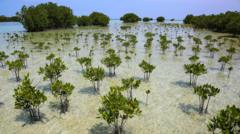
A wave of optimism is washing over global conservation circles, driven by data suggesting that the world’s mangrove forests are finally healing after decades of relentless human destruction. Satellite monitoring shows deforestation rates have slowed significantly, and in some regions, canopy cover is actively expanding. But this superficial victory masks a much darker reality. While raw acreage numbers look promising on a spreadsheet, the actual ecological health of these vital coastal buffers is fracturing under the weight of flawed restoration tactics, corporate greenwashing, and systemic corruption. We are replacing ancient, highly complex ecosystems with fragile, single-species plantations that cannot survive the rising tides they are meant to protect against.
The narrative of a sweeping mangrove recovery collapses the moment you step into the mud. For a generation, shrimp farming, coastal development, and charcoal production gutted these intertidal forests, wiping out more than an estimated 20% of global mangrove coverage since 1980. The recent stabilization of total forest area is a genuine achievement of localized community activism and stricter enforcement of environmental laws. However, equating mere tree counts with true ecological restoration is a dangerous mistake that ignores how these unique environments actually function.
The Illusion of the Green Line on the Graph
Data points often lie by omission. International agencies regularly publish maps showing a stabilization of global mangrove losses, celebrating a transition from net loss to potential net gain. What these maps fail to reveal is the stark difference between a primary, old-growth mangrove forest and a newly planted monoculture.
An intact mangrove system is a genetic fortress. It relies on a delicate balance of multiple species, each adapted to specific tidal elevations, salinity gradients, and soil conditions. For instance, Avicennia species might anchor themselves closest to the pounding surf, while Rhizophora species thrive slightly further inland, creating a tiered defense system against storm surges.
Modern mass-planting initiatives regularly ignore this biological zoning. Well-meaning non-profits and corporate sponsors looking for quick carbon offsets typically buy millions of seeds of a single, easy-to-grow species—frequently Rhizophora mangle—and plant them indiscriminately in areas where they do not belong. They plant them on open mudflats, in seagrass beds, or even in deep water where the seedlings drown during the first high tide. The result is not a forest. It is a crop, and like any monoculture, it is highly vulnerable to disease and climate shocks.
How Carbon Markets Incentivize Malpractice
Money is flooding into coastal ecosystems, but it is driving the wrong behaviors. The rise of blue carbon markets—where companies buy credits generated by marine carbon sequestration—has turned mangrove restoration into a high-stakes numbers game. Because these markets reward speed and volume, project developers are incentivized to optimize for the maximum number of stems planted per dollar, rather than the long-term survival of the ecosystem.
Consider a hypothetical example of a standard corporate offset program. A multinational tech firm funds the planting of 500,000 mangrove seedlings along a degraded coastline in Southeast Asia. The press releases are drafted, the photographs of local workers holding bright green saplings are distributed, and the carbon credits are instantly logged against the corporation's emissions.
Two years later, nobody returns to check on the site. Had they looked, they would find that 85% of those saplings died within the first six months because they were planted in an area with blocked tidal hydrology. The local community, which was paid a pittance for the initial planting labor, has no long-term stake in guarding a dead mudflat. The carbon was never sequestered, but the corporate marketing campaign remains online.
This dynamic creates a perverse incentive structure:
- Quantity over quality: Funding is tied to the act of planting, not the milestone of survival.
- Species simplification: Nursery operators cultivate only the easiest, fastest-growing species, wiping out local biodiversity.
- Land grabs: Governments and private entities sometimes displace traditional fishing communities from public mudflats to clear space for profitable carbon-credit plantations.
The Hydrology Blind Spot
You cannot simply stick a mangrove seed in the mud and expect a forest to grow. The true secret to mangrove restoration lies not in botany, but in civil engineering. Mangroves are remarkably resilient plants that can heal themselves naturally, provided the underlying coastal hydrology is intact.
When shrimp aquaculture operations or coastal highways destroy a mangrove forest, they do more than just cut down trees. They bulldoze channels, build dikes, and alter the flow of fresh and saltwater. This ruins the precise tidal flushing that mangroves require to survive. When a site is cut off from the sea, the soil dries out, acidifies, and becomes toxic to new growth. Conversely, if a site is permanently flooded without tidal recession, the plants' specialized aerial roots—their pneumatophores—cannot breathe, suffocating the tree.
True investigative work in the field shows that the most successful restoration projects in the world involve almost no manual planting at all. Instead, they focus entirely on breaking down old aquaculture dikes, clearing blocked channels, and restoring the natural ebb and flow of the tide. Once the water moves correctly again, wild mangrove seeds floating in from nearby intact forests settle in the mud naturally. They find their own ideal tidal zones, and a diverse, resilient forest grows back on its own within a decade.
But ecological hydrological restoration is difficult, expensive, and requires deep local knowledge. It does not offer the simple, photogenic photo-ops that politicians and corporate executives demand. It involves heavy machinery, land rights negotiations, and months of monitoring water salinity and flow rates before a single plant appears.
Shrimp Farming and the Mobile Frontier of Destruction
While global headlines praise the slowing rate of mangrove clearing, they frequently overlook the geography of destruction. Mangrove loss has not stopped; it has merely migrated to countries with weaker regulatory oversight.
In nations where environmental enforcement has tightened, large-scale aquaculture companies have faced stiffer penalties and public backlash. In response, the industry has shifted its focus toward frontiers where enforcement is virtually non-existent. Pristine mangrove tracts in parts of West Africa, Central America, and remote islands in the Indonesian archipelago are being quietly systematically dismantled to make way for new industrial shrimp ponds.
MANGROVE LOSS AND RESTORATION BALANCE

[Traditional Frontier] -----------> Stricter Laws & High Enforcement
                                      |---> Result: Apparent Stabilization / Localized Growth

[New Frontier] -------------------> Weak Regulations & High Corruption
                                      |---> Result: High-Velocity Clearing of Old-Growth Forests
This creates a highly deceptive global average. A hectare of 200-year-old, highly biodiverse mangrove forest cleared in Papua New Guinea cannot be offset by a hectare of single-species seedlings planted in a compromised estuary in Thailand. The global data ledger might read net zero, but the planet has suffered a massive, irreplaceable loss of carbon storage capacity, storm protection, and marine habitat.
The Social Cost of Top-Down Conservation
The survival of any coastal forest is inextricably linked to the people who live alongside it. For centuries, traditional coastal communities have managed mangrove systems as common property resources, utilizing them sustainably for firewood, building materials, crabs, and fish.
When international conservation agencies or carbon project developers move in with top-down, exclusionary management models, they sever this human-ecological bond. Fencing off a mangrove forest and declaring it a strict nature reserve turns the local population into poachers overnight. Without a financial or cultural stake in the forest's preservation, local residents have little reason to protect it from illegal loggers or industrial encroachers.
Furthermore, many community-based projects fail because the economic incentives are poorly structured. If a fisher can make $20 a day by cutting down mangroves to burn into high-quality charcoal, offering them a one-time payment of $50 to plant seeds that will take ten years to mature is an economic failure. True sustainability requires long-term alternative economies, such as community-managed ecotourism, sustainable wild-catch fisheries, or direct payments for ecosystem maintenance where communities are compensated based on the verified survival rate of the forest over decades.
Rising Seas and the Coastal Squeeze
Even if we correct our restoration methods and stamp out corruption in the carbon markets, a looming existential threat remains that no planting initiative can solve on its own. Mangroves are caught in a geographic vice known as the coastal squeeze.
As climate change accelerates sea-level rise, mangroves naturally attempt to survive by migrating inland. They slowly retreat up estuaries and low-lying coastal plains to maintain their preferred water depth. However, in the modern world, the land behind the mangroves is rarely empty. It is occupied by concrete sea walls, coastal highways, sprawling urban centers, and intensive agricultural fields.
THE COASTAL SQUEEZE MECHANISM

[Rising Ocean] ===> [ Mangrove Forest ] ===> [ Concrete Sea Walls / Cities ]
                          |
                  (No Room to Retreat)
                          |
             [ Forest Suffocates & Dies ]
With their path blocked by human infrastructure, the forests cannot migrate. As water levels rise too quickly, the trees spend more time submerged than their biology allows. The soil becomes waterlogged, oxygen levels plummet, and the outer edges of the forest begin to die back, collapsing into the sea.
To save these ecosystems over the next century, coastal management strategies must look beyond the current shoreline. Governments must establish protected inland migration corridors, buying up agricultural land and preventing development in areas where mangroves will inevitably need to move as the ocean rises.
Redefining True Ecological Success
The narrative that mangroves are healing is a dangerous half-truth that encourages complacency. It allows coastal developers to claim their projects are sustainable because they funded a poorly executed planting scheme down the coast. It allows governments to boost their environmental credentials while continuing to approve industrial permits in pristine wetlands.
We must stop measuring conservation success by the number of seedlings put into the ground or the raw square mileage of green canopy detected by a satellite. True restoration is measured by the return of the tides, the re-emergence of multiple native plant species, the recovery of local fish stocks, and the long-term economic security of the coastal communities who guard these forests. Until our global financial structures and conservation metrics reflect this complexity, the apparent recovery of the world's mangroves remains nothing more than a fragile mirage. Every dollar spent on an unmonitored, single-species planting project is a dollar stolen from genuine, scientifically grounded habitat rehabilitation.