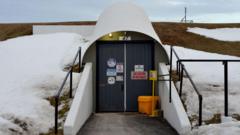
The ultra-wealthy are buying subterranean real estate in retrofitted Cold War missile silos, convinced that a multimillion-dollar price tag can purchase a ticket through the apocalypse. Glossy brochures promise indoor pools, simulated digital windows displaying sunny meadows, organic hydroponic gardens, and armed military-grade security.
It is a beautiful, comforting lie.
In reality, these high-end underground condos are not sanctuaries. They are gilded, highly pressurized coffins.
The entire luxury survival industry is built on a fundamental misunderstanding of physics, human psychology, and basic security logistics. If societal systems collapse, the owners of these bunkers will not be reigning over a subterranean utopia. They will be trapped inside a mechanical failure loop, guarded by people who have no reason to keep them alive, waiting for their air filters to clog.
The Great Mercenary Myth
The most glaring flaw in the luxury bunker business model is the security plan.
Bunker developers love to boast about their security details. They promise ex-Navy SEALs, former special forces operatives, and state-of-the-art armories to keep the desperate masses at bay. But this setup ignores a basic tenet of human behavior: the social contract of money only exists when there is a system to enforce it.
Imagine a scenario where the global power grid permanently fails, financial markets erase overnight, and the local currency becomes useful only as kindling.
You are a billionaire sitting in your subterranean suite. Outside your blast door stands a team of highly trained tactical operators carrying automatic weapons. You paid them in dollars, euros, or gold certificates.
Now, ask yourself: Why would they continue to take orders from you?
- Your money is worthless. Digital bank balances no longer exist. Physical gold cannot buy groceries when there are no grocery stores.
- They have the guns. You have a lease agreement signed in a society that no longer exists.
- The power dynamic is absolute. The moment survival becomes the only metric of value, the person holding the rifle is the boss.
Technology theorist Douglas Rushkoff famously wrote about being invited to a secret resort to advise tech billionaires. They did not want to talk about climate change or renewable energy; they wanted to know how to maintain control over their security forces after "The Event." They suggested ideas like using combination locks on the food supply that only the billionaires knew, or putting electronic shock collars on the guards.
This is the level of desperation and delusion we are dealing with. If your survival plan requires putting shock collars on armed mercenaries, your plan is already dead. The moment the blast doors seal, the security team does not work for you anymore. You are their hostage, and your luxury condo is their armory.
The Thermodynamic Nightmare of Closed Systems
Bunker developers present their properties as self-sustaining ecosystems. They point to hydroponic farms, water reclamation systems, and massive diesel generators as proof of long-term viability.
This is engineering fantasy. There is no such thing as a closed, maintenance-free system on earth.
[External Environment]
         │
         ▼ (Contaminated air, water, or dust)
   ┌───────────┐
   │ Intake    │ ──► [Filters & Scrubbers] (Requires proprietary spare parts)
   └───────────┘
         │
         ▼
   ┌───────────┐
   │ Living    │ ──► [Human Waste & CO2] (Requires chemical reagents to process)
   │ Space     │
   └───────────┘
         │
         ▼
   ┌───────────┐
   │ Machinery │ ──► [Generators & HVAC] (Requires constant oil, gaskets, and fuel)
   └───────────┘
Every machine wears down. The more complex the machine, the faster it fails without a constant influx of specialized spare parts, lubricants, and expert technicians.
The HVAC Death Sentence
The air you breathe in a retrofitted missile silo is entirely dependent on massive heating, ventilation, and air conditioning (HVAC) systems coupled with positive-pressure HEPA and gas filtration units. These are not standard residential AC units. They are highly complex industrial machines.
If a single specialized bearing in an intake fan shears two years into a fallout event, where do you get the replacement? You cannot order it online. You cannot forge it in your underground kitchen. If the fan stops, carbon dioxide levels rise. Within hours, lethargy sets in. Within days, asphyxiation occurs.
The Hydroponic Failure Cascade
Hydroponic farming is not as simple as putting seeds under LED lights. It is a fragile chemical balancing act.
- Nutrient dependency: Plants grown without soil require precise ratios of nitrogen, phosphorus, potassium, and trace minerals dissolved in water. If your stored chemical nutrients run out or spoil, your crops die.
- Biological vulnerability: In a sealed environment, a single mold spore or plant virus introduced by a resident can wipe out an entire crop in days. Without industrial fungicides and pesticides, the farm becomes a dead zone of rotting vegetation.
- Energy consumption: Grow lights demand immense amounts of electrical power. Running them on diesel generators is a race against your fuel reserves.
The Battery and Fuel Expiration Date
Stored diesel fuel degrades. Even with high-grade stabilizers, diesel begins to oxidize and gum up fuel injectors within 12 to 24 months. Battery banks used to store solar or wind power degrade with every charge cycle. Within a few years, their capacity drops significantly, leaving the bunker in the dark.
The Subterranean Psychosis
Let us assume your machinery works perfectly and your guards do not mutiny. You still have to survive the most unstable variable in the bunker: the human brain.
Humans did not evolve to live in concrete tubes deep underground. The psychological toll of prolonged confinement is well-documented by space agencies and submarine crews, but those groups have two advantages that bunker residents lack: rigorous psychological screening and a defined mission end-date.
"The psychological degradation of confinement is non-linear. You do not just get slightly more bored every day; you slowly lose the ability to regulate emotional responses."
In a luxury bunker, you are trapped with a small group of highly stressed, entitled individuals who are used to getting their way. There is no escape.
- Sensory Decay: No real wind. No natural sunlight. The smell of recycled air, ozone, and grease permeates everything. Even the most expensive Italian marble countertops cannot mask the reality that you are living in a sewer-treatment plant with bedrooms.
- Micro-Tyrannies: In tight spaces, minor annoyances become existential threats. The way someone chews, the hum of an air duct, or an uneven distribution of fresh produce will trigger intense interpersonal conflicts. Without an external authority to arbitrate, these disputes escalate.
- The Loss of Purpose: When survival is reduced to sitting in a room waiting for the outside world to stop glowing, depression is inevitable. The realization that there is no rescue coming, no estate to manage, and no legacy to leave behind turns these sanctuaries into psychological torture chambers.
The Sitting Duck Dilemma
The final, fatal flaw of the bunker strategy is its physical location.
A bunker is a static target. By definition, it cannot move.
Modern military reconnaissance, satellite imaging, and local rumors mean that the locations of these retrofitted silos are not secret. Every local survivalist, desperate militia, and rogue military unit within a hundred-mile radius knows exactly where the wealthy ran to hide.
To neutralize a multimillion-dollar underground fortress, an adversary does not need to blast through a ten-ton steel door. They do not need to fight your armed guards. They only need to locate the intake vents.
           [Surface Level]
             │   │   │
     ┌───────┴───┴───┴───────┐
     │   Intake Air Vents    │ ◄─── (Easiest point of attack: plug,
     └───────┬───┬───┬───────┘       burn tires over, or pump exhaust into)
             │   │   │
             ▼   ▼   ▼
     ========================= (Soil/Concrete)
             │   │   │
     ┌───────┴───┴───┴───────┐
     │    Underground Silo   │
     └───────────────────────┘
A bucket of concrete poured down an air intake pipe costs less than fifty dollars. Burning a pile of wet leaves or car tires over the intake grates will pump carbon monoxide directly into the filtration system, forcing the occupants to choose between suffocating inside or opening the blast doors to face an angry mob.
A fortress that can be defeated by a bucket of wet cement is not a fortress; it is a trap.
The Real Preservation Strategy
If high-tech subterranean isolation is a failure, what actually works?
History shows us that during systemic collapses, the survivors are not the ones who hide in holes with piles of canned goods. The survivors are those who belong to resilient, adaptable, and self-sufficient communities.
True security is active, decentralized, and social.
- Horizontal Integration Over Vertical Isolation: Instead of building a vertical silo underground, build horizontal networks on the surface. Invest in regenerative agricultural land with active, working communities.
- Redundant, Low-Tech Systems: Rely on gravity-fed water systems rather than electric pumps. Use wood-burning stoves instead of computerized HVAC systems. The simpler the technology, the easier it is to maintain when the supply chains break.
- Social Capital: The ultimate survival asset is not a stash of gold or an armored vehicle. It is a group of neighbors who trust you, who possess practical skills (medical, agricultural, mechanical), and who have a mutual interest in protecting each other.
Stop looking at the end of the world as a luxury real estate opportunity. You cannot buy your way out of the human condition, and you cannot survive a collapse by hiding from the very people you need to build a new world with.