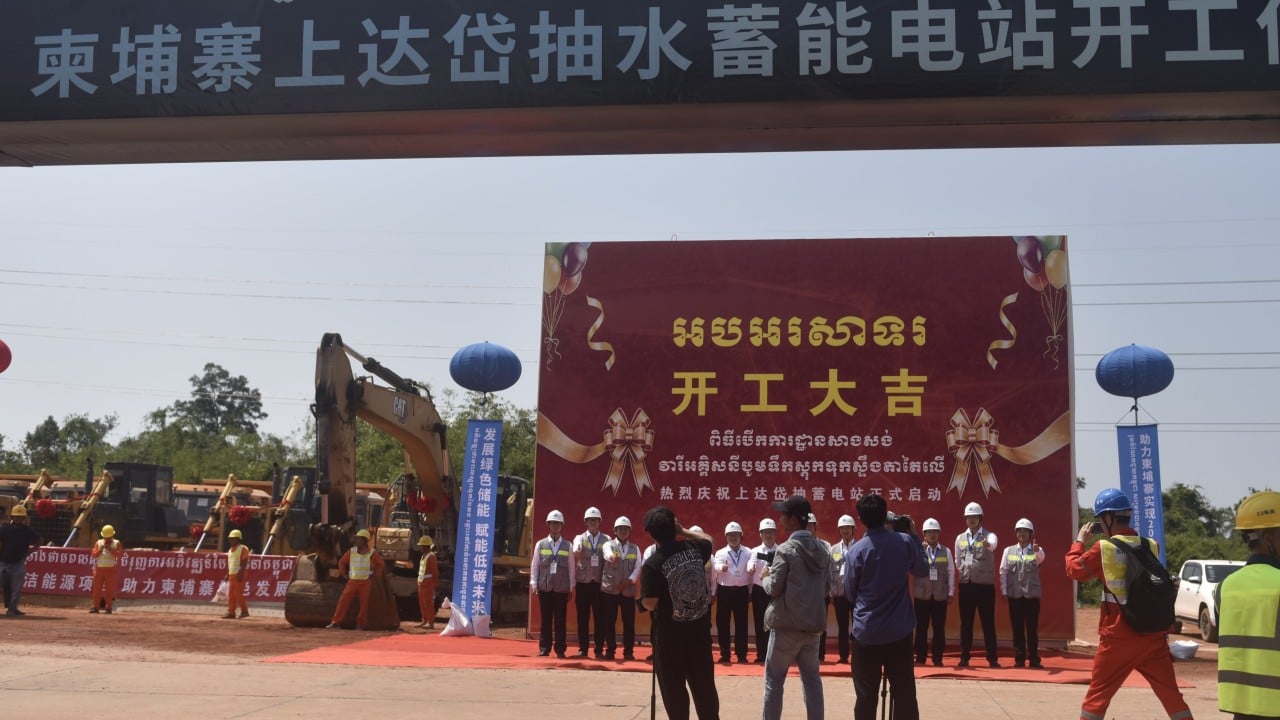
The $1 billion Stung Tatai Krom hydropower project is being sold to the public as a lifeline. It isn't. It is a high-interest mortgage on a nation’s ecological sovereignty, signed during a moment of manufactured panic. While mainstream outlets regurgitate press releases about "energy security" and "carbon neutrality," they ignore the basic physics of the Mekong basin and the brutal math of the Southeast Asian grid.
Building a massive dam to solve an energy crisis is like trying to fix a dehydration problem by drinking salt water. It looks like a solution until you actually swallow it. This isn't just about electricity; it's about the fundamental misunderstanding of what a modern economy requires to survive a warming world. For a more detailed analysis into similar topics, we recommend: this related article.
The Seasonal Scam of Hydropower
The central lie of the $1 billion hydropower "fix" is the illusion of reliability. Investors love the word "baseload," but in Cambodia, hydropower is a fair-weather friend.
The region operates on a binary: the monsoon and the drought. During the wet season, Cambodia often has an embarrassing surplus of power. During the dry season, when the heat is unbearable and the factories are screaming for juice, the reservoirs drop. The turbines stop spinning. The "security" vanishes. For additional background on this development, detailed reporting is available on MarketWatch.
$$P = \eta \cdot \rho \cdot g \cdot Q \cdot H$$
Look at the power equation above. In this formula, $P$ is power, $\eta$ is efficiency, $\rho$ is water density, $g$ is gravity, $Q$ is flow rate, and $H$ is head height. The variable that kills the Cambodian dream is $Q$—the flow. When the rains fail, $Q$ nears zero. You can spend $10 billion instead of $1 billion; it won't matter if the riverbed is a cracked graveyard of silt. We are building massive hardware for a software problem that the climate is rewriting every year.
I have watched developers dump concrete into rivers across three continents. The pattern is always the same: inflate the projected output, ignore the evaporation rates of the reservoir, and pretend the "emergency" justifies skipping the rigorous environmental auditing. By the time the dry season blackouts hit five years from now, the construction firms will have cashed their checks and moved on to the next "crisis."
China Is Not Philanthropic (And Why That Matters)
The narrative that this is a "gift" or a "partnership" from Beijing is a fantasy for the naive. This is a Build-Operate-Transfer (BOT) model. The China Huadian Corporation isn't here to lower your electric bill; they are here to extract a guaranteed Internal Rate of Return (IRR) over a 35-year concession period.
- The Debt Trap is Carbon-Coated: By labeling this "green energy," the project evades the scrutiny placed on coal, yet the ecological debt is arguably higher.
- The Silt Crisis: Dams trap sediment. Without that sediment, the Mekong Delta—the rice bowl of the region—literally sinks into the sea. We are trading long-term food security for short-term industrial voltage.
- The Sovereignty Shift: When a foreign state-owned enterprise controls your primary energy switch, your foreign policy is no longer your own.
The Solar Elephant in the Room
The most infuriating part of this $1 billion concrete tomb is that it ignores the plummeting Levelized Cost of Energy (LCOE) of solar and battery storage.
While Cambodia sinks capital into a project that will take years to synchronize, modular solar arrays can be deployed in months. More importantly, solar production peaks exactly when the hydropower fails: during the scorching, cloudless dry season.
The "lazy consensus" says solar is too intermittent for a developing nation. That is 2010 thinking. In 2026, the real intermittency threat isn't the sun going behind a cloud; it’s a river drying up for six months because of a regional drought. A diversified grid—distributed solar, wind, and pumped storage—is a fortress. A hydro-heavy grid is a house of cards.
The Hidden Cost of "Cheap" Power
People ask: "Isn't any electricity better than no electricity?"
That's the wrong question. The right question is: "What is the cost per kilowatt-hour when you factor in the destruction of the Tonle Sap's fish stocks?"
The Tonle Sap lake provides the vast majority of the protein for the Cambodian population. The fish migrations depend on the "flood pulse" of the Mekong system. When you dam the tributaries like the Tatai, you dampen that pulse. You aren't just building a power station; you are tax-farming the diet of the poor to subsidize the air conditioning of the urban elite.
I’ve seen this play out in the Amazon and the Nile. You get the lights on in the capital, but you create a protein deficit in the provinces that costs more in healthcare and social instability than the electricity is worth. It is a classic case of externalizing the costs while privatizing the profits.
The Myth of the "Clean" Dam
Stop calling these projects "carbon neutral."
When you flood a tropical forest to create a reservoir, the submerged vegetation rots. This anaerobic decomposition releases massive amounts of methane ($CH_4$). Methane is roughly 80 times more potent than carbon dioxide ($CO_2$) at trapping heat over a 20-year period.
In many tropical environments, the "emissions" from a new reservoir can actually exceed the emissions of a natural gas plant of the same capacity for the first decade of operation. But because it doesn't have a smokestack, the bankers get to pat themselves on the back for their "ESG-compliant" investment.
Moving Beyond Concrete Fetishism
Cambodia doesn't need more dams. It needs a smarter grid.
- Grid Modernization: 15-20% of power is lost in transmission. Fix the wires before you build more plants.
- Decentralization: Microgrids in rural areas negate the need for massive, high-risk infrastructure.
- Transboundary Cooperation: Stop treating the Mekong like a buffet. If every nation upstream builds a "battery," the guys at the end of the line get nothing but a dry ditch.
The Stung Tatai Krom project is a monument to the 20th century. It is a heavy, slow, and fragile response to a fast, volatile, and complex 21st-century problem. We are cheering for the construction of a billion-dollar anchor while the ship is already taking on water.
If you want to save the Cambodian economy, stop pouring concrete into its veins. Focus on the energy that falls from the sky, not the water that is being choked out of the earth.
The river is dying, the fish are disappearing, and when the next Great Drought hits, that $1 billion concrete wall will be nothing more than a very expensive tombstone for a river that used to feed a kingdom.
Stop building for the world we had and start building for the world we’ve broken.