Britain just hit the brakes on one of its most controversial foreign policy moves in decades. The plan to hand over the Chagos Islands to Mauritius is officially on ice. If you’ve been following the headlines, you know this wasn't just a minor administrative hiccup. It’s a full-blown diplomatic collision. The UK government basically had the pens ready to sign away the last of its African colonial territories, but then Washington pulled the rug out from under them.
The timing is everything. Just as the Labour government was preparing to push through the legislation needed to finalize the 2025 treaty, the White House went quiet. Specifically, the US refused to provide the formal exchange of letters required to amend the 1966 defense agreement. Without those letters, the deal is legally dead in the water.
The Trump factor changed the math
It’s no secret that Donald Trump isn't a fan of this deal. Earlier this year, he took to social media to call the handover an "act of great stupidity." He even shouted in all-caps for the UK to not give away Diego Garcia. While the proposed deal technically allowed the US to keep its massive military base on a 99-year lease, Trump and his advisors aren't buying the security guarantees.
They’re worried about China. Mauritius has increasingly close economic ties with Beijing, and the fear in Washington is that a "sovereign" Mauritius might eventually allow Chinese "commercial" ports or surveillance tech to creep closer to Diego Garcia. For a base that serves as a critical launchpad for operations in the Middle East and the Indo-Pacific, that’s a non-starter.
A billion dollar bill for a base we already have
Critics in the UK have been sharpening their knives for months. Kemi Badenoch and Nigel Farage haven't held back, pointing out that the UK was essentially agreeing to pay Mauritius an average of £101 million a year—totaling roughly £3.4 billion over the lease—for the right to keep using a base Britain already controls.
It feels like a weird kind of "rent-back" scheme that doesn't sit well with a lot of people. You’re paying billions to a country that has never actually governed these islands, all while the people who were actually kicked off the land—the Chagossians—are still largely left out of the decision-making loop.
What the lawyers say
The legal reality is that the UK government has run out of time. With the parliamentary session winding down and no backing from the US, the Chagos legislation won't make it into the King's Speech in May. Legally, the 1966 treaty between the US and the UK takes precedence. If the US says they won't sign the amendment letters, the UK can't fulfill its side of the bargain with Mauritius. It's a classic geopolitical stalemate.
The human cost of the delay
While diplomats argue over sovereignty and shipping lanes, the actual victims of this 50-year saga remain in limbo. The Chagossians were forcibly removed in the late 60s and early 70s so the US could build its "Unsinkable Aircraft Carrier."
Human Rights Watch and other advocates have been vocal about the fact that this entire deal ignores the right of return. Even under the now-paused agreement, the islands weren't exactly being "returned" to the people; they were being transferred to a government 1,200 miles away. Now, even that transition is stalled. For the displaced families living in the UK, Mauritius, and the Seychelles, it’s just another chapter of being used as bargaining chips in a game they didn't ask to play.
The strategic nightmare
Let's talk about why Diego Garcia matters so much right now. In a world where tensions with Iran are spiking and the South China Sea is a powder keg, the US cannot afford to lose an inch of control over this territory.
- Intelligence gathering: The base is a massive hub for signals intelligence.
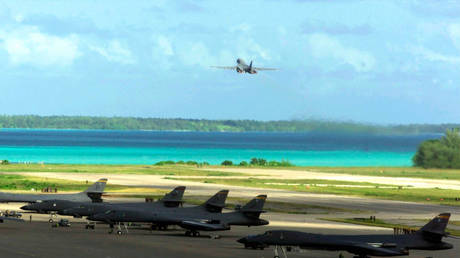
- Long-range bombers: It’s one of the few places capable of hosting B-2 and B-52 bombers with easy access to multiple conflict zones.
- Nuclear free zones: There’s a messy legal question about the African Nuclear Weapons Free Zone Treaty. If Mauritius takes over, the US might face pressure to remove nuclear assets from the base.
Washington looks at these variables and sees a headache they don't need. They'd rather keep the status quo, where the UK holds the keys and does whatever the US asks.
Where do we go from here
Honestly, the deal looks like it's heading for the bin. If the UK can't secure a formal "yes" from the White House, they can't move forward without risking the "Special Relationship." And with Trump making it a point of personal pride to block the handover, Keir Starmer's government is stuck.
Don't expect this to be resolved by the summer. The UK is likely to park this issue indefinitely, or at least until the political winds in Washington shift again. If you're looking for the next steps, keep an eye on the King's Speech in May. If Chagos isn't in there, the treaty is effectively on life support. For now, the Union Jack stays up, the rent checks stay in the bank, and the residents remain in exile.
Stop waiting for a quick resolution. This is a long-term freeze, not a temporary pause. Check the parliamentary schedule for the next session, but don't hold your breath for a breakthrough. The Chagos Islands remain the most complicated 2,000 square miles in the Indian Ocean.