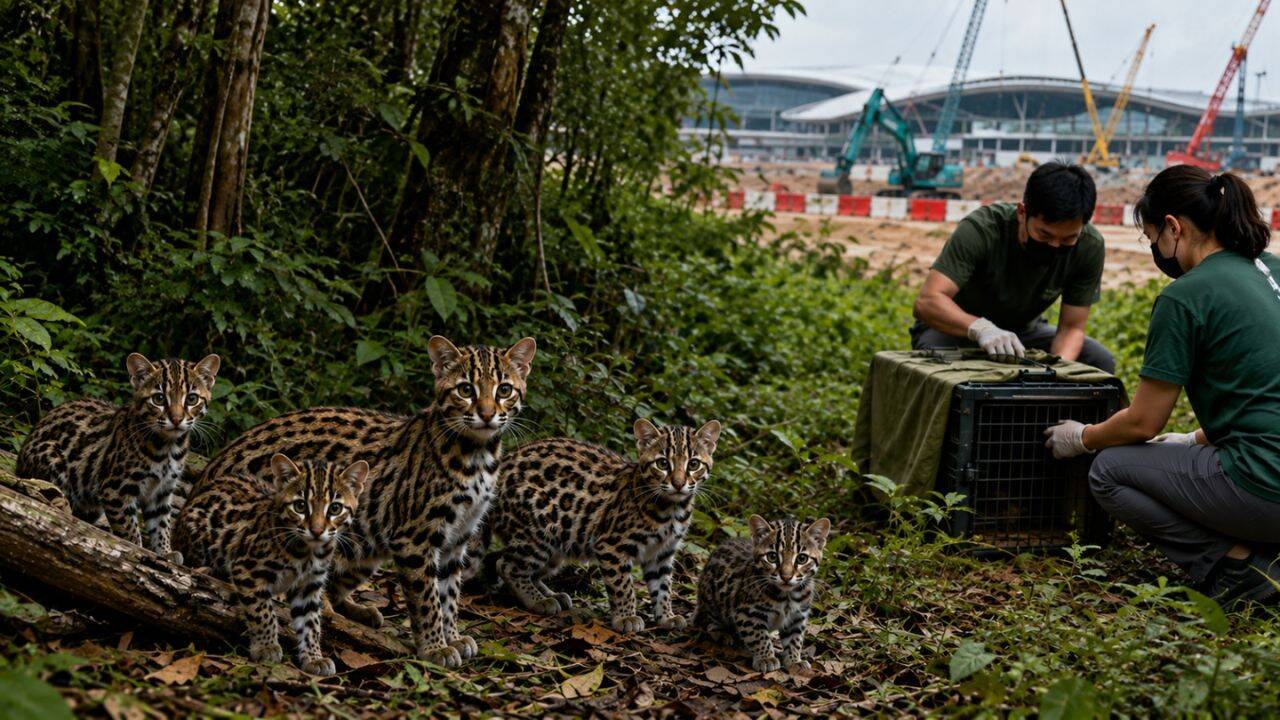
You wouldn't expect to find a breeding family of secretive wildcats hiding right next to one of the busiest aviation construction zones on earth. Yet, deep in the coastal foliage of Changi, that is exactly what happened. Citizen scientists and conservationists tracked a hidden population of critically endangered leopard cats, proving that these elusive predators were reproducing against incredible odds.
Then reality hit. Massive infrastructural expansions, specifically the massive Changi Airport Terminal 5 project and ongoing coastal land reclamation, mean this pocket of wilderness has an expiration date. With fewer than 20 mainland leopard cats estimated to survive across Singapore, saving this specific family has turned into a high-stakes rescue mission.
How Citizen Scientists Found the Changi Cats
For years, rumors floated around conservation circles that wildcats were moving through the eastern coast. Hard proof arrived tragically in January 2019 when a leopard cat was killed by a vehicle on a Changi road. That single accident kicked off a much deeper investigation.
In July 2025, the Singapore Wildcat Action Group (SWAG) partnered with the National Parks Board (NParks) and local volunteers to set up an extensive network of 18 motion-sensor camera traps. More than 50 volunteers spent months checking equipment, gathering footage, and mapping nocturnal movements after dark.
By April 2026, the data painted a clear picture. The cameras logged five distinct leopard cats: two adult males, one adult female, and two juveniles. Finding cubs changed everything. It proved the forest wasn't just a temporary pitstop for animals swimming across the strait from Pulau Tekong. It was a functional, breeding home.
The Threat of Terminal 5 and Habitat Loss
Discovering the cats was the easy part. Keeping them alive while an entire landscape transforms is entirely different.
Mammal researcher Marcus Chua from the Lee Kong Chian Natural History Museum pointed out a harsh truth. The remaining forest fragments around Changi are simply too small to sustain a permanent wildcat population once heavy industrial and aviation construction scales up.
Leopard cats need space, quiet corridors, and abundant prey like rodents, frogs, and lizards. Cramming them into shrinking patches bordered by roaring highways creates a death trap. Roadkill remains a persistent threat because these nocturnal hunters frequently have to cross asphalt to find food, colliding with heavy commercial vehicles servicing the airport zone.
Fencing off the area won't work either. Without room to roam or genetic diversity, isolation destroys small wildlife populations just as fast as bulldozers do.
The Relocation Gamble
Faced with shrinking options, NParks announced plans to safely relocate the five Changi leopard cats to secure nature reserves and protected habitats starting in the second hlaf of 2026.
Relocating wild carnivores is notoriously difficult. Experts from SWAG, NParks, and the Mandai Wildlife Group have had to weigh heavy questions. Should the family stay together or be separated to reduce territorial conflict in new zones? Where are the exact release spots? Authorities are keeping those locations strictly confidential to prevent poachers and curious onlookers from disrupting the transition.
Veterinarians will monitor every step of the capture and transport process to minimize physical stress. Teams are even looking at international case studies, such as wildcat relocation efforts in Taiwan, to avoid common pitfalls.
Singapore's last native wildcats hang on by a thread. The Changi cats proved that nature can still find a foothold in unexpected urban corners, but human ambition always demands more space. How we manage their eviction will set the standard for urban wildlife management moving forward.


