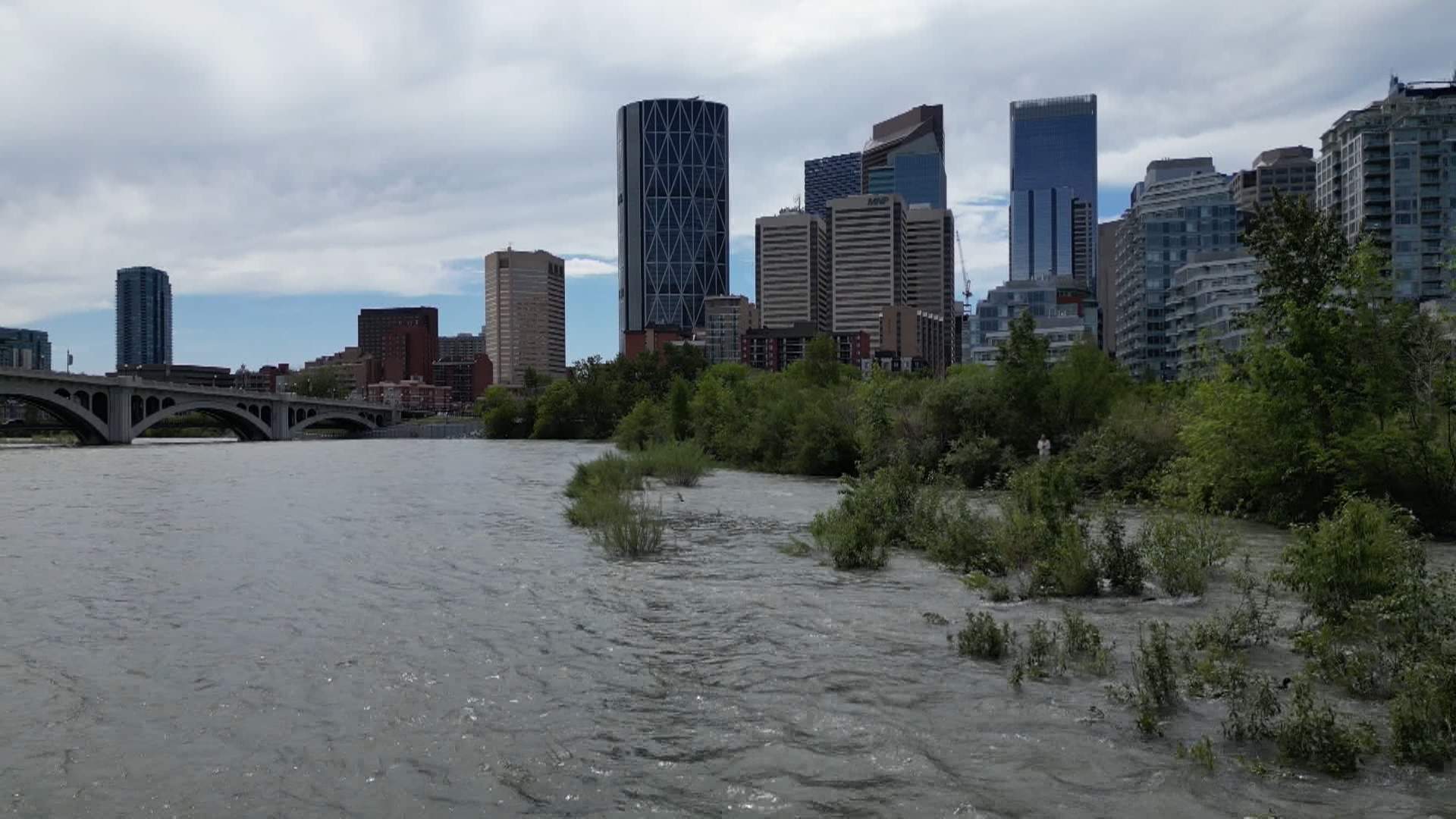
The water tells you everything if you know how to listen. In the early days of June, the Bow River does not whisper. It roars. It moves with a heavy, brown muscle, thick with silt scraped from the rocky slopes of the Rockies, carrying entire pine trees like toothpicks. To stand on the banks near Prince's Island Park during the peak of the spring runoff is to feel a low-frequency vibration in your chest. It is beautiful, but it is a beauty edged with teeth.
For weeks, Calgary looked at its water from a distance. The Calgary Fire Department had placed the city under a blanket safety advisory. The message was clear: stay out. The Bow and the Elbow rivers were too fast, too cold, and entirely too unpredictable. The water temperature hovered just above freezing, enough to steal the breath from your lungs in less than sixty seconds.
Then, the rhythm shifted.
It happened quietly over a few warm afternoons. The mud settled. The angry, churning chocolate milk hue softened into a deep, glacial green. The flow rates, monitored by quiet hydrologists and anxious first responders, finally dipped below the threshold of immediate peril. The Calgary Fire Department officially lifted the water safety advisory.
Just like that, the veins of the city were open again.
The Invisible Watchers
To understand what this lift means, you have to look at the people who spend their spring staring at flow meters. Consider a hypothetical firefighter named Marc. For Marc, the river isn't just a scenic backdrop for a Saturday morning jog. It is a shifting, living entity that he might have to dive into at three in the morning.
During the advisory, Marc’s shift is defined by tension. When the Bow runs at over three hundred cubic meters per second, a human body in the water becomes a projectile. If a raft flips, the occupants do not just swim to shore. They are swept under sweepers—fallen trees anchored to the bank that act like giant colanders, trapping debris and people beneath the surface while the current pins them down.
When the Fire Department lifts an advisory, it is not an announcement that the river has become a swimming pool. It is an acknowledgment that the risk has shifted from inevitable disaster to manageable adventure. The flow rates have calmed, but the river never truly loses its capacity to surprise.
The transition from high alert to open water requires a massive amount of data. Officials track the snowpack melt up in the mountains, the weekly rainfall patterns, and the daily cubic-meters-per-second discharge from the Ghost Dam. It is a calculus of human behavior balanced against the laws of fluid dynamics. They know that the moment the sun breaks through the clouds and the thermometer hits twenty-five degrees, Calgarians will feel the magnetic pull of the water.
The Great Summer Ritual
Calgary has a unique relationship with its moving water. In many major cities, the river is an industrial highway, fenced off and concrete-lined. Here, it is a playground. The moment the advisory lifts, a strange transformation occurs in garages and basements across the city.
Dusty blue and yellow rubber rafts are dragged into the sunlight. Air pumps hum in driveways. Families pack coolers with sandwiches and sunscreen, preparing for the classic voyage from Baker Park down to the Calgary Zoo. It is a slow, drifting pilgrimage that defines summer in the foothills.
But the real problem lies elsewhere, hidden in the camaraderie of a hot afternoon.
When the water looks calm, vigilance fades. The sun beats down, a beer is opened, and the life jacket ends up on the floor of the raft instead of strapped tight across the chest. This is the exact moment the river becomes dangerous again. The advisory might be gone, but the physics of moving water remain unchanged.
Consider what happens next when a raft hits the bridge piers at the Cushing Bridge. The current splits. One side of the raft catches the concrete, the other side drops, and the river pours over the gunwale. In less than three seconds, an inflatable boat can be flipped and pinned by thousands of pounds of hydrostatic pressure. Without a personal flotation device securely fastened, a swimmer is at the mercy of the undercurrents.
This is why the lifting of the restrictions is always accompanied by a quiet plea from the authorities. They are giving the river back to the people, but they are begging the people to respect the gift.
Reading the River Like a Book
Navigating the Bow or the Elbow after a high-water event requires a specific kind of literacy. The river that Calgarians floated down last August is not the same river that exists today. The spring floodwaters rewrite the topography of the riverbed every single year.
New gravel bars have formed. Old channels have been choked off by gravel, and entirely new paths have been carved through the islands. A bank that was perfectly safe last summer might now be an undercut ledge, ready to collapse under the weight of a passerby.
- Sweepers and Strainers: Trees that fell during the high water are now lurking just beneath the surface or angling out from the banks. They look stationary, but the water rushing through them creates a deadly trap.
- Bridge Pillars: These create powerful eddies and pressure waves. Approaching them requires a clear plan and early steering maneuvers.
- The Changing Temperature: Even in July, the Bow is fed by mountain snow. It is cold enough to trigger hypothermia surprisingly fast, draining the strength from even the strongest swimmers.
The casual tuber often misses these details. They see the blue sky reflected on the surface and assume the water is static. It is not. It is a conveyor belt that never stops moving, never tires, and never feels remorse.
The Shared Space
The lifting of the advisory also brings back the delicate dance between different river users. The Bow is a world-class trout fishery. As the rafts launch, the fly-fishermen return to the flats, casting long, elegant lines into the seams where the fast water meets the slow.
There is an art to sharing this space. A raft drifting blindly through a quiet pool can ruin hours of patient stalking for an angler. Conversely, a poorly placed backcast can catch more than just a fish. The reopening of the river is a test of civic etiquette. It asks Calgarians to look out for one another, to yield space, and to recognize that the river belongs to everyone and to no one all at once.
The Elbow River offers a different flavor of experience. Smaller, shallower, and slower than the Bow, it attracts the tubers—congas of interconnected inner tubes, floating past the backyards of multi-million dollar homes in Rideau and Roxboro. It feels like a lazy backyard party, but even the Elbow has its pinch points, notably the weir structures and the sharp bends where the current pushes hard against rock retaining walls.
The Long Drift Home
As the afternoon wanes, the shadow of the downtown skyline stretches across the water. The temperature drops noticeably as the sun dips behind the high banks of McHugh Bluff. The rafts begin to pull over at the designated egress points, their occupants sunburned, tired, and deeply satisfied.
The lifting of a safety advisory is more than just a bureaucratic checkbox. It is the true commencement of the Calgary summer. It marks the moment we stop fearing the wildness of our environment and find a way to live inside it, if only for a few hours on a Sunday afternoon.
The fire trucks parked near the boat launches remain watchful, their crews sitting in the cabs with their gear ready. They watch the colorful flotilla drift past. They hope their services won't be needed, but they are there just in case. The river is open, the current is steady, and the city is alive on the water once more.