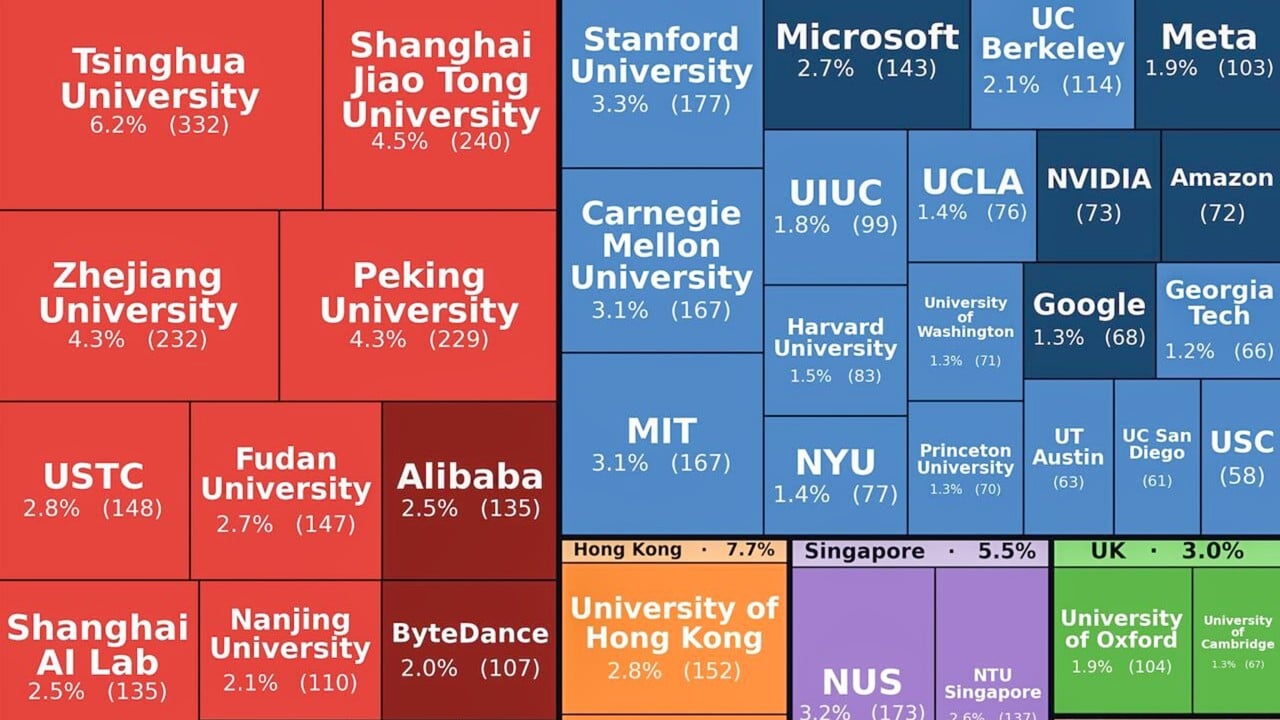
The latest numbers from the top global artificial intelligence conferences aren't just a trend. They're a takeover. If you've looked at the author lists for papers at NeurIPS or CVPR lately, you'll see a sea of names from Tsinghua, Peking University, and Shanghai Jiao Tong. It’s reached a point where some researchers are calling these international events "Chinese home games." This isn't about some vague future threat. It's happening right now. China has built a research machine that’s outperforming the West in sheer volume and, increasingly, in raw quality.
Western observers often try to downplay this. They say Chinese researchers just churn out incremental improvements or focus on narrow surveillance tech. That's a dangerous mistake. You're seeing foundational shifts in computer vision, large language model efficiency, and autonomous systems coming straight out of labs in Beijing and Shenzhen. The narrative that China only copies is dead. If you aren't paying attention to the preprint servers coming out of the East, you're already behind.
The Paper Mill Myth vs Reality
Critics love to talk about "paper mills." They suggest that the surge in Chinese AI submissions is just a result of government-mandated quotas. Sure, the Chinese academic system rewards volume. But look at the citations. High-impact research—the kind that other scientists actually use to build new things—is increasingly coming from Chinese institutions.
In the world of computer vision, Chinese teams often take the top spots in global challenges. At the Conference on Computer Vision and Pattern Recognition (CVPR), the sheer number of accepted papers from China has eclipsed the US. This isn't just about gaming the system. It's about a massive, coordinated investment in human capital. China’s "Talent Programs" have successfully lured back researchers who trained at Google, Meta, and Stanford. They didn't just bring back their suitcases; they brought back the entire Western playbook for high-end research and then scaled it up.
Why the Global AI Conference Scene Shifted
Money is the obvious answer, but it's not the only one. China’s advantage comes from a unique blend of massive datasets and a lack of the same regulatory hurdles that slow down Western labs. When a Chinese startup wants to train a model on millions of medical images or urban traffic feeds, the path is often much smoother.
There's also a cultural intensity that’s hard to ignore. The "996" work culture (9 am to 9 pm, six days a week) might be controversial, but it produces results in a field that moves as fast as AI. While American researchers are debating the ethics of a specific dataset for six months, a team in Hangzhou has already trained three versions of a model on it. Speed is a feature, not a bug.
It’s also about focus. While the US spends a lot of its intellectual energy on AI safety and alignment—which are vital—Chinese research remains heavily skewed toward application and performance. They want things that work in the real world. They want robots that can navigate warehouses and chips that can process imagery at the edge with zero latency.
The Breakdown of Regional Influence
If we look at the data from the most recent AAAI (Association for the Advancement of Artificial Intelligence) conference, the shift is undeniable. Over half of the submissions now originate from China. This has created a weird friction. When the majority of your reviewers and the majority of your authors come from one region, the "global" nature of the conference starts to feel a bit thin.
Some Western academics feel alienated. They argue that the sheer volume of Chinese papers makes it harder for niche or truly "out of the box" ideas from smaller labs to get noticed. But that's how competition works. If you're being out-researched, you don't complain about the volume; you step up your game.
The dominance isn't just in academia either. Companies like Baidu, Tencent, and Alibaba are no longer just "the Google of China." They are entities that pioneer their own architectures. Look at the Moore’s Law Thread or the latest developments in MoE (Mixture of Experts) models. You'll find Chinese names at the top of the leaderboards consistently.
Talent Flow and the Great Divorce
We used to live in a world where Chinese students went to the US for a PhD and stayed to work at OpenAI or Microsoft. That’s changing. Geopolitical tensions and the "China Initiative" in the US have made many researchers feel unwelcome. So, they’re going home. Or they’re staying in China from the start.
This brain drain in reverse is the biggest win for Chinese AI. You have a generation of brilliant minds who have no intention of moving to Silicon Valley. They have world-class facilities in Beijing. They have access to more compute than ever before, despite Western export bans. Speaking of bans, the US hardware restrictions were supposed to hobble China. Instead, they've sparked a massive domestic push for AI chip sovereignty. It's a classic case of unintended consequences.
Is Quality Keeping Up With Quantity
It’s easy to get lost in the "Basically a Chinese racket" sentiment when you see the sheer numbers. But the quality gap is closing fast. If you filter for the top 1% of most-cited papers, China’s share has been climbing for a decade straight. They aren't just participating; they're setting the agenda.
One area where China leads significantly is "AI for Science." Using neural networks to predict protein folding, weather patterns, or new material properties is a massive priority for the Chinese Academy of Sciences. While the West is obsessed with chatbots that can write poetry, China is busy using AI to try and win the next industrial revolution. It's a pragmatic, almost cold approach to technology.
What You Should Do About It
If you’re a developer, an investor, or a tech leader, ignoring Chinese AI research is a form of professional negligence. You don't have to like the politics to recognize the technical prowess.
First, stop relying solely on English-language tech news. A lot of the best breakthroughs are discussed on platforms like WeChat or Juejin before they ever hit a Western blog. Use translation tools and dive into the original papers on arXiv. You'll find that many of the "new" ideas popping up in San Francisco were actually discussed in a lab in Shanghai six months prior.
Second, watch the hardware. The way Chinese researchers optimize models to run on non-NVIDIA hardware is going to be the blueprint for the rest of the world as GPU shortages and costs continue to bite. They are the masters of doing more with less because they've had to be.
Don't buy into the idea that China's AI rise is just a "racket" or a fluke of statistics. It's a fundamental reordering of the technological world map. The center of gravity has shifted East. You can either adapt to that reality or keep wondering why your "cutting-edge" model feels like it's a step behind.
Start tracking repositories on GitHub that originate from Chinese labs. Look at projects like PaddlePaddle or the latest LLM releases from 01.AI. The documentation might be a bit rough in translation, but the code is where the truth lives. If you want to see where AI is going in 2026, you have to look at what's being built in Beijing today. end