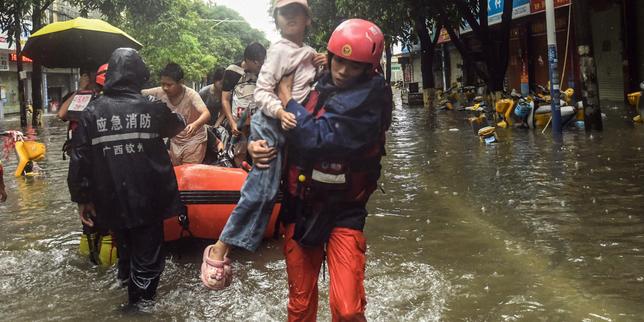
You can build the thickest concrete walls in the world, but water always finds the crack. Right now, across central and southern China, massive engineering projects are hitting their absolute limit. A brutal combination of Typhoon Maysak and violent convective weather has turned entire regions into high-risk disaster zones, leaving at least 17 people dead, hundreds injured, and over 130,000 displaced.
This isn't a standard seasonal rain scenario. It's a chaotic, multi-front weather crisis that broke a dam, triggered rare tornadoes, and sent over 40 major rivers spilling far past their danger marks. While state media broadcasts footage of orange-vested rescue crews paddling inflatable boats through submerged streets, the real story lies in how rapidly these systems are overwhelming modern infrastructure. For a different perspective, see: this related article.
The Dam Breach and the Snake Town Panic
The southern region of Guangxi is bearing the heaviest burden of this deluge. Typhoon Maysak hit the area with enough force to turn local reservoirs into structural liabilities. In Hengzhou, near the regional capital of Nanning, the Liulan Reservoir gave way completely.
State broadcaster CCTV captured muddy torrents tearing through the collapsed concrete walls of the dam. The water rushed down so fast that villagers didn't even have time to grab dry food or shoes before fleeing to higher ground. Similar analysis on this matter has been shared by The Washington Post.
Guangxi Flood Toll:
- 6 people confirmed dead
- 11 people missing
- 130,000 residents evacuated
- 40 rivers overflowing warning levels
The chaos took a bizarre, terrifying turn in one flooded Guangxi town. The rising waters swamped a local commercial breeding farm, releasing roughly 800 snakes into the community. Videos of panicked villagers wading knee-deep through brown water while trying to catch swimming reptiles exploded across Chinese social media, drawing over 180 million views. It's a stark reminder that when rural infrastructure fails, the secondary hazards are completely unpredictable.
Tornadoes in the Industrial Heartland
Hundreds of kilometers away in the central province of Hubei, the weather took an even weirder, more destructive turn. Instead of slow-rising floods, Hubei got hit by sudden, violent thunderstorms and rare tornadoes.
The winds were strong enough to hollow out buildings. In the city of Huanggang, a tornado struck a logistics hub and a warehouse, lifting multiple heavy cargo trucks up to 30 meters into the air.
Local resident Wang recounted how his brother-in-law, Zhang, was literally sucked out of his apartment by the sheer force of the wind. Rescuers later found him unconscious outside the complex. Wang described the interior of the apartment as if it had been completely scooped clean. Sofas, dining tables, and wall cabinets vanished in seconds.
The storm system in Hubei killed 11 people, injured 331, and damaged nearly 5,000 homes. Students at a local dormitory reported being cut by flying glass after assuming the storm was just a routine summer downpour. The suddenness of these convective winds means early warning systems can only do so much.
The Threat Looming on the Horizon
President Xi Jinping has ordered an all-out emergency mobilization, directing local governments to deploy every available resource to search for the missing and reinforce weak embankments. Emergency funds totaling 30 million yuan have already been cleared for hard-hit areas like Gansu province, where a separate rain-induced landslide killed five people.
The immediate problem is that the ground is completely saturated. Minister of Water Resources Li Guoying noted that major hydrological stations are seeing flood peaks exceeding warning levels by more than six meters. When levees sit in high-level floodwaters for days, the soil softens, making catastrophic failures much more likely.
Worse, the country doesn't get a breathing room break. Even as rescue teams pass out instant noodles, bottled water, and sausages to people stranded on second-floor balconies, meteorologists are tracking Super Typhoon Bavi offshore. Packing sustained winds near 150 mph, Bavi is currently projected to slam into China’s eastern manufacturing coast. If it hits before the current floodwaters recede, the economic and human toll will spike dramatically.
If you live in or travel through low-lying areas in Guangdong, Guangxi, or eastern coastal provinces, don't wait for an official evacuation order if you see local waterways rising. Monitor real-time hydrological updates via local emergency management apps, pack a go-bag with essential documents and medications, and know exactly which high-ground structures in your neighborhood are designated as emergency shelters.